Chapel Hill project could complement Southern Village, meet housing needs, builders say
A neighborhood proposed for a wooded slope across from Southern Village needs some work, including better stormwater planning, safer pedestrian connections and housing at a variety of prices, Chapel Hill Town council members said Wednesday.
Developer Beechwood Homes submitted the concept plan for several hundred condos and townhomes, and some commercial space, in November. Its South Creek project could occupy 40 acres along U.S. 15-501 South, while preserving another 80 acres of more environmentally sensitive land to the east, around Wilson Creek.
A concept plan is not an official application. It is a rough draft that lets the developer seek feedback from the Town Council and town advisory boards that then can be used to craft an official application.
The project could bring diverse housing within walking distance of shops and bus lines, officials have said. A recent town report advised the council to engage in more comprehensive community planning for how and where 35% more housing could be built each year.
The town needs about 485 housing units a year through 2040, roughly 90% of which would serve working-age and senior adults, consultant Rod Stevens said in the Chapel Hill Housing Report. The rest — about 45 units — would serve students living off campus.
U.S. Census data shows Chapel Hill added an average of 430 new residents a year from 2010 to 2020.
Council member Jessica Anderson noted the council is more interested in middle-income housing, instead of “missing middle” housing, which involves a variety of housing types as well as price ranges.
“I think what we’re really looking for is middle income,” Anderson said. “We’re not looking for a housing typology, but an income level, so really talking through with our housing and community (staff) and looking for that middle income I think will be really important and very needed.”
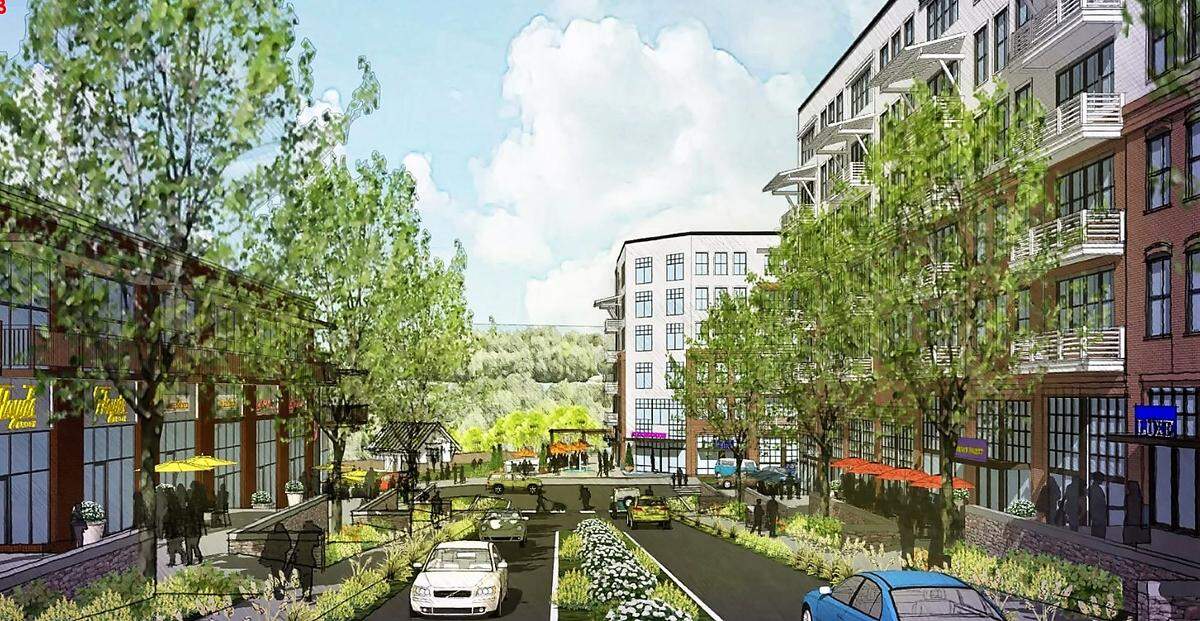
South Creek project details
▪ Acres: 40 developed, 80 undeveloped
▪ Residential: 650 condominiums and townhomes
▪ Affordable housing: The council urged the developer to work with local nonprofits, such as Community Home Trust, and with town staff and advisory board members. The town’s inclusionary zoning ordinance requires at least 15% of for-sale housing in a project to be affordably priced for residents earning up to 80% of the area median income — an individual earning up to $48,400 a year and a family of four earning up to $69,120.
State law prohibits rent control, but the council can leverage incentives, such as density bonuses, and negotiate with developers.
▪ Commercial: 42,000 square feet of retail and office space
▪ Building height: The townhome buildings are shown at three stories, with the condo buildings ranging from four to seven stories as the construction moves east down the hill.
▪ Amenities: Rain gardens, pocket parks, pool, a pavilion overlooking the park, and a terraced, central green space with a band shell
▪ Transportation: The developer could add a stop on the future North-South bus-rapid transit line and is working with the N.C. Department of Transportation to weigh other potential road improvements. Stoplight-controlled driveways onto U.S. 15-501 are proposed at Market Street and Sumac Road. Parking would be under the condo buildings and in garages.
What the council said
Pedestrian safety, traffic and environmental consequences for the steeply sloped site, which includes an abandoned quarry east of the creek, will be important issues to resolve. Council members urged the developer to consider a conservation easement for the preserve and a range of housing affordability.
The developer also could work with groups, such as Housing Options for People with Exceptionalities (HOPE), to integrate a different model of affordable housing for people with disabilities, Anderson said.
Council member Michael Parker suggested revising the plan to intermix the condos and townhouses using a variety of building styles. That could create a more organic community, instead of one where everything looks the same, he said. He also encouraged a mix of larger stores and basic community retail, to create “more of a neighborhood feel that gives people reasons to walk around.”
Some live-work housing units would be a good addition, council member Tai Huynh added.
Council members agreed with the developer that South Creek should complement the existing homes, apartments and commercial center at Southern Village. Pedestrian safety — and a stoplight at Sumac Road — is going to be critical for that connectivity and for making the highway corridor into a boulevard and a place, council member Amy Ryan said.
She suggested the developer and the town work within that context to come up with a better plan.
“This is very much the green gateway into the southern part of town,” Ryan said. “Southern Village observed and kept a lot of that character. I think there’s going to be interest in figuring out how to keep that here as well.”
What happened to Obey Creek
If approved, South Creek would replace the previously approved Obey Creek proposal, which the council signed off on in 2015.
That project, which was supposed to add roughly 1.6 million square feet of retail, offices and apartments with an 85-acre public park, failed to materialize when the developer struggled to find the retail and office tenants necessary to start construction.
In August, Beechwood Obey Creek LLC, a subsidiary of Beechwood Homes, paid $7.25 million to Obey Creek Ventures LLC for the land, county records showed.
The council would have to terminate the Obey Creek development agreement before agreeing to a new conditional zoning permit with Beechwood Homes. The land slated for Obey Creek has already been annexed into the town limits.
This story was originally published January 13, 2022 at 8:27 AM.