Apartments, police station, entertainment? Chapel Hill weighs future of coal ash site
Chapel Hill leaders asked the public to “elevate the dialogue” and expressed concern for health and safety Wednesday while reviewing development plans for a town-owned site where coal ash is buried.
“I hope that we as a council and we as the community can move away from the accusations and fingerpointing,” Town Council member Karen Stegman said. “This council cares deeply about this town, about the people who live in it, and the people who will live in it in the future.”
Council member Paris Miller-Foushee echoed her comments, adding that she is excited about providing town employees with better work spaces at 828 Martin Luther King Jr. Blvd., and the potential to “make this a place for community” and housing.
“Council members are deeply committed to the safety of our community, and if we find out information that states it’s not safe [to build there], we won’t move forward, and that needs to be clearly understood,” Miller-Foushee said.

The council hasn’t fully committed yet to working with the Belmont Sayre firm to redevelop the 10-acre property at 828 Martin Luther King Jr. Blvd. The site currently houses the Chapel Hill Police Department.
The town has tried to move the police department unsuccessfully for nine years because it is too small and poorly designed with old plumbing and ventilation systems.
A concept plan presented Wednesday provides a rough draft of what could be built, letting the developer get feedback for an official application later this spring. The council doesn’t vote to approve or reject concept plans.
Wednesday’s plan showed
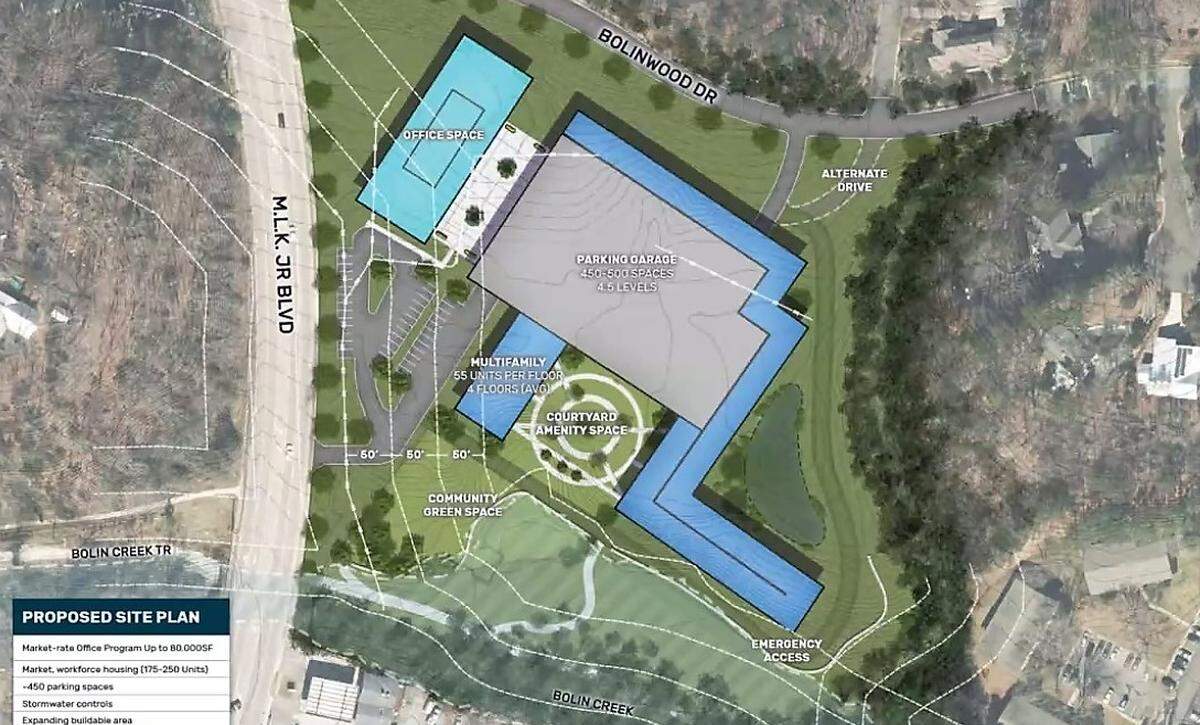
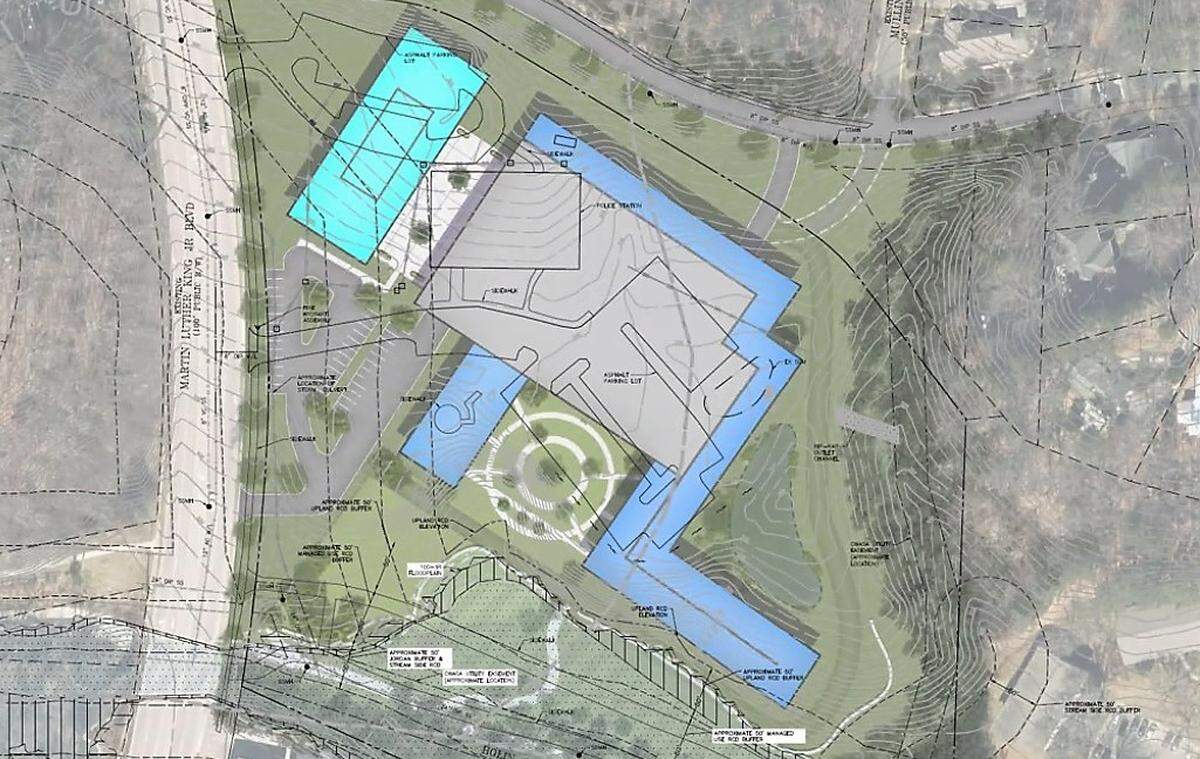
▪ a four-story, 80,000 square foot office building along MLK Jr. Boulevard for police, fire, parks and recreation, and other town services.
▪ A second-story plaza spanned the distance between the building and a five-story deck with 450 parking spaces at the center of the site.
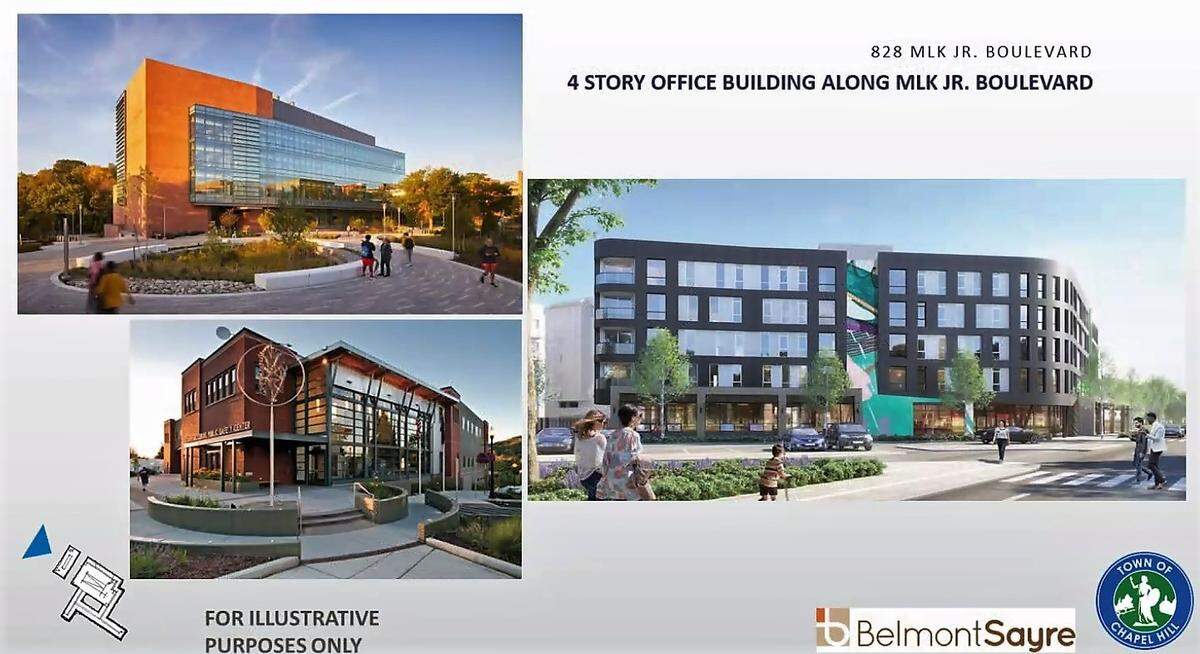
▪ A 200-unit apartment building with a courtyard wrapped around the deck, rising from three stories near Bolinwood Drive to four and five stories closer to Bolin Creek, which lies at the bottom of the steep site.
Roughly 15% of the apartments could serve residents earning up to 60% of the area median income, or roughly $36,300 a year for a single person and $51,840 for a family of four. Federal housing vouchers also could be accepted.
The area, already served by multiple buses, also will have a stop on the future North-South bus rapid transit route.
Council members largely supported the idea, the building sizes and the public spaces, but firmly rejected a large parking deck.

Coal ash, entertainment, and a meeting
Any construction is contingent on the town first dealing with coal ash that has been on site since the 1960s, when it was used to fill construction dirt pits. The town bought the site and built the police station in the 1980s, but did not learn about the coal ash until 2013.
One option would remove a large portion of the coal ash and replace it with clean soil. That would be capped with buildings and pavement, and a retaining wall would be built into the hill to keep the soil in place. The cost: $3 million to $5 million.
The other option would remove and replace all of the contaminated soil, increasing the cost to $16 million or more. Roughly 5,000 dump truck loads of dirt would be buried in a licensed landfill in another county.
N.C. Department of Environmental Quality officials will meet virtually with the public May 16 to talk about the state Brownfields Program rules for reusing contaminated sites. The program allows the construction of apartments and commercial buildings on brownfields sites, but Belmont Sayre officials said a recent market study showed commercial development may not work there.
Council members and residents have taken issue with that determination, noting other successful businesses and restaurants just a short walk away.
Winding Ridge neighbor Andi Morgan suggested making the site a place that people from all over will want to visit.
In the late ‘90s, Chapel Hill “was arguably the best part of the Triangle,” Morgan said, attracting people from other cities to visit. The 828 MLK site is “an incredible opportunity to add some local culture and fresh entertainment options,” she said.
“Because of the proximity it has to Bolin Creek, Franklin Street and Carrboro, it could be so much better used as an expansion of downtown, connecting and extending the entertainment options with restaurants, bars, shops, etc.,” Morgan said.
“It could be creatively combined with the few existing options nearby, such as Lucha Tigre and Root Cellar, and accessible to the creek through smaller retaining walls with steps rather than one large wall, so that people can visit the trail and creek as part of a larger, walkable downtown.”
Public health risks at issue
The project, if approved, will take two years to build, said Ken Reiter, president of Carrboro-based Belmost Sayre. That’s after the police department is relocated, he told the council, noting that demolition of the current building could start in 2024.
The next step is an official application and negotiating an economic development agreement spelling out the costs to the town and Belmont Sayre for cleanup and construction, and other key issues. A deal is not certain until the agreement is signed.
The town has allocated roughly $34 million in future bond money to build the municipal center.
Council member Adam Searing continued to oppose the housing plan and push the town for a full cleanup of the site, citing concerns about human health risks. Advocacy groups and residents also continued to voice support for a full cleanup Wednesday.
What strikes him most, Searing said Wednesday, “is the language we’re using and the reasons we’re using for putting housing on the site are so similar to what other town officials in other areas, in other times, when they were building on exactly these kind of sites, used to justify building the housing and inviting people into these sites.”
He noted similarities with Gordon Plaza, a neighborhood built on a former New Orleans landfill, and the parking lot sinkhole and cancer clusters found in Mooresville, North Carolina, where coal ash has been uncovered.
.jpeg "Adam Searing_fitted (2).jpeg")
“We don’t want to be on this list in 20 or 30 years of towns that are embarrassed and where townspeople are getting hurt, and we shouldn’t have to have people live on top of this site just because some political imperative that we have,” Searing said.
Coal ash is a carcinogen and can be dangerous to human health, particularly if it is stored in lagoons or unlined landfills, or is exposed to stormwater runoff that leeches contaminants into nearby streams and groundwater.
While most of the coal ash is buried under the police department and its parking lot, Searing recently walked the site, taking photos of coal ash spilling out of the soil on the bank overlooking Bolin Creek. Roughly 1,000 tons of coal ash near the creek was replaced with clean dirt in 2020, and the bank was reinforced with vegetation and fencing.
Multiple studies conducted by the town’s consultants found coal-related contaminants, including arsenic, lead, barium, chromium and selenium in the soil and groundwater. High levels of mercury also were found in the groundwater.
The studies did not find “significant impacts to stream sediment or surface water” in the creek, a town report noted, or any risk to pedestrians and cyclists using the Bolin Creek Greenway.
This story was originally published April 28, 2022 at 11:01 AM.