‘This is home for us’: Police Chief Chris Blue on 25 years of service to Chapel Hill
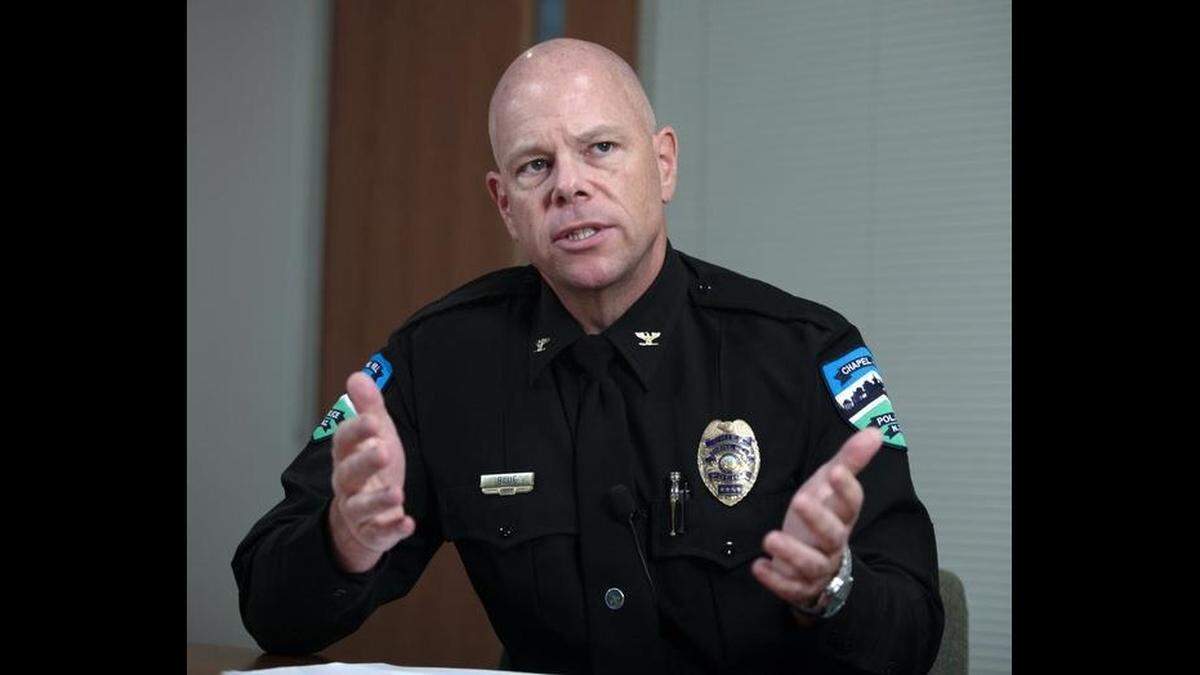
Chapel Hill Police Chief Chris Blue announced this week that he will retire at the end of the year after serving the town for about 25 years, including the last 12 years as a chief.
Blue, 54, spoke with The News & Observer Tuesday about some of his most proud and challenging moments, and a lingering regret.
But he also shared a little of his off-duty life. Blue and his wife, Natasha, have two daughters who both live in Boone, which is also the name of one of the family’s dogs.
Nearly three years ago, Blue and his wife moved to three acres outside the city limits. They have three dogs (Boone, Rosie and Hank), some goats and chickens.
“We are just weekend hobby farmers,” said Blue, who also has an interest in guitars, owning about a dozen.
You can’t have too many, he said.
“My favorite one is generally the next one on my list to acquire,” he said.
Here are Blue’s responses to questions about his tenure, edited for space and clarity.
When you started as an officer 1997, did you know you would be police chief?
No, definitely not. The best job in the department is a patrol officer. If you really love people and you love the community that you are serving in, being a patrol officer is the best gig going because you are out in the community interacting with them every day, hopefully helping them solve problems and being a resource for them. I loved that job.
As you get a little experience under your belt, you want to think about ways that you may be able to help bring change to the organization, maybe inform and influence others around you a little but more effectively. Often times that is through moving into leadership roles.
Do you feel like you brought change to the organization?
No I wouldn’t say that. I inherited an organization that already had a strong foundations of good, smart, progressive compassionate policing. All I did was, maybe not mess that up.
What are some of the accomplishments that you are most proud of?
We have had some really tough incidents in our community. We have had young people come here to be educated in this world-class university murdered in our community, and it has been our department’s responsibility to investigate those cases and try to bring justice to those families.
And every time that has sadly happened, and we have been able to bring charges, those are moments that you feel a satisfaction that you are doing important work in your community.
It is hard to take pride in that but it is certainly a strong sense of job satisfaction to know that you have met that obligation and done it well.
I think just one other thing I would say, is that every time we graduate a new recruit class of police officers, I will tell you it is something that makes me very proud, and I would say increasingly so in today’s environment.
What were some of your most challenging moments?
I certainly mentioned some homicides we have had in the community that have been particularly difficult, the 2012 murder of Faith Hedgepeth and the long investigation was difficult. (Note: Police arrested a man in the UNC student’s death in 2021.)
From day one we were confident that we would charge someone in that case, but it took us nine years to do it. And nine years of the family and the community grieving, and me knowing we haven’t yet met that responsibility to that family.
As were the murders of Deah, Yusor and Razan, for different reasons.
A grieving family with murders that really had an international impact and feeling a responsibility for how those murders were perceived was very, very difficult and something that we reflect on and learned a lot from in our organization.
Finally, the whole controversy about Silent Sam and the Confederate Monument debate landing here in the front porch of our university had significant effects in the Chapel Hill community. Even though the monument was on the campus grounds, that affected us for months and months and months, just as it did our university partners.
Obviously, it was a highly contentious experience in our community, politically charged and so on, and that was difficult and that had pretty serious fatiguing effects on our employees the whole fall of 2018.
What are some of your regrets?
The one that resonates with me most of all was the narrative that developed around the murders of Deah, Yusor and Razan.
(Note: Deah Barakat, Yusor Abu-Salha and her sister, Razan Abu-Salha were shot by a neighbor in 2015. Police initially said the killings grew out of a parking dispute. The family maintained it was a hate crime.)
The morning after they were killed we issued a press release. While it was intended to be informative, it turned out be very, very damaging to the families, to the Muslim community, to the reputation of the compassionate, thoughtful police organization.
I take responsibility for that message, that was my message, and I regret it to this day because I don’t think it reflects our organizational values, and I don’t think in hindsight it conveyed what we intended to convey to those families.
Do you think it was a hate crime?
Whether it met the federal legal definition of hate crimes had been resolved by federal authorities. What I would say there is no disputing is that those were hateful deeds that had serious repercussions, and three bright lives were snuffed out.
What is next for you?
I am not sure. I am going to take a little bit of time to think about that. This is home for us, so we are not picking up and going anywhere else. My wife still works; she’s worked for UNC Health Care for years and will continue to for a while. This is home for me, and I don’t intend to fade into the woodwork.
This story was originally published June 7, 2022 at 5:28 PM.