
Chapel Hill removes artistic banner on Franklin Street after Gaza-related backlash
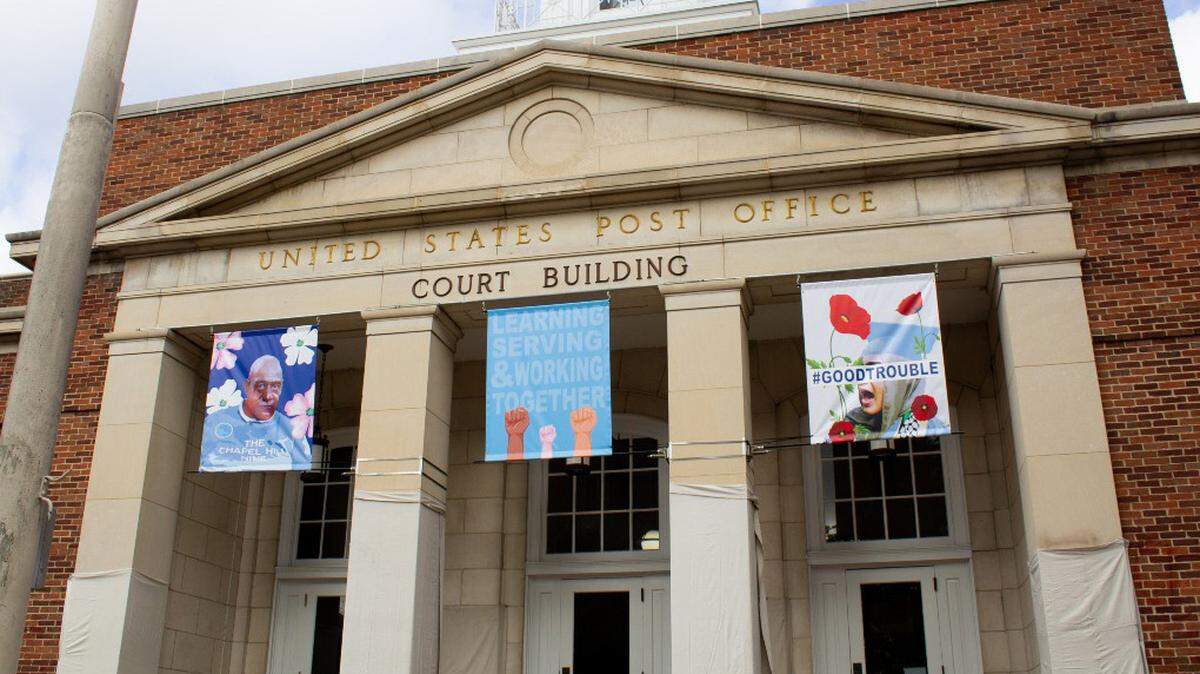
The Chapel Hill town manager ordered an artistic banner removed from Franklin Street on Wednesday because of “deep division” it caused in the community related to the war in Gaza.
In a statement, Town Manager Chris Blue said the display of three banners was meant to be thought-provoking and spur difficult conversations.
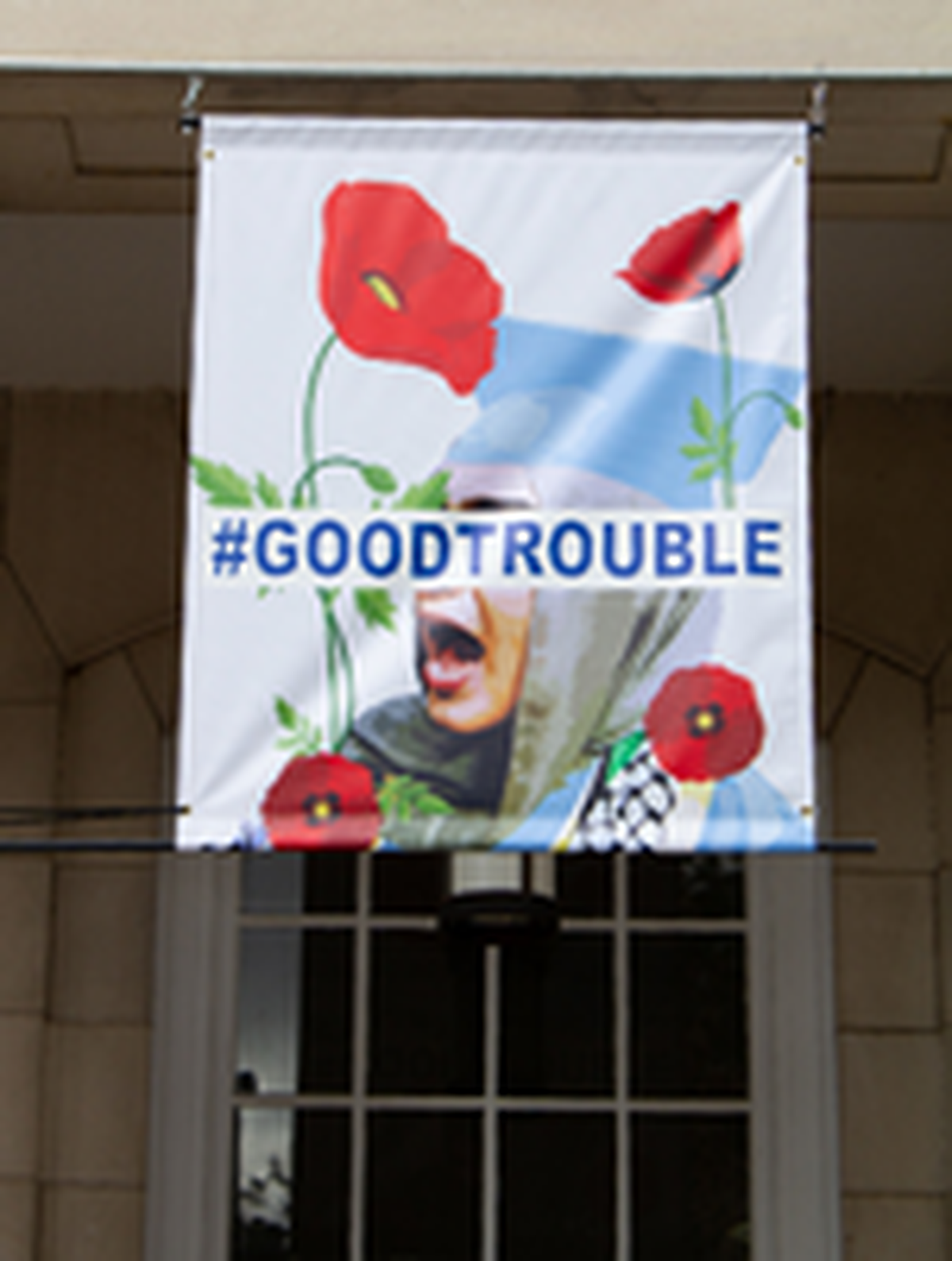
One banner showed a woman in a hijab, a headdress some Muslim women wear, and a blue graduation cap. The banners were created by Wilson-based artist Tyshika Dickens, who goes by Sadie Rose, for her display, “The Power of Good Trouble,” hanging from the old post office at Peace & Justice Plaza, at 179 E. Franklin St.
“Intentional or not, the piece is evoking strong feelings for many about the conflict between Palestine and Israel, especially for those who are close to Chapel Hill native Keith Siegel, who remains in captivity in Gaza,” Blue wrote.
Siegel moved to Israel decades ago and is being held hostage by Hamas, The News & Observer has reported.
The terrorist organization attacked Israel on Oct. 7, 2023, killing over 1,200 people. Israel retaliated, killing over 44,700 people as of this month, Al Jazeera reports.
Art display ‘does not target’ Jewish people
The banner does not explicitly say it is pro-Palestinian.
In a statement, Dickens said: “[T]his artwork does not, in any way, target or criticize Jewish people or Judaism. It does not contain any symbols, language, or messaging that convey antisemitic ideas.”
“Its purpose is to uplift the values of justice and unity across all communities, while standing firmly against antisemitism and all forms of discrimination,” the statement read.
Dickens said her piece “intertwines the bold red poppy flowers, dogwood flowers, synonymous with remembrance and resilience.”
The display included an illustration of James “TT” Foushee who, during the Civil Rights Movement in 1964, started a hunger strike on the old post office lawn on Franklin Street.
“These elements converge with the image of a graduate, adorned in their blue cap and gown, defiantly protesting, embodying the spirit of courage and determination we’ve witnessed from some community members,” Dickens said. “Together, they evoke the essence of the ongoing struggle for racial justice, each element a testament to the indomitable spirit of those who dare to challenge the status quo.”
The theme “Good Trouble” is a nod to former civil rights leader and Congressman John Lewis’ charge to “get in good trouble, necessary trouble, and redeem the soul of America.”
Town records show Dickens was paid $3,000 for her work.
Chapel Hill receives backlash
Some users in the Facebook group Chapel Hill Community Arts & Culture commented about the public art display. Over 40 comments criticized it as offensive.
One user, Gabriela Nicola, called the banners “tone deaf and incredibly insensitive” to the town’s Jewish community.
Another Facebook user, Michele Graber Cubell, said the work was a “gross display” for its use of what appears to be a keffiyeh on the illustrated woman’s shoulder.
A keffiyeh is a traditional black-and-white or red-and-white scarf in the Middle East that symbolizes the pro-Palestine movement and resistance. Some critics associate the garment as a symbol of violence.
“There is no peace or justice in supporting those who murdered 1,200 people, mostly civilians. Disgusted that this was approved to be displayed,” Cubell wrote.
Blue said after listening to residents’ concerns, “I directed that the display be removed earlier today to allow space for some further community conversations.”
“I know that our community has proven capable of having such conversations many times in the past when confronting challenging topics and raw emotions,” Blue wrote.
He said people may feel strongly about the display coming down and told residents to continue sharing their feedback.
This story was originally published November 20, 2024 at 12:09 PM.