NC program trains women, nonbinary people for construction. DOGE cut its funds
Update: Hope Renovations had raised $143,725 of its $300,000 goal by July 28, 2025. The nonprofit organization also announced it had won a $600,000 Gable Grant from the Lowe’s Foundation. The grant will be awarded at Hope Renovations’ graduation on July 31, 2025.
A Triangle nonprofit that teaches construction skills to women and nonbinary people is trying to raise $300,000 after learning it will lose the remainder of its federal grant.
Hope Renovations, a job training program based in Carrboro, learned this week that the Department of Government Efficiency cut the last payment from its $700,000 federal grant awarded in 2023, because it does not support the department’s “priorities for its grant funding, including with regard to diversity, equity, inclusion, and accessibility.”
More specifically, DOGE targeted the organization and others because they help women, nonbinary people, and especially people of color, who make up over half of Hope Renovations’ graduates and trainees, founder Nora El-Khouri Spencer said.

“Honestly, it just stings to read the verbiage that was in the termination letter,” Spencer said. “The argument we’ve been making the whole time is it’s not about DEI. It’s about workforce development.”
Spencer started Hope Renovations in 2020 as the COVID pandemic shut down everything. Its goal is to narrow the gender gap in the construction industry by giving women and nonbinary people more training opportunities and a pipeline to apprenticeships and jobs.
The program has won accolades, including in 2023, when the National Association of Home Builders named Spencer its Woman of the Year. In March, it received a $600,000, two-year grant from the Lowe’s Foundation, and last week it was featured on PBS-NC’s “My Home, NC.”
The new grant will help, but “it’s a pretty big gap for a small nonprofit to fill,” Spencer said.
“I think we’re all just so disheartened that our federal government would essentially say this is not important because you’re helping women,” she said.
Meeting industry, community needs
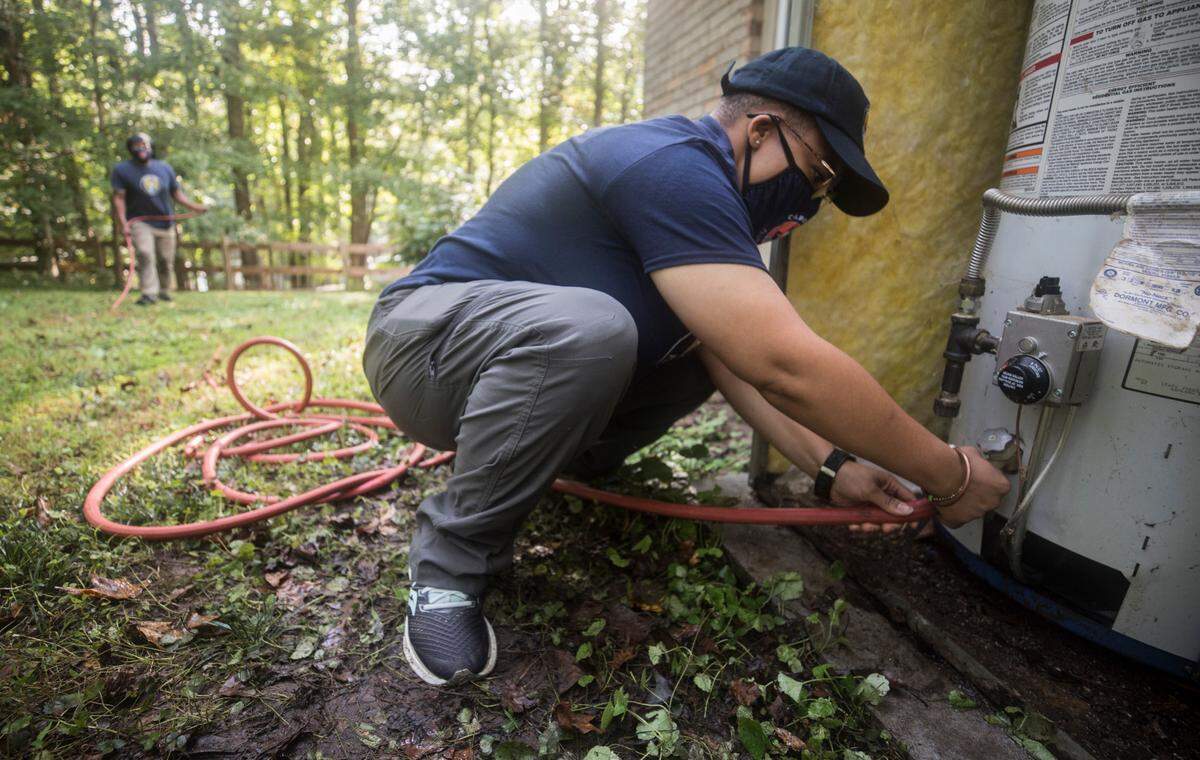
Since 2020, 159 people have graduated from the nine-week program with skills in carpentry, plumbing, electrical work and other trades, as well as field-related administrative work, networking, conflict resolution, and job search skills.
Trainees spend the last two weeks on the job, making repairs and renovations that allow older adults and adults living with disabilities to stay in their homes.
They’ve completed or are working on 322 projects for homeowners and nonprofit partners, Spencer said, from installing shower bars to building a Pee Wee Homes tiny home for someone coming out of homelessness. The customers are charged on a sliding scale, with roughly 79% of them qualifying as low to moderate income, she said.
Hope Renovations now has 102 graduates working in the industry and 66 pursuing additional education, licenses and certification.
The work fills a critical need in the construction industry, which has an older workforce that is retiring and fewer young workers coming online.
In March, the national Associated Builders and Contractors trade association reported 439,000 new construction workers are needed this year, and even more could be needed next year if interest rates fall. The U.S. Bureau of Labor Statistics reported 8.3 million people worked in construction industry trades in April.
Registered state and federal apprenticeship programs are not meeting the demand for new workers, ABC reported.
Women still make up only about 5% of the construction industry workforce, Spencer said.

Grant-funded training expansion
Hope Renovations was one of seven community organizations that shared a $5 million Women in Apprenticeships and Non-Traditional Occupations grant in 2023 from the U.S. Department of Labor. The program started in 1992 during Republican President George H.W. Bush’s administration.
The money was a big piece of Hope Renovations’ roughly $1.5 million budget, Spencer said. Over half of the budget pays for trainee stipends, renovation projects, and Career Catalyst, a six-week incentive program that pays employers $5 an hour per trainee.
“It’s been hugely successful,” Spencer said. “The employment outcomes for this internship program are better than our general program, but now we don’t have the funding to be able to subsidize those internships anymore.”
The grant also let them grow to 96 trainees this year — up from 25 to 35 people — and ramp up partnerships with Durham Tech and Wake Tech community colleges, Spencer said.
Hope Renovations shifted its model to community colleges last year, paying tuition for trainees and using campus lab space, which is usually empty during the day, she said. The organization provides the curriculum and the instructors.
“A lot of people that we serve, they think that college of any type is completely out of reach, but they come through our program, they get accustomed to the community college atmosphere, and then a lot of them are continuing their enrollment at Wake Tech and Durham Tech after our program,” Spencer said.
Word of the program has spread, creating a waitlist for the first time, she said, and they had hopes of expanding the model to more community colleges starting in 2026.
They are asking supporters to reach out to federal lawmakers about the cuts and encouraging donations to support the work, she said. Dozens of employers and industry officials have emailed her since Monday saying, “we’re with you,” she said.
“I know they don’t have the same political leanings as I do, but it doesn’t matter,” she said. “This transcends the aisle. It’s about getting people into jobs and keeping this industry running.”
This story was originally published May 13, 2025 at 1:59 PM.