
Bald eagle population soars in the Triangle
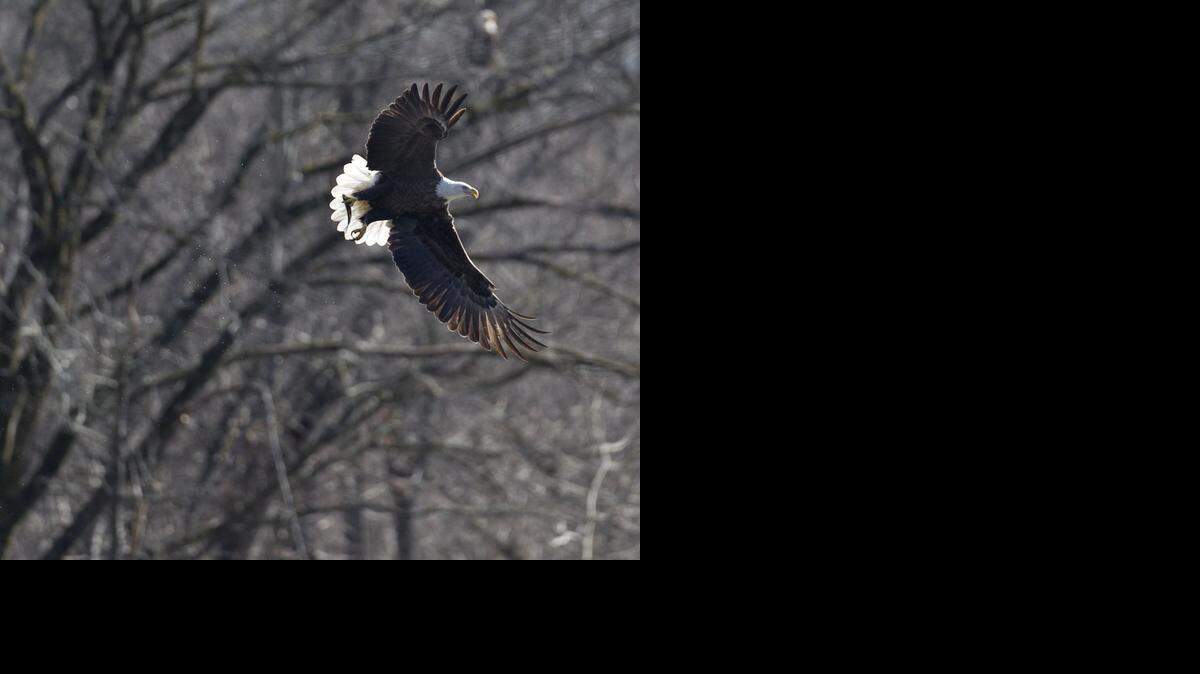
Ronnie Floyd of Wake Forest is 73 years old, spent four years in the Navy and retired after 30 years with IBM, and until two days after Christmas he had never seen a bald eagle in the wild.
Floyd was walking with his daughter, Tiffany, on a trail near Falls Lake dam when they spotted one in a tree.
“She said look at that big bird up there. I said, ‘Oh my God, that’s a bald eagle,’ ” Floyd said. “I had no idea they were even around here. It’s just amazing.”
For people who remember when bald eagles were nearly extinct in most of North America some 40 years ago, spotting one for the first time can feel like seeing a leprechaun.
But the eagles have made a remarkable recovery, both in North Carolina and nationwide. While still protected by other federal laws, the birds were removed from the list of threatened and endangered species in 2007 because their numbers had increased so much.
Not a single pair of bald eagles were nesting in North Carolina in 1983 when state biologists released the first of 29 juveniles near Lake Mattamuskeet in Hyde County. When a pair built a nest 7 miles from the lake the following year, it was the first in the state in more than a decade.
Now there are at least 192 bald eagle nesting territories statewide – places where the birds are nesting now or have in recent years, said David Allen, supervisor of the wildlife diversity program for the state Wildlife Resources Commission.
And those are just the ones Allen knows about. There are probably at least 100 more, he says, but the efforts to count the birds and nesting sites have waned as they’ve become more common.
The bald eagle’s decline in North America was well underway when the bird was chosen for the national emblem of the young United States in 1782. Not only were the bald eagles hunted, but the tall trees where the birds build their nests were felled and the rivers and lakes where they fished became polluted, depriving them of their basic needs to survive.
The near fatal blow came in the mid-20th century when pesticides such as DDT got into the fish the eagles ate, causing reproductive problems that included a thinning of the birds’ egg shells, which often broke in the nest.
The use of DDT in the United States was banned in 1972, and bald eagles were listed as an endangered species in 43 states six years later. That provided them with additional protection, and government and private agencies followed with breeding programs and other efforts to reintroduce the birds to the wild, which included the release at Lake Mattamuskeet.
Since then, it’s become clear that while humans nearly drove the birds to extinction, man-made lakes are helping them thrive again, at least in North Carolina. Bald eagles are not only found on Falls and Jordan lakes in the Triangle, but also smaller ones like Crabtree, Johnson, Harris, Wheeler, Benson and even Yates Mill Pond – all man-made bodies of water surrounded by trees and full of fish the birds eat.
Statewide, Allen says he can’t think of a large lake in North Carolina that doesn’t have bald eagles.
“If there’s some relatively large pine trees around without too much disturbance, near a large lake, the birds are going to be there,” he said.
And most large lakes in North Carolina were built in the last century.
“That’s a habitat those birds didn’t have before,” Allen said. “We have the potential to have more eagles in the state now than we had 100 years ago.”
A favored fishing spot
Nowhere is the comeback of the bald eagle more evident this time of year than just below the dam at Jordan Lake in Chatham County.
The lake provides good eagle habitat, and was one of the places wildlife biologists concentrated when they were trying to encourage the bird’s recovery, by thinning the trees around large pines to make them more enticing to nesting birds.
Now there are at least 14 pairs of bald eagles nesting around the lake and another just downstream, says Francis Ferrell, a conservation biologist for the U.S. Army Corps of Engineers, which manages the lake and owns the land around it. That’s more than twice as many nests as there were about five years ago.
Biologists and birders are loath to disclose the locations of bald eagle nests, for fear that crowds of people will spook the birds. But there are no nests at the dam – just lots of eagles, at times, fishing in the roiling waters of the Haw River as it emerges from the base of the dam.
“It’s just really easy fishing for them,” Ferrell said. “They come a lot closer to the dam when we’re releasing more water. I don’t know if it confuses and dazes the fish, or the fish are being killed as they pass through the dam.”
The dam attracts other birds, too, including osprey in warmer months and gulls and vultures year-round. But, Ferrell said, “For people who have never seen an eagle in the wild, it’s probably the best place to get out to see one.”
The area below the dam has become a favorite for wildlife photographers like Brent Bogart, a corporate recruiter who lives in Wake Forest. Bogart, 41, and friend Scott Luihn, 53, arrived a little before 7 a.m. on a recent cold, sunny Saturday and saw 30 to 50 eagles swooping in and plucking crappie from the river, one after the other.
“The comeback they’ve made is just amazing,” Bogart says of the eagles. “It’s an amazing story. It shows that conservation works.”
Biologists aren’t sure why the birds congregate around the dam in the winter; the summer eagle population is actually larger, Ferrell said, but more spread around the lake. During one summer eagle count that took place during a fish kill, more than 100 bald eagles were spotted, he said.
Bogart says even with so many eagles concentrated at the dam, there are no guarantees.
“You’ve just got to have patience,” he said, shouldering a camouflaged camera with a lens nearly as long as his arm. “They’re like any other wild animal. They’re not going to show up on demand.”
As Bogart and Luihn left mid-morning, Brad Lenear and Ellen Tinsley stuck it out, cameras ready. The birds had mostly moved downriver, but photographing such a beautiful bird in flight can be addictive, said Lenear, 52, an apartment maintenance supervisor from Holly Springs.
Tinsley, 67, a retired veterinarian from Fuquay-Varina, says she photographed three eagles – two adults and one immature one – at Yates Mill Pond just south of Raleigh in early January.
The adults are what people consider a bald eagle, with the distinctive white head and tail. Immature bald eagles haven’t developed the white markings yet, and are harder to identify.
As she spoke, Tinsley suddenly spotted one overhead.
“There’s a white head, guys,” she said, and up came the lenses. Click, click, click. “Brad, is that a 4 or a 5 year old?” Tinsley said. “Looks like a full 5.”
More clicking, as the bird angled off over some trees. “I was hoping he’d fish,” Lenear said.
Unexpected encounters
As the population grows, the chances for an unexpected encounter with a bald eagle does, too. One potential spot, surprisingly, is over Interstate 40 near Raleigh-Durham International Airport.
A pair of bald eagles built a nest in a wetland area at Lake Crabtree, just off Aviation Parkway south of the eight-lane interstate, in 2004 and remained until 2011, said Colleen Bockhahn, who plans environmental programs at Lake Crabtree County Park.
“We’re not sure what scared them away from the nest, but they have not been back since,” Bockhahn said. “They seemed pretty content there for the time that they were there.”
But it’s still possible to see eagles at Lake Crabtree pretty much year-around, said Bockhahn. This winter, two mature adults have been seen at the lake, and park staff members are pretty sure there’s a nest somewhere nearby.
Floyd says the eagle sighting near Falls Lake Dam in December caused quite a stir. Everyone he and his daughter encountered on the trail was talking about it, he said.
“I’m glad I could live long enough to see one in the wild like that,” he said.
This story was originally published February 14, 2015 at 1:31 PM with the headline "Bald eagle population soars in the Triangle."