
Wake County EMS has one solution to overcrowded emergency rooms
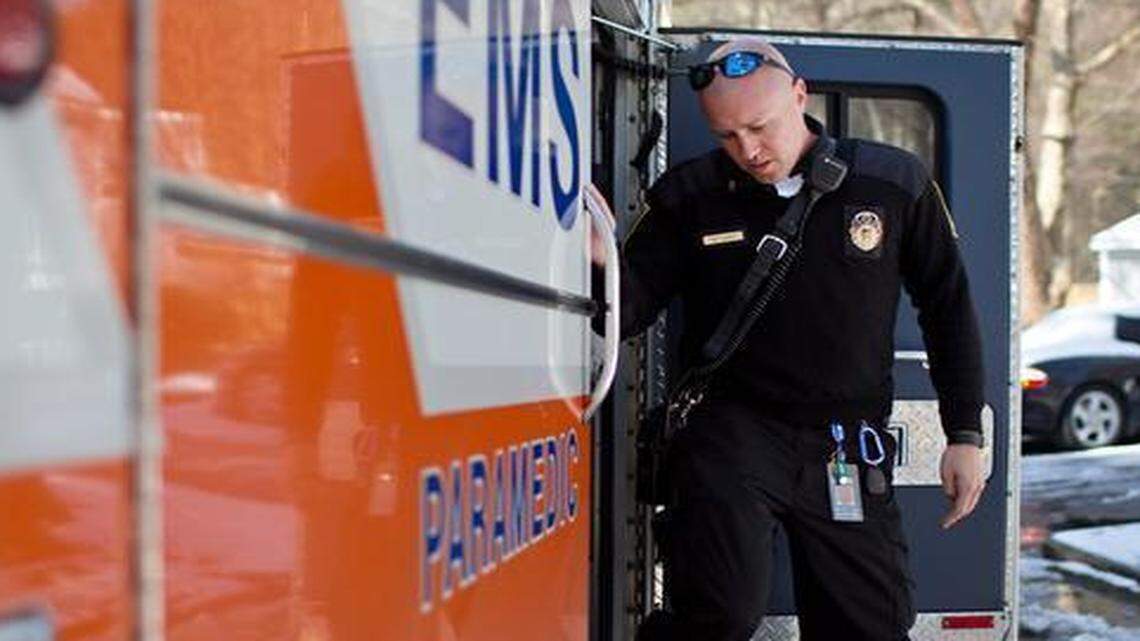
Inside the ambulance dispatched to a Southeast Raleigh parking lot, Wake County paramedic Benjamin Currie calms a mentally troubled man who is coughing through an oxygen mask. The patient is well-known to Wake County Emergency Medical Services, sometimes calling 911 several times a day.
“What’s going on? Anything different today?” Currie asks the man as he inhales his nebulizer treatment. “I think you know we’re repeating a pattern – going to the hospital and going home – and we want you to work on the long term.”
The patient, a low-income Raleigh resident, has come to rely on hospital emergency rooms to treat his recurring breathing difficulties. Each time he calls 911, paramedics have to assess whether they’re dealing with a health emergency or another case of panic and confusion.
In the past, he would have been taken to the hospital. But, under one of the first programs of its kind in the country, Wake County Emergency Medical Services is trying to keep people with behavioral health problems out of emergency rooms.
Instead, specially trained Wake County paramedics determine whether they should steer such patients to more appropriate care: a psychiatric facility or a substance abuse clinic. In some cases, the patients are persuaded to stay home and take their medicine.
“His problem is, he thinks he’s going to die every time he coughs,” Currie explained about the Southeast Raleigh patient. “If he has his way, it’ll be WakeMed for lunch, Rex Hospital for dinner and Duke Regional for breakfast.”
Wake County’s 6-year-old pilot project saved Medicaid about $500,000 in hospital and related costs during a recent 12-month period, according to data submitted March 1 to the state Legislature by the N.C. Department of Health and Human Services. The health agency’s report praises the Wake County EMS project and recommends expanding the approach in other parts of the state. Before a permanent statewide expansion could happen, there would need to be policy changes to Medicaid and Medicare. Until then, the state’s only option is to fund more training for pilot projects.
“It’s better care; it’s less expensive; it’s the right answer,” said Dave Richard, deputy secretary for behavioral health and developmental disabilities at the N.C. Department of Health and Human Services. “We’d like to see it replicated in places where it makes sense.”
The approach, launched here in 2009, is being replicated in several hundred communities around the country in an effort to prevent local hospitals from turning into high-cost way stations for the mentally ill.
Of the 260 paramedics in Wake EMS, 20 are advanced paramedics, specially trained to evaluate 911 callers for mental illness and substance abuse. An additional 30 paramedics in Wake County have gone through the 240-hour training program and would be deployed here if the program were expanded, said Wake County EMS director Brent Myers.
Wake County’s approach focuses on identifying the mentally ill, from their first 911 call. The patients are typically taken to a mental health facility by police cruiser or driven by a relative, or picked up by a van from a substance abuse facility.
Reducing wait times
Psychiatric patients often end up in hospital ERs, or jails, for lack of available mental health treatment options. In 2001, North Carolina opted to shift mental health treatment for nonsevere patients from expensive state-run psychiatric hospitals to less intensive community facilities.
As a result, the number of state-operated psychiatric beds, reserved for the most serious patients, shrunk to 892 in 2014 from 1,314 a decade earlier. State policy calls for expanding bed capacity in the coming years to address the chronic shortage, but the extra beds have been set back by ongoing funding delays.
The bed shortage has become so severe that on Jan. 25 WakeMed’s Raleigh hospital for the first time closed its emergency room for 3 1/2 hours to nonserious cases after the ER overflowed with 65 psychiatric cases.
Once hospitalized, mentally-ill patients can wait for days for a psychiatric bed to become available. WakeMed Health & Hospitals, Rex Hospital and Duke Raleigh Hospital are all staffed with round-the-clock “sitters” to monitor psychiatric patients until they are transferred to a mental health facility. The sitters are not a reimbursed expense and cost WakeMed about $7 million in fiscal 2014, said hospital spokeswoman Deb Laughery.
According to the N.C. Hospital Association, about a third of mental health patients who enter the emergency department end up staying in the hospital for an extended time. Those who are going to a state psychiatric hospital wait 78 hours on average in area hospitals until they can be transferred, according to 2012 data hospitals reported to the association. Those going to a community mental health facility have a shorter wait – 27 hours on average. They go either to the private Holly Hill Hospital, the nonprofit Healing Place of Wake County, or the nonprofit UNC Health Care Crisis and Assessment Service at WakeBrook. In August, WakeBrook added a primary care clinic to provide basic medical care for mentally ill patients so that they don’t have to be taken to the hospital for minor health issues.
By comparison, when a patient is successfully diverted from a hospital ER, Wake County EMS typically assesses and treats that person in about an hour, Myers said.
Diverting from the ER and taking patients directly to a psychiatric facility may appear like the obvious thing to do, but the strategy bumps up against a complex health care system that operates by established safety protocol.
The biggest hurdle is built into the system: Ambulance services, including Wake EMS, are paid only for taking patients to hospital emergency rooms. They also are not paid for onsite evaluations of patients. The federal payment policy, set by Medicaid and Medicare, is also adopted by private insurers.
The reimbursement policy creates a “perverse incentive” to deliver mental health patients to the most expensive option, regardless of a patient’s need, Myers said.
“People call 911 because they don’t know what else to do,” Myers said. “They don’t need a medical doctor. They end up in a hospital and stay there until they can go where they should have been taken in the first place.”
Alternatives must be safe
Nationwide about 260 pilot projects are underway to divert psychiatric patients from hospital ERs, said Matt Zavadsky, chairman of the Mobile Integrated Healthcare/Community Paramedic Committee at the National Association of Emergency Medical Technicians.
Only one such diversion program, in Nevada, pays for ambulance transport to a non-ER treatment setting, Zavadsky said. That 3-year-old project, which is scheduled to end June 30, operates under a waiver of federal reimbursement policy as part of a $9.9 million federal Health Care Innovation Award grant.
Medicaid programs in just three states – Maine, Minnesota and Idaho – reimburse ambulance services for evaluations, home visits and other preventive treatments designed to avoid a hospital stay.
Zavadsky said in order for the federal payment policy to change, emergency health officials around the country will have to demonstrate the alternative approaches are safe and effective in a variety of settings. The pilot programs around the country are intended as a collective demonstration project, he said.
In this state, DHHS has made “mini-grants” of $5,000 each to seven local EMS agencies for paramedic training and equipment to develop programs similar to the one in Wake County. Wake EMS and Wake Technical Community College paid for the paramedics’ training. Myers would like to see agencies such as his paid by Medicaid, Medicare and private insurers for evaluating and treating patients even if they are not taken to hospitals.
In its report to the legislature, DHHS recommended that lawmakers explore funding options for such diversion programs through policy changes or waivers to state and federal reimbursement policies for alternative ambulance transport. The state would have to request such waivers from Medicare and Medicaid before it could adopt a permanent statewide program. DHHS did not estimate the cost of extra training, equipment and payments.
In the Wake County pilot, EMS prevented 764 emergency room visits in the past two years, Myers said. That’s about 20 percent of the 3,831 patients evaluated for mental health and substance abuse between January 2013 and January 2015. Some of those who weren’t diverted refused any kind of help.
The range in savings to the Medicaid system is $124 to $415 per patient diverted from the hospital, depending on the seriousness of each patient’s health condition. The money represents reimbursements not paid to Wake EMS.
Currie’s Southeast Raleigh patient is among those who frequently need to be diverted. Between Jan. 1 and Feb. 23, he made 34 calls to 911. On Jan. 17 alone he called four times. In eight instances, paramedics were able to divert him from the emergency room.
Last week, Currie was able to persuade him to return home, escorting the man out of the ambulance and to a relative’s car awaiting in the parking lot. Currie then arranged to pick up the man’s inhaler from the pharmacy and take it to him.
Because the man told Currie he had no money, the paramedic paid for the prescription with $16 from the Wake County EMS petty cash account.
Murawski: 919-829-8932
This story was originally published March 14, 2015 at 4:00 PM with the headline "Wake County EMS has one solution to overcrowded emergency rooms."