A Raleigh home will no longer be a local landmark due to one-time owner’s racist past
The home of Josephus Daniels, a white supremacist and former publisher of The News & Observer, is no longer a local historic landmark.
The Raleigh City Council unanimously voted Tuesday to strip the home at 1520 Caswell St. of the local designation.
The request to remove the landmark status was submitted by Scott Murray, of Scott Murray Land Planning, on behalf of property owners the Masonic Temple of Raleigh. The house, called Wakestone, has been home to the Masonic Temple of Raleigh since 1950.
“We designate hallowed ground where tragedies occurred as vessels of memory,” Murray wrote in a letter to the City Council. “Daniels’ legacy in white supremacy is certainly now having its reckoning as a tragic episode. But this site, and this designation, does not stand in the same way as a memorial of hallowed ground, to teach us lessons. It is a celebration of accomplishment. Is white supremacy the kind of accomplishment upon which the City of Raleigh wishes to officially confer recognition? What lesson does that convey?”
The property is about 4 acres in the Hayes Barton neighborhood off of Glenwood and Wade avenues. The property is worth $4.1 million, according to county land records.
There have only been three requests to remove historic landmark designations, including the Daniels house.
Helped orchestrate Wilmington race riot
Daniels used The N&O to incite fear of Black residents and political leaders and helped orchestrate the 1898 race riot in Wilmington. That insurrection overthrew a mixed-race government and resulted in the killings of at least 60 Black residents.
The change is one of several from the last year as organizations look to distance themselves from Daniels.
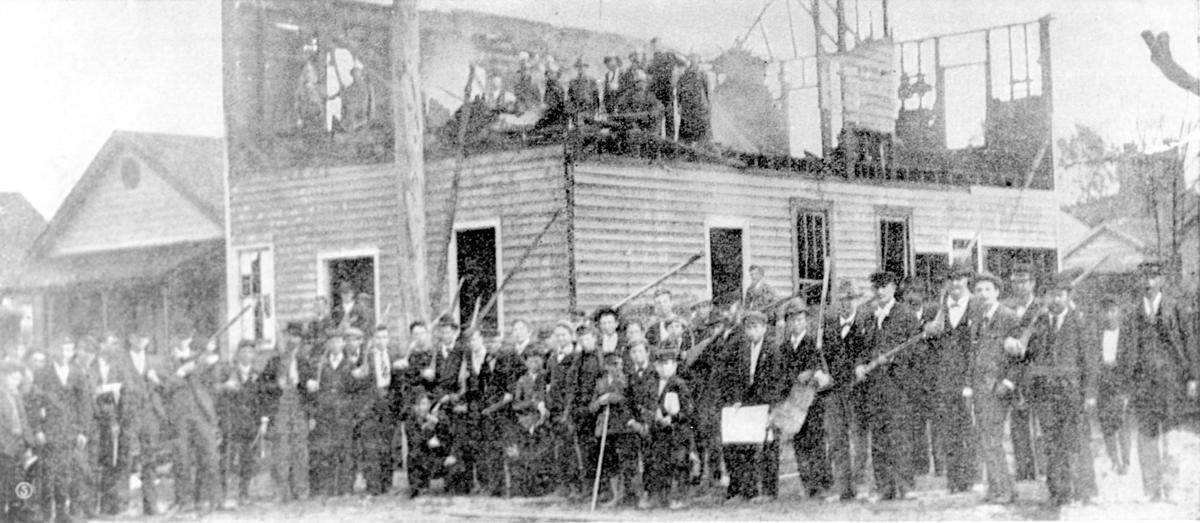
A statue of Daniels outside the former N&O office in Nash Square was removed at the request of Daniels descendants last summer, and both a Wake County middle school and N.C. State University renamed buildings originally named for Daniels.
The Raleigh Historic Development Commission voted unanimously to recommend removing the local designation in January.
The property is still listed on the National Register of Historic Places. It was added to that list in 1976.
Legacy burdens potential sale
The Masons have fought historic designations for their property before. In 2010, the group’s request to have the 1976 National Historic Landmark designation taken away was denied by the National Park Service.
Five years earlier, a developer’s plan to subdivide the property into lots for houses and townhouses prompted neighbors and preservationists to urge the state to declare it a property of statewide significance. The Masons opposed that designation as well, arguing that alterations to the site, including a large addition with a commercial kitchen, dining room and auditorium that seats more than 200, make most of it unrecognizable as the old Daniels estate.
“There could hardly be a historic site that had been more significantly altered than this site,” David Cronk, then president of the Masonic Temple of Raleigh, wrote to the Department of Cultural Resources in 2005, arguing against having it declared a property of statewide significance. “We feel very strongly that the neighbor’s attempt to have the entire site designated is a blatantly inappropriate attempt to misuse the historic preservation laws to deprive us of the fair and economic use of our property.”
This time, Murray said in his letter, “during this period of cultural reckoning the racist legacy of Josephus Daniels has further burdened the property.
“Simply stated, ties to the Josephus Daniels’ legacy presents a dark cloud over the Freemasons/Masonic Temple of Raleigh organization,” he said, adding the Masons worry about the property being the site of protests and unrest.
A phone call to the Masonic lodge was not returned Tuesday.
This story was originally published February 2, 2021 at 1:29 PM.