‘Addiction is a public health issue.’ Here’s what one Raleigh agency is doing about it
Landy Tyler only planned to stay at Healing Transitions for a couple of weeks.
About to lose his last place to live and bouncing between jobs, he entered the drug and alcohol recovery center in a “selfish” attempt to appease his mother so he could move in with her when he got out.
He ended up staying for more than a year.
Now, 21 months sober, Tyler said Healing Transitions saved his life. And the lives of others, too.
“This place teaches you how to love yourself again,” he said in an interview with The News & Observer. “I did not love myself when I first got here. I was taught almost like a toddler, like baby steps, on how to start the process of loving myself and, now, I can stand on my own two feet and know what it means to love myself. And not be afraid of everything.”
Tyler was one of 2,678 people Healing Transitions helped in 2019, a record year for the 20-year-old nonprofit.
The center prides itself on not turning people away, but demand for its no-cost recovery program and emergency shelter is rising.
To address those needs, Healing Transitions will expand its women’s and men’s campuses through a $16.75 million fundraising campaign. It has met 93% of its campaign goal and construction should begin by early summer, leaders said Thursday during a virtual groundbreaking.
“We understand addiction is a public health issue,” executive director Chris Budnick said. “The opportunity for change is often fleeting. So our doors are always open. And we offer our life-saving services the moment someone asks for them. As many times as it takes.”
‘He died as an alcoholic’
Tyler, 31, moved to Raleigh in 2015, hoping to be closer to family and leave behind some of the choices he’d made back in Massachusetts.
“I liked to drink. I didn’t do too many hard substances, but toward the end alcohol always came with cocaine,” he said. “The two always seem to go together. But what really brought me to my knees at the end was addiction to cocaine.”
It’s rare for a person to use only one substance, Budnick said. And the agency continues to see opioid addiction. In 2020, North Carolina saw a 23% increase in the number of opioid overdose emergency department visits.
Tyler started drinking before he was a teenager. Healing Transitions was his first recovery program, though he was familiar with Alcoholics Anonymous.
His sister’s father raised Tyler until he was about 11 years old.
“He was an alcoholic,” he said. “He died as an alcoholic. And I knew he was involved with AA. So my first opinion on AA was it didn’t work because it didn’t help him.”
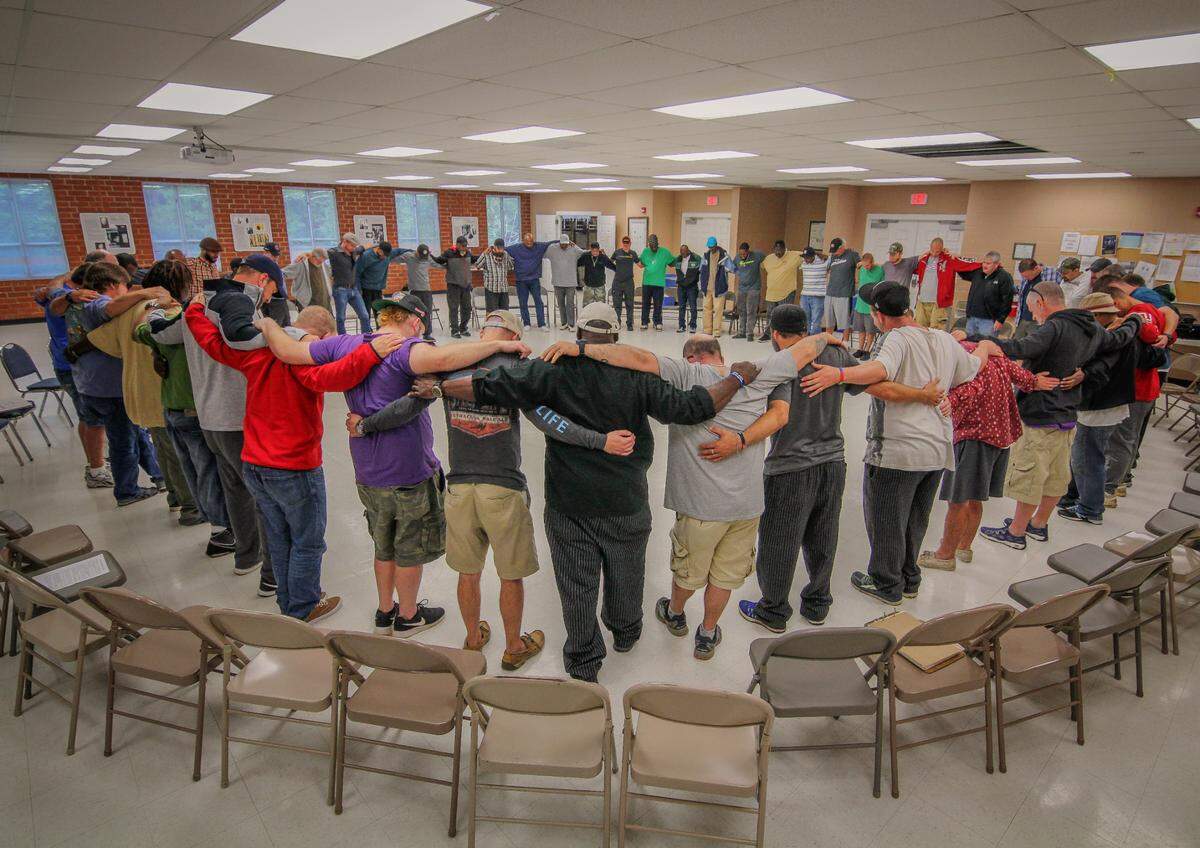
In his first weeks at Healing Transitions, Tyler was able to attend recovery classes and sleep at the campus but there wasn’t space to fully start the program because there wasn’t enough room. It’s like that for many who start out at the campus.
“It’s in that first week or two that you say ‘I’m here. I’m going to stay for a long time’ or ‘I’m not doing this,’” he said. “It doesn’t help your verdict and make you want to stick it out when it just super overcrowded. Having the space will keep people here longer.”
Sleeping in classrooms
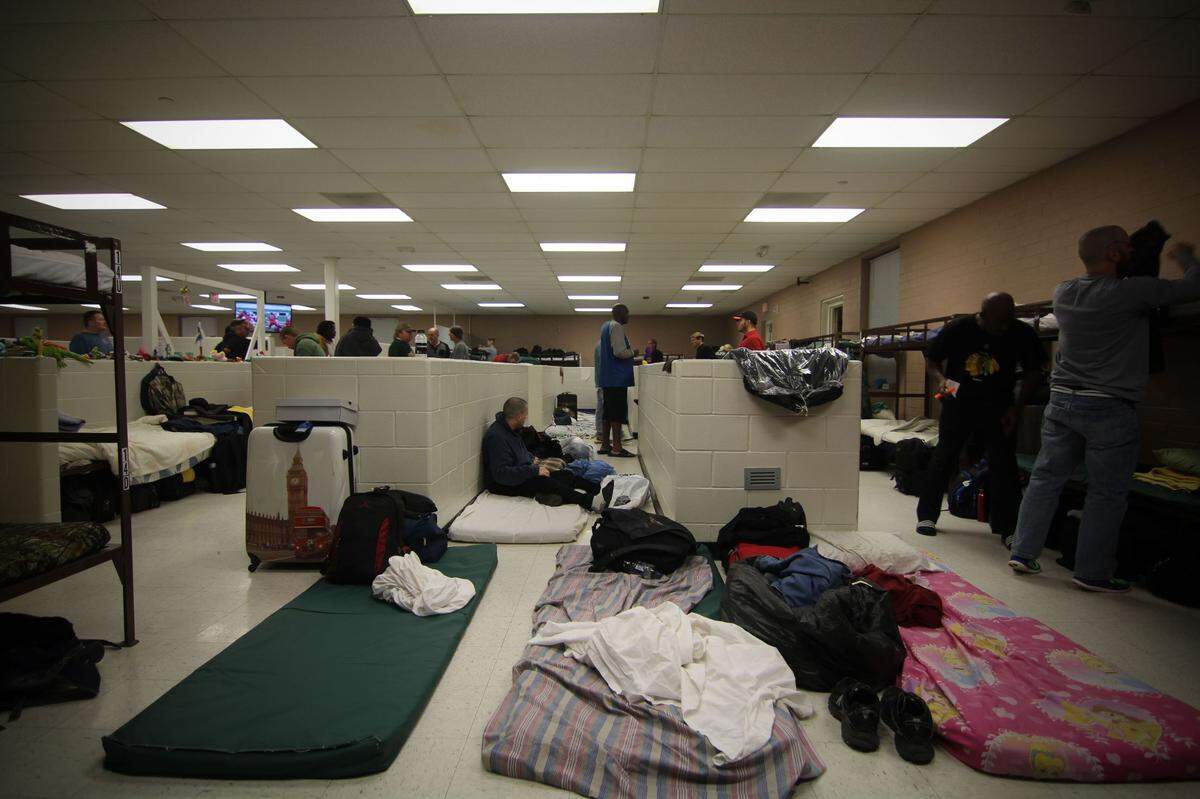
Between its two campuses, Healing Transitions has 253 beds.
“By January 2020 we were averaging 348 individuals per night,” Budnick said. “With men and women sleeping on classroom floors, sleeping in the community rooms, the overcrowding has become unsustainable.
“So we faced a choice,” she said. “Do we start saying no? And risking health, safety and lives? Or do we expand and help more people find recovery?”
The expansion should help people get off the mats in the two shelters.
At the men’s campus the expansion would add 115 beds, new restrooms and showers, a kitchen renovation, a new building for vocational training and increased parking. The women’s campus would get 16 new shelter beds and 46 new program beds, a kitchen expansion and a new classroom building.
Between the two campuses, capacity would jump to 500 beds and 37,000 square feet of new space.
Alice Lutz, CEO of Triangle Family Services, compared Healing Transitions’ work to that of first responders and triage nurses.
“The additional beds are going to be essential,” she said. “They serve an incredibly critical part of our safety net in the community.”
Addiction during COVID
Healing Transitions is a vital partner in addressing the needs of homeless people with addictions, said Kim Crawford, executive director of the Raleigh/Wake Partnership to End Homelessness.
“They do some of the really hard work,” she said. “The staff and the people over at Healing Transitions are some of the smartest and compassionate people I’ve ever met.”
And those services might be needed more in the aftermath of the COVID-19 pandemic.
In June 2020, 40% of adults in the United States reported struggling with mental health or substance use, according to a report by the Centers for Disease Control and Prevention. About 13% of adults started or increased their substance use.
And COVID has increased pressure on Wake County’s programs for homeless people. Wake County normally has about 600 beds available for those experiencing homelessness. Now Wake County has about 800 beds available but there are more than 1,000 people on a waiting list trying to get shelter.
COVID restrictions kept Tyler from experiencing some of the privileges he would have normally received as he neared completing his treatment.
“I wasn’t able to leave and come back or visit my family,” he said. “They wouldn’t even let the guys out to go look for a job or get a job because of the coming back and forth and the fear of spreading the disease here. It would spread like wildfire if it got here.”
Alumni are an integral part of the process and often came back to speak to residents, donate food, clothes and teach classes.
Raleigh and Wake County partner on expansion
Local governments will cover half of the expansion’s cost.
Wake County allocated a total of $5.5 million and has been long-time partners with the nonprofit, Wake County Commissioner Matt Calabria said.
“Healing Transitions fills a critical role in our community,” he said. “We know the kind of services that Healing Transitions provides is greatly needed and in short supply. They are in shorter supply than ever because of the pandemic. But as we grow we have got to continue to build out important facilities like these so we can help get people back on their feet.
And Raleigh has committed $3 million from its recently approved $80 million affordable housing bond to the expansion. In a tweet after the groundbreaking, Raleigh Mayor Mary-Ann Baldwin called it her “most joyful moment” as mayor.
“Not only does it improve the quality of life for our most vulnerable residents, but it’s a wise investment because it reduces emergency room visits and other high-cost services,” she said in an interview.
Healing Transitions offers a long-term recovery program with “program beds,” an overnight shelter where anyone can stay and a non-medical detox program that has been used as an alternative to emergency rooms or jails.
On the nonprofit’s website, it says its average cost is $35 per day compared to $103 per day in prison and anywhere from $500 to $1,4000 for an emergency department visit.
Fun and a sense of purpose
During his first few weeks in recovery, Tyler began asking if he’d ever have fun again.
“Everything I considered to be fun involved around (drinking),” Tyler said. “I learned fast that you can have a lot of fun in recovery. And it was through the help of the alumni and the people who have been in recovery for a long time that you can.”
At Healing Transitions, Tyler organized volleyball and basketball tournaments, karaoke and family feud nights. People started seeing him in the courtyard asking what he had planned for the weekends.
“It gave me a sense of purpose,” he said. “It was a healthy sense of purpose for the first time in a really, really long time. I was kinda known as the guy who was going to bring the fun. Which meant a lot to me.”
In the Healing Transition classrooms, Tyler learned the science behind addiction and began participating and then facilitating group classes on fatherhood in recovery.
“It was a really safe place for us because it’s a really emotional thing to know the type of damage we may have done to our children and their lives,” Tyler said. “Most of the time it was not something we did willingly. It was just something we did while we were in active addiction.”
After being out of his 11-year-old son’s life for several years, Tyler made contact with him again. The phone calls lasted a few minutes just a couple of times a month. Now their video calls can go on and they play Fortnite together.
When an addict is “chasing the next drink or the next drug” they don’t care about anything else, he said.
“And it’s hard for me to say that knowing that I’m saying I didn’t care about having a relationship with my son or a relationship with my mother or with people who I knew loved me,” Tyler said. “I just really didn’t care about much.”
Since leaving Healing Transitions Tyler has found a place to live in Raleigh and is working two jobs, including as an overnight staff member at Green Hill Recovery.
When it’s safer to travel again he wants to take his son, who lives in New York, on a trip to visit his family who still lives in Massachusetts.
“Still the plan!” he said in a text message Thursday.
This story was originally published March 26, 2021 at 9:29 AM.