Rising real estate costs put Raleigh’s Six Forks Road project in a $56 million hole
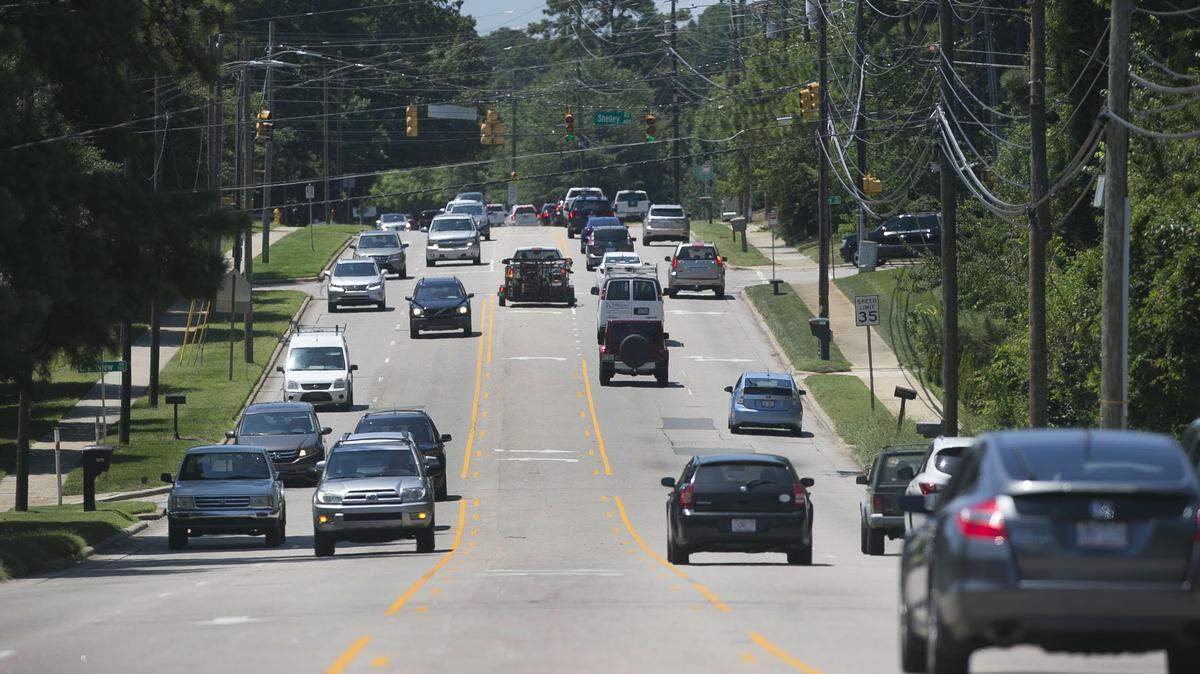
As the city prepares to rebuild and widen Six Forks Road near North Hills, it’s finding the real estate it needs is costing more than it expected.
Appraisals for right-of-way along the road are the main reason the city is short an estimated $56 million. The city still hopes to begin construction about a year from now but first must figure out how to overcome that deficit.
“At this point, identifying how we’re going to fund the project is really the operative question,” Kenneth Ritchie, the city’s mobility strategy and infrastructure manager, told City Council members Tuesday. “The real estate costs have started to grow exponentially beyond what we could have projected even last year.”
The city wants to improve traffic flow on Six Forks and make it safer for cyclists and pedestrians between Lynn Road and Rowan Street, near Carroll Middle School. It plans to build a grassy median to separate traffic and add a third travel lane between Rowan and Millbrook Road. New sidewalks and bicycle paths will be separated from cars by a curb and strip of grass, and intersections will be redesigned to make it safer for pedestrians to cross.
The wider footprint means the city needs to buy property from churches, businesses and residents along a nearly 2-mile stretch of Six Forks Road.
The Six Forks project is one of 17 the city planned to complete using $206.7 million in transportation bonds approved by voters in 2017. But rising costs for materials, labor and real estate have forced changes.
The city previously delayed the start of construction on three projects and indefinitely paused an unpopular plan to widen a stretch of Leesville Road north of the high school.
“The supply chain is such that we’re seeing very high prices relative to materials needed to be able to get projects on the ground,” Sylvester Percival, the city’s roadway design and construction manager, told council members. “Similarly, the labor market. We continue to hear from our vendors that maintaining labor forces is very challenging. And that drives costs.”
The city’s options for covering the deficit
The city has not actually purchased any property along Six Forks yet, Ritchie said. Its understanding of the growing cost is based on appraisals; the actual costs could be lower. The city also hasn’t finished designing the project, which will help determine the final cost of property and construction, said Michael Moore, the assistant city manager who oversees transportation.
“Getting the appraisals in, getting the design done, are all kind of critical steps to having a better understanding,” Moore said.
The city has budgeted $60.1 million for the Six Forks Road project, including a $14 million federal grant it hopes to receive. Rising real estate prices have pushed the estimated cost to $116 million.
To cover the deficit, Moore said the city could build the project in phases, though that would likely increase the overall cost and would prolong the disruption caused by construction. Another option is to use money from another transportation bond issue the city may ask voters to support late next year.
Council member Jonathan Melton noted that $56 million for Six Forks Road would be a sizable chunk of a bond request, at a time when rising costs have forced Raleigh to delay other projects around the city.
“The public is expecting them, and we haven’t delivered all of them yet because of these funding issues,” Melton told fellow council members. “So I would like to see us think bold and big for a future transportation bond. These are things that we know that we need to improve quality of life, and for a lot of them it’s just been promises deferred.”