Moore Square’s got problems. Are police, permits to feed homeless the answer?
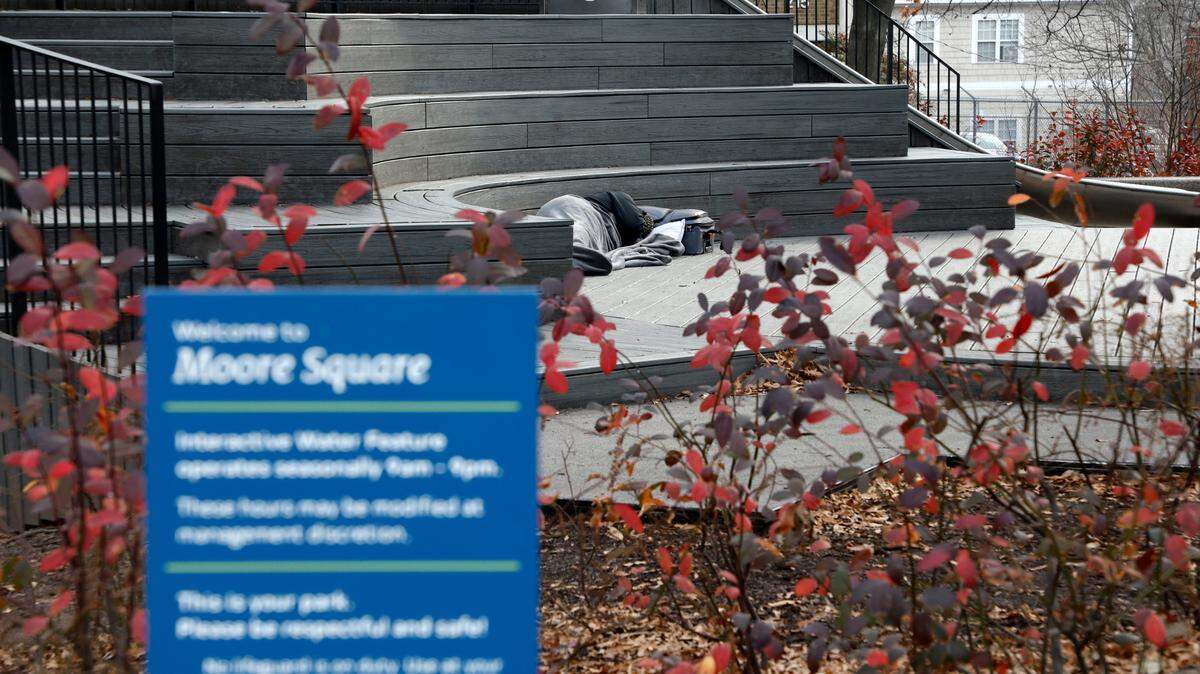
Sometimes it’s boxes of days-old pizza tossed out of a van onto the sidewalk at Moore Square.
Other times it’s organized churches, nonprofits or groups of people serving hot, healthy meals at the downtown Raleigh park.
The food meant for people who are homeless arrives sporadically. Sometimes, for weeks at a time, no food arrives. Other times multiple groups show up on the same day.
“It’s the wild, wild west,” said Troy Burton, acting assistant director of Raleigh’s Parks, Recreation and Cultural Resources. “It’s all over the map.”
‘Biscuitgate’
City rules require groups that want to distribute food or meals at parks to get an $800 permit.
In 2013, the city made national news when police officers threatened to arrest volunteers for passing out 100 sausage biscuits near Moore Square. The “Biscuitgate” incident spurred the eventual creation of Oak City Cares, first located near Moore Square and now on Wilmington Street next to the men’s homeless shelter.
That move coincided with the city’s two-year renovation of Moore Square, and permits have been issued inconsistently and hardly ever since the COVID-19 pandemic.
Now, Raleigh is considering a new permit to distribute food at the park, just one of several measures the city may adopt to address crime, harassment and other problems there..
“In some ways it is 2013 all over again,” Burton said. “We’re just trying to figure out what is a way to effectively manage the park and protect the asset that the citizens have put a lot of time, energy and money into while balancing this real, palpable need of our most fragile folks in our community.
The city’s goal, he said, is logistical. It wants to make sure there are enough trash cans for leftover food and that multiple groups don’t come at the same time.
“We would like to figure out a solution that, you know, might not get everything solved but maybe gets us down the road to working,” Burton said. “Because right now it really isn’t.”
During a recent meeting, City Council member Stormie Forte said many nonprofits and churches are worried about the growing homeless population and see providing food as one way to help them. Any new rules should be the least restrictive possible, she said.
The City Council hasn’t taken action on a new food-distribution permit, and there is no timeline for enacting one.
‘Free speech zones’
Raleigh is also considering “free speech zones” at Moore Square like some college campuses and political events have.
“We understand Moore Square Park has traditionally been an area for the public to express their views, what we in this country consider the right to petition,” Burton said. “We understand it. We respect it. We are absolutely are in favor of the history and expression of that.”
The city designed the southwest corner at Blount and Martin streets as a promenade entrance to the park. That large entrance also was designed to allow ambulances or police vehicles into the park, but the groups that gather there often block that safety route, Burton said.
“Would [a free speech zone] solve all the issues we have as it relates to the practice of petition right now at Moore Square Park? Probably not,” he said.
The City Council approved new rules to address harassment after complaints at Moore Square and other places earlier this year.
Litter, graffiti, biohazards
Raleigh also added new security cameras and doubled its daily cleanings at the park. Off-duty police officers and private security are called in for special events and programs, and the city just posted signs listing the park rules.
There’s already a team that cleans downtown Raleigh every day starting at 6:30 a.m., focusing on litter, small graffiti, stickers and biohazards.
So far this summer, the team has:
- Patrolled more than 3,250 miles
- Removed more than 160 gallons of litter
- Swept 1,300 miles of downtown streets
- Power washed 80 blocks
- Removed 92 large graffiti pieces
- Responded to 98 biohazard complaints
‘Who are we designing downtown for?’
Earlier this month, Mayor Mary-Ann Baldwin told The News & Observer that the city will hire private security officers to patrol parts of downtown to supplement local police efforts.
That news surprised some council members.
“There have been a lot of conversations out there on the Internet, on Facebook, in the paper about what we are up to,” said Council member Jane Harrison. “If you didn’t hear it at council it isn’t a council decision.”
When Council member Mary Black learned about the private security from media reports, she said she told her fellow council members that an “increased police state downtown” made her uncomfortable.
“No one has ever really meaningfully addressed the safety that Black, brown, people of color feel in a heightened police state,” she said.
“Who are we designing downtown for? And who do we want to feel safe there?” she asked. “If we are not looking at other options besides just police presence without also looking at policy or police protocols then I think we are doing a disservice, specifically to our Black and brown downtown goers.”
‘Wanting to see more officers’
Policing also came up at a recent neighborhood meeting at Barwell Road Community Center, in southeast Raleigh, said Mayor Pro Tem Corey Branch.
“The conversation they had was actually (about) speeding and wanting to see more officers,” he said. “So I think we have a community in the city that it depends on what day and who you ask how they see or how they view things.”
“I think we need to have that holistic conversation overall,” Branch said. “But I do want to uplift what that community, majority minority, asked for.”
Harrison said she was looking forward to a council conversation around this “very complex and sensitive topic.”
“I do recognize that we have different lived experiences in this space, different needs and concerns,” Harrison said. “What I always think about are how do we implement solutions to [address] the root causes of crime or public safety concern?”
This story was originally published September 26, 2023 at 5:30 AM.