Capital Blvd freeway, other Triangle highway projects face more delays. Here’s a list.
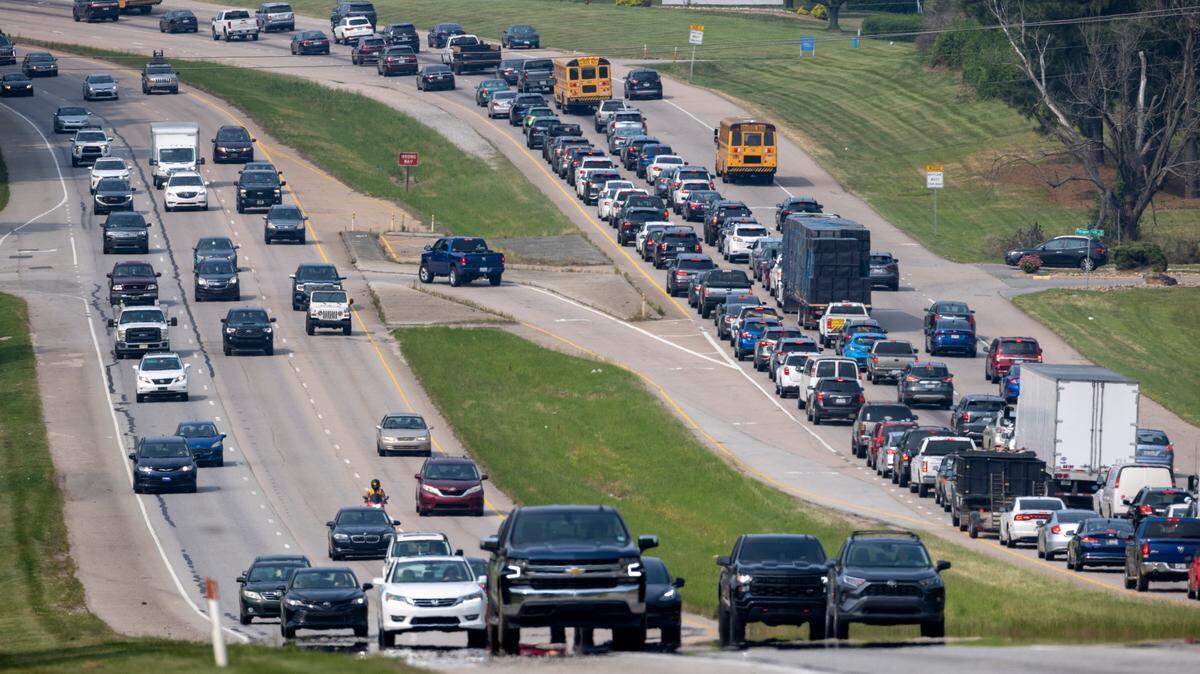
The state’s plan to turn a congested stretch of Capital Boulevard into a freeway north of Raleigh may be delayed again, along with several other big highway projects in the Triangle.
A proposed update to the N.C. Department of Transportation’s 10-year plan would push back the Capital Boulevard project five years, to 2031. That’s a decade later than NCDOT initially expected when it unveiled plans to turn the road into a six-lane freeway from Interstate 540 north through Wake Forest.
NCDOT says rising costs are forcing it to put off dozens of projects across the state.
“The main culprit for the delays is the inflation that we’re all seeing,” Transportation Secretary Joey Hopkins told lawmakers last week. “We’re all paying more for goods that we’re buying at the grocery store. Everything that we buy is costing us more. Our project costs have gone up with that.”
Rising construction costs are a national problem, according to Leigh Wing, NCDOT’s director of planning and programs. The U.S. Department of Transportation’s National Highway Construction Cost Index, a measure of inflation in road building, has increased 67% in the last three years, Wing said, compared to 22% in the previous 14 years.
“This is construction,” she said. “We’ve also seen right-of-way and utilities increase as well.”
NCDOT is seeking public feedback on a plan it calls the STIP, the State Transportation Improvement Program. Updated every two years, the STIP lists thousands of transportation projects the department plans to spend money on in the coming decade. The latest version will cover 2026 through 2035.
The update provides new schedules and cost estimates for many long-planned projects. In many cases, that means more delays for work that was already previously postponed. The proposed local changes include:
▪ The conversion of U.S. 70 into a freeway between I-540 at Brier Creek and T.W. Alexander Drive delayed two years to 2030.
▪ The widening of U.S. 64 in Cary and Apex, including the conversion of intersections into interchanges between U.S. 1 and Laura Duncan Road, delayed two years to 2032.
▪ The widening of U.S. 64/264 to six lanes between Wendell Boulevard and the split at Zebulon pushed back to sometime after 2035.
▪ The widening of Interstate 885 between Research Triangle Park and the N.C. 147/Durham Freeway delayed one year to 2030.
▪ The widening of N.C. 42 west of Clayton in Johnston County delayed two years to 2031.
▪ A planned interchange where U.S. 64 meets N.C. 751 in eastern Chatham County delayed three years to 2032.
▪ Widening I-85 between Durham and Hillsborough delayed beyond 2035. Upgrades to the South Churton Street interchange and widening of the street pushed back two years to 2033.
Hopkins says in the face of inflation, NCDOT is trying to better manage expenses. It has improved its forecasting process, though as often as not that results in higher estimates. He said the department has also begun giving contractors incentives to cut costs, by sharing some of the savings with them, and says department leaders more closely monitor what things cost.
“They see those now on a monthly basis when those cost estimates change,” he said. “We can ask our project teams, ‘What happened and why did that happen? What can we do to mitigate that?’”
A freeway many see as long overdue
Rising costs have plagued the Capital Boulevard/U.S. 1 freeway project. In 2018, NCDOT estimated the 10-mile highway would cost about $465 million. By 2023, that estimate had climbed to $750 million.
Now the latest draft of the STIP puts the cost at $1.34 billion, a big factor in the continued delay. Because of competition from other projects across the state, NCDOT broke the freeway into four parts and proposed to start with the first leg, between I-540 and Durant and Perry Creek roads in Raleigh. That 1.5-mile section alone would cost about $516 million, NCDOT now says.
To many commuters, the freeway is long overdue. As Capital Boulevard/U.S. 1 heads north, it narrows from three lanes to two at I-540, where traffic from RTP and Raleigh merge. Busy most any time of day, the highway especially bogs down in the afternoons and evenings and at traffic lights.
NCDOT’s solution is a 10-mile freeway, six lanes wide with a concrete median and a speed limit of 65 mph. Instead of intersections with traffic lights, there would be four new interchanges at Durant/Perry Creek roads, Burlington Mills Road, Falls of Neuse Road/Main Street and Purnell/Harris roads.
Other streets that now intersect with U.S. 1 would lose that direct connection. New access roads would reach homes and businesses that now have driveways on Capital.
Building the freeway has been a top goal for the Triangle’s business community, says Joe Milazzo, executive director of the Regional Transportation Alliance, a program of the Greater Raleigh Chamber of Commerce.
The alliance has pushed NCDOT to accelerate construction by turning the completed highway into a toll road. NCDOT, through the N.C. Turnpike Authority, would be able to borrow the money it needs for the project and pay it back with future toll revenue, much the way it has financed and built N.C. 540, the Triangle Expressway, in southern Wake County.
“Capital Boulevard is already a ‘toll’ road. It is taking a toll on our sanity and on our ability to get to places in a reasonable amount of time,” Milazzo says. “We are supporting the accelerated creation of a new, reliable, signal-free option.”
A study of how tolls might work is underway, at the request of the Capital Area Metropolitan Planning Organization, which helps set transportation priorities for the region.
NCDOT will accept comments on the proposed 10-year STIP through April 4. For more information, go to www.ncdot.gov/initiatives-policies/Transportation/stip/.