They brought a symbol of Cold War communism to the Triangle and made it run again
AI-generated summary reviewed by our newsroom.
- Father and son in Apex restored a rare East German Trabant into driving condition.
- Only two Trabants are registered in North Carolina, highlighting their rarity.
- The Trabant draws attention at local car events, sparking nostalgia and curiosity.
It was “Corvette Day” at Cars & Coffee Morrisville, the Saturday morning gathering that each month draws thousands of auto enthusiasts to an office park off Page Road near Research Triangle Park.
Sports cars lined the parking lots, with super chargers, spoilers and racing stripes. Engines revved or rumbled as cars came and went or their owners showed off for admirers.
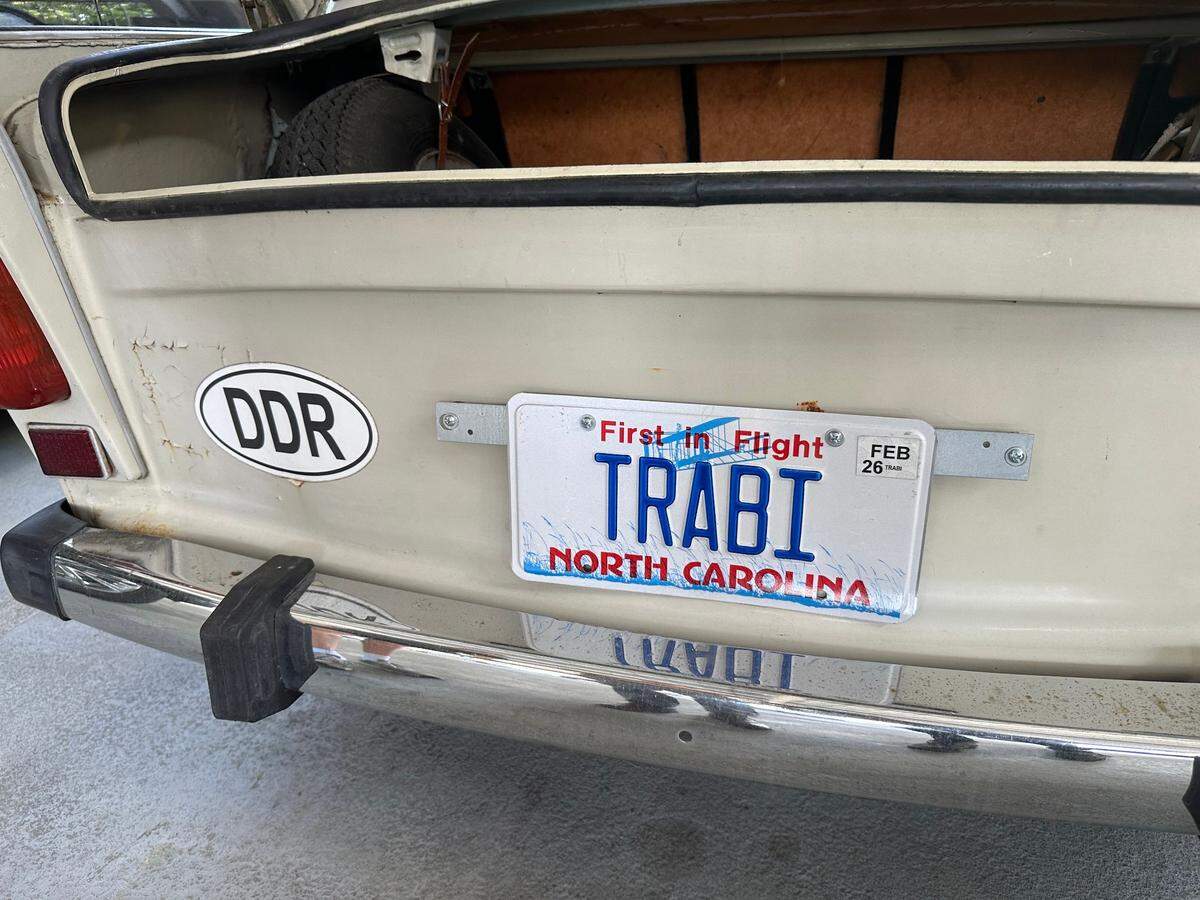
Amid all that automotive testosterone, Mitch Armbruster of Apex and his son Noah stood next to their Trabant, a Cold War relic from East Germany that they bought two years ago and returned to running condition. The diminutive, 60-year-old Trabant, with blemished papyrus white paint and a DDR sticker on the back, was something different.
“I know there’s a lot of souped-up stuff here, and I like checking that stuff out,” Mitch said. “But I always like finding the weirdest things. When we come to Cars and Coffee, we know we’re going to be one of them.”
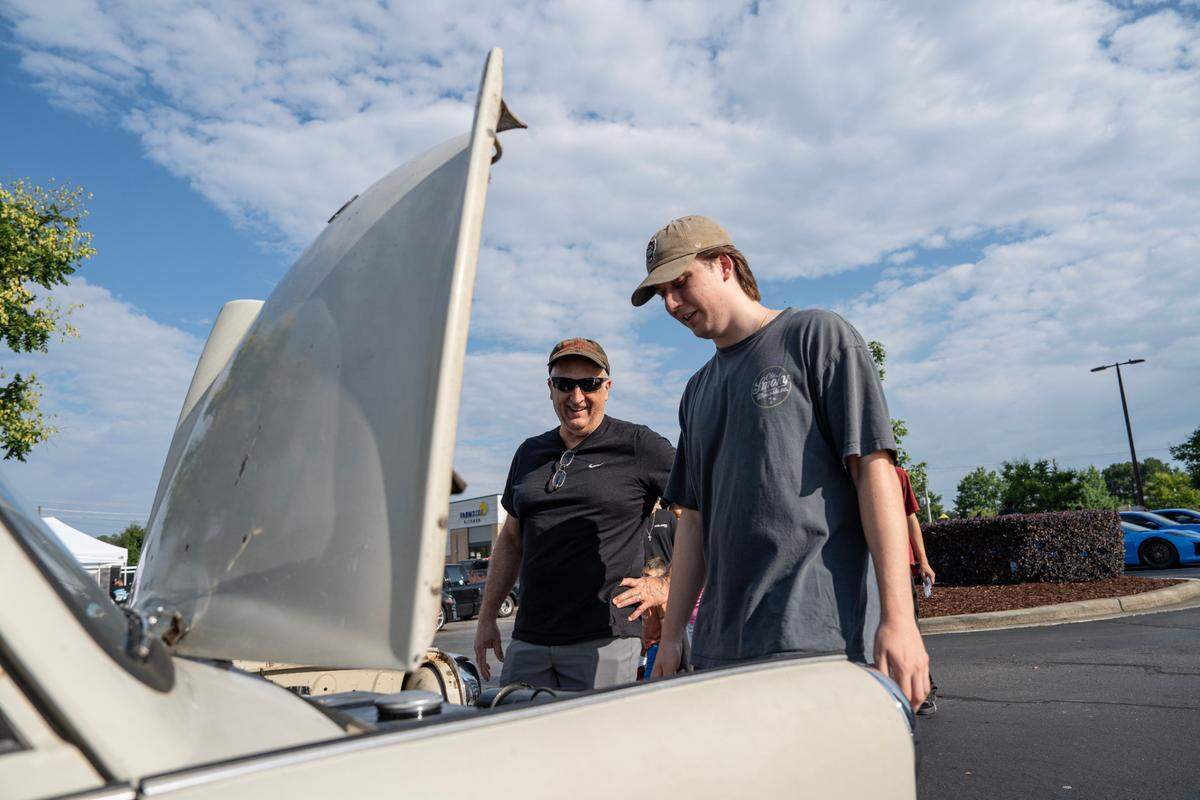
The Trabant is a father-son project. Noah, who graduated from N.C. State University in May with a degree in computer and electrical engineering, had driven one on a trip to Berlin and thought it would be cool to buy and restore one. His father, a lawyer in Raleigh, relished the time working with his son.
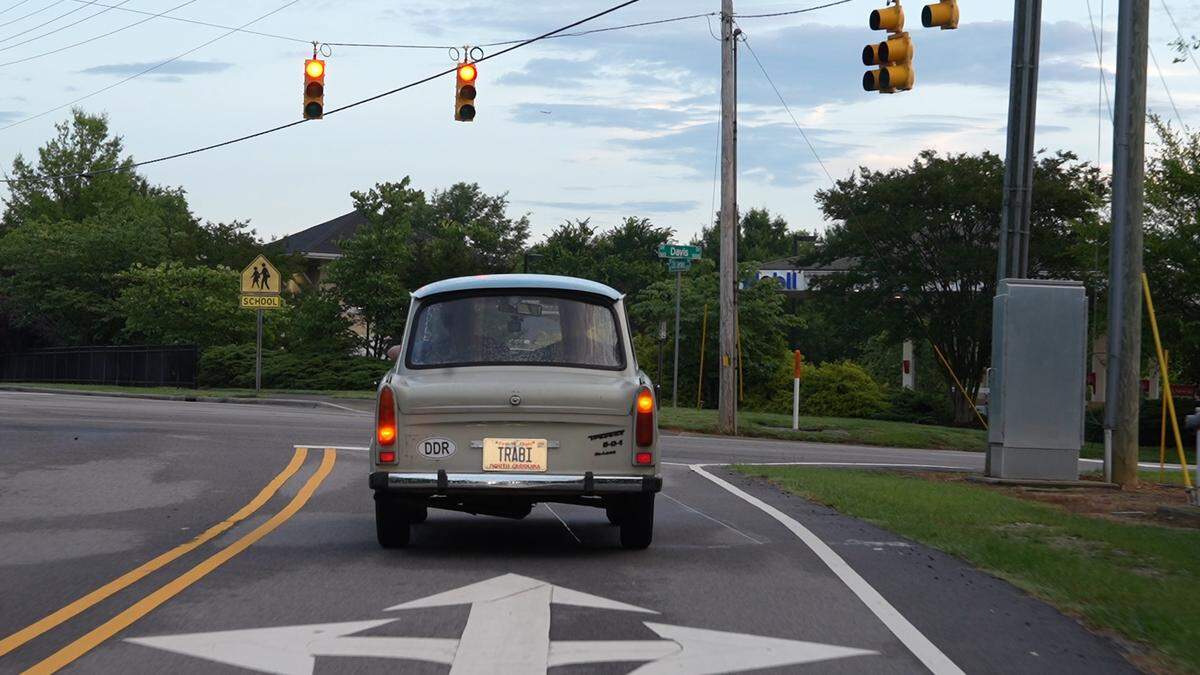
They’re stewards of an unusual piece of history. More than 3 million Trabants were produced in the former East Germany from 1957 to 1991, a year after reunification. Among the enduring images of the end of communism in 1989 were Trabants streaming through the Berlin Wall and a man hoisting a sparkling wine bottle out the passenger window of one on the Autobahn.
To people in the West, the no-frills cars became synonymous with the deprivation and conformity of Soviet-era communism.
“But to the people I’ve met who grew up in the Eastern Bloc, to them it really is a symbol of freedom,” Mitch said. “They had the freedom to get around, to have a vehicle, the only thing they could get. Even though it was a crappy car, it was their car.”
A car that looks familiar but isn’t
A Trabi, as they are affectionately or derisively known, has more in common with a lawnmower than a car.
It’s powered by a two-stroke engine that takes a leisurely 21 seconds to reach a top speed of about 60 mph. You must mix oil with the gas, which helps create the tell-tale blue-grey smoke from the tailpipe. Because of steel shortages in East Germany, the state-owned manufacturer made the car’s thin shell from Duroplast, a hard plastic composed of waste cotton and resin.
It has seat belts, but no head rests or other safety equipment. It’s roadworthy, but not something you want to risk an accident in.
“It’s going to lose a battle to any other car,” Mitch said. “So just our own internal rule, we don’t take it on the interstate.”
People unfamiliar with the Trabi liken them to the British Leyland Mini driven by comedian Mr. Bean or a Ford Anglia, the flying car in the Harry Potter movie.
At Cars & Coffee, Bart Latamud of Fayetteville thought at first he was looking at an old Škoda from Czechoslovakia. Pleased to be mistaken, Latamud, an Air Force veteran, said he had seen a Trabant in the museum at Wright-Patterson Air Force Base in Ohio.
“This is the first time I’ve ever seen one in the wild,” he said.
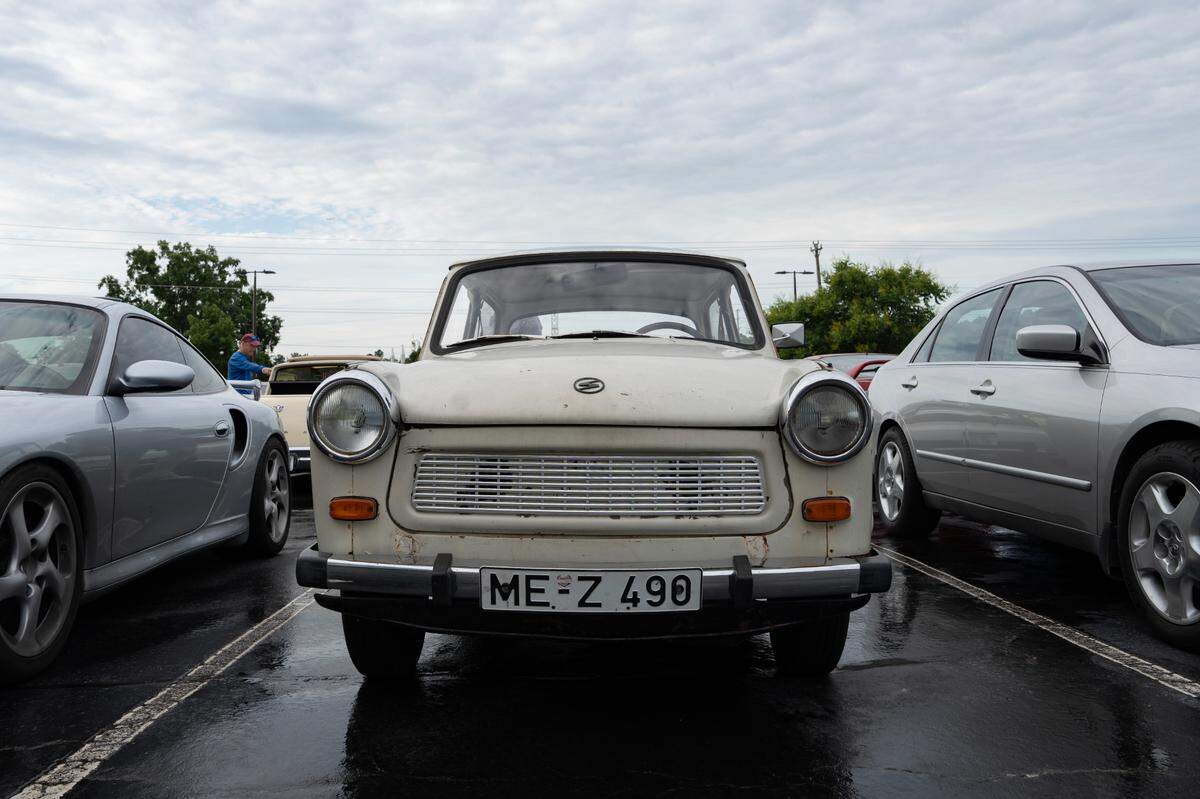
Trabis are rare in the United States, though the exact number is unclear. Two are registered in North Carolina, according to the Division of Motor Vehicles — the Armbrusters’ and one in Henderson County.
Nick Staup, founder of the North America Trabant Owners Club, estimated there are 100 in the U.S., then asked members of the club’s Facebook group what they thought. Some suggested 200 to 300, but no one knew for sure.
Staup, who has owned two Trabants and lives in Florida, said people like the cars because they’re quirky and fun to own and drive. He says if he’s in a hurry to run an errand, he knows not to take the Trabi, because people will inevitably want to talk to him about it.
“I get stopped almost every single time by someone who is, ‘Just what is this?’” he said. “Or next thing you know I’ve got someone from Hungary or Poland who just has tears welling in their eyes in nostalgia.”
Father and son are their own mechanics
When Noah and Mitch Armbruster went looking to buy a Trabant, they found one listed online in Louisiana. It was a Trabant 601 deluxe, with upgrades such as a real chrome bumper and a glacier blue roof.
The man wanted $3,000. But when he met the Armbrusters, he said he would take $2,600 because in Noah he saw a young man who was passionate about the car.
It took the Armbrusters six months to get the car running. There are no Trabant mechanics in the U.S. But the cars are simple, and the internet is full of how-to videos and guides and other Trabant owners willing to share their advice.
Finding parts can be an adventure. To replace the brakes, the Armbrusters needed a special tool that they eventually found on a German version of eBay.
For the most part, though, they’ve been able to improvise. The car’s tires were made for trailers, the horn is for a motorcycle and the six-volt battery is the kind used in golf carts.
Trabants looked essentially the same for their entire 34-year run, so a particular car’s age is not immediately apparent.
But there were some internal changes over the years that suggest to the Armbrusters that theirs was built in 1965. Evidence includes the car’s air handling system: A driver must open the hood and move a hose to let in air either directly from outside or heated by the engine. Later models let drivers switch the source of air internally, though there never was air conditioning.
There’s also no gas gauge. The gas tank is under the hood, next to the engine, and drivers must use a dip stick to see how much is left, though a small auxiliary tank kicks in when the main one goes dry.
An unusual car that turns heads
On a recent drive through Raleigh, Noah demonstrated the four-speed shifter on the Trabant’s steering column, a lost-skill that he taught himself before driving one in Berlin. The car rattles as he drives, and at about 30 mph, the hood begins to bounce.
“It’s really locked in there, but it does move around a bit,” he said. “When it gets up to speed, the whole thing shakes.”
People on sidewalks stopped to look and smile as the Trabant passed. One guy flashed a hang ten sign.
“People are excited to see it,” Noah said. “And I’m excited to bring joy to the world when I drive it around.”
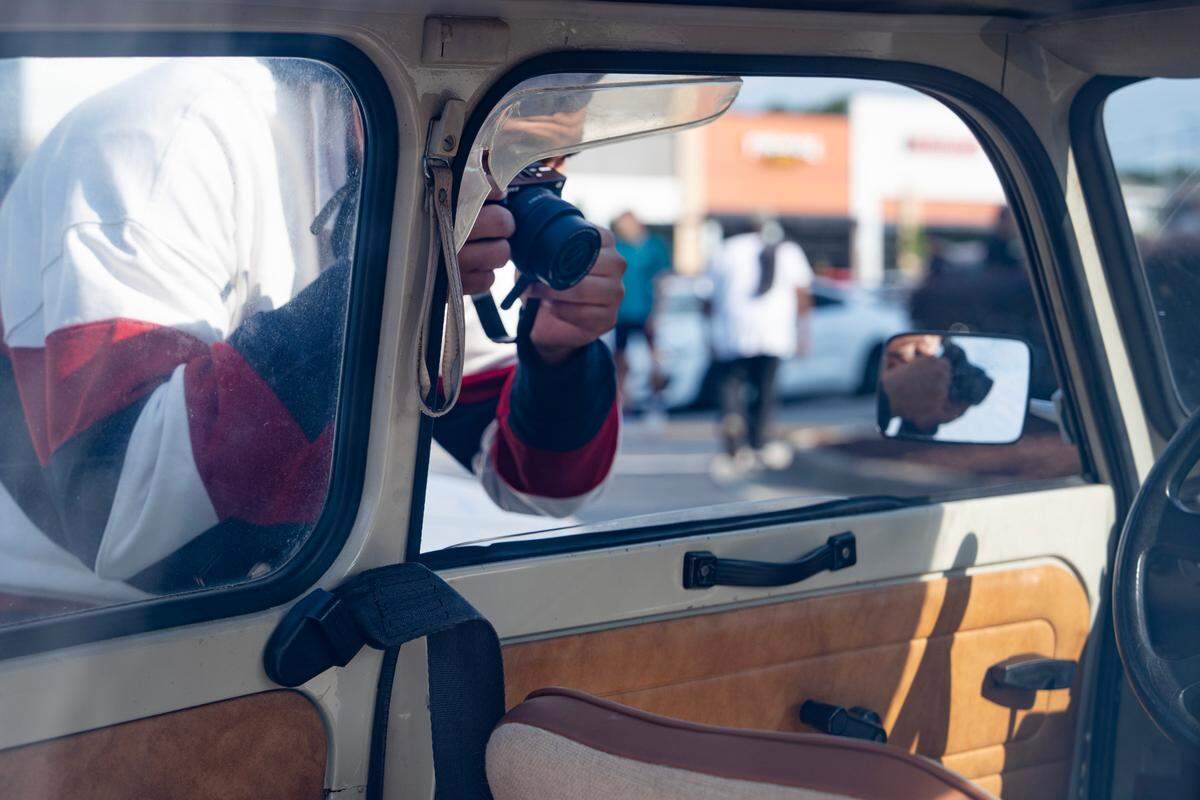
The Trabant drew plenty of attention at Cars & Coffee, especially from those who know the car. Hamish Stevens of Holly Springs was born in Mecklenburg-Vorpommern, north of Berlin, well after the wall came down, but he remembers seeing Trabants on the road as a small boy.
“They started dying out because, much like Yugos, they were really bad cars,” said Stevens, 19. “But you did see the occasional one every now and then.”
Bre Wakefield of Cary lived in Germany for three years and brings her 1968 Volkswagen Karmann Ghia to Cars & Coffee. Wakefield recognized the Trabant right away.
“This is fun,” she said. “This is why we come to Cars & Coffee. Not for the Corvettes.”
Uniquely NC is a News & Observer subscriber collection of moments, landmarks and personalities that define the uniqueness (and pride) of why we live in the Triangle and North Carolina.
This story was originally published July 15, 2025 at 10:49 AM.