
Raleigh’s second bus rapid transit line will require sacrifice from property owners
AI-generated summary reviewed by our newsroom.
- Raleigh plans 5.1-mile southern BRT along Wilmington Street to Garner Walmart Supercenter
- Extension of Wilmington Street threatens three shopping centers
- Estimated cost $220–240M with $86M federal pledge; design completed by summer 2027
As construction begins on Raleigh’s first bus rapid transit line along New Bern Avenue, planning for the second is well under way between downtown Raleigh and the Walmart Supercenter in Garner.
Unlike that first line, which follows New Bern Avenue, the southern BRT route involves building a new road that will cut through several properties, including three shopping centers. The owner of at least one of those centers is trying to persuade the city to avoid it.
Raleigh will hold the second of two public workshops on the southern BRT project on Monday, Nov. 17, from 5 to 7 p.m. at the Peach Road Cultural Center, 911 Ileagnes Road. It’s an opportunity to see and comment on preliminary plans for the route.
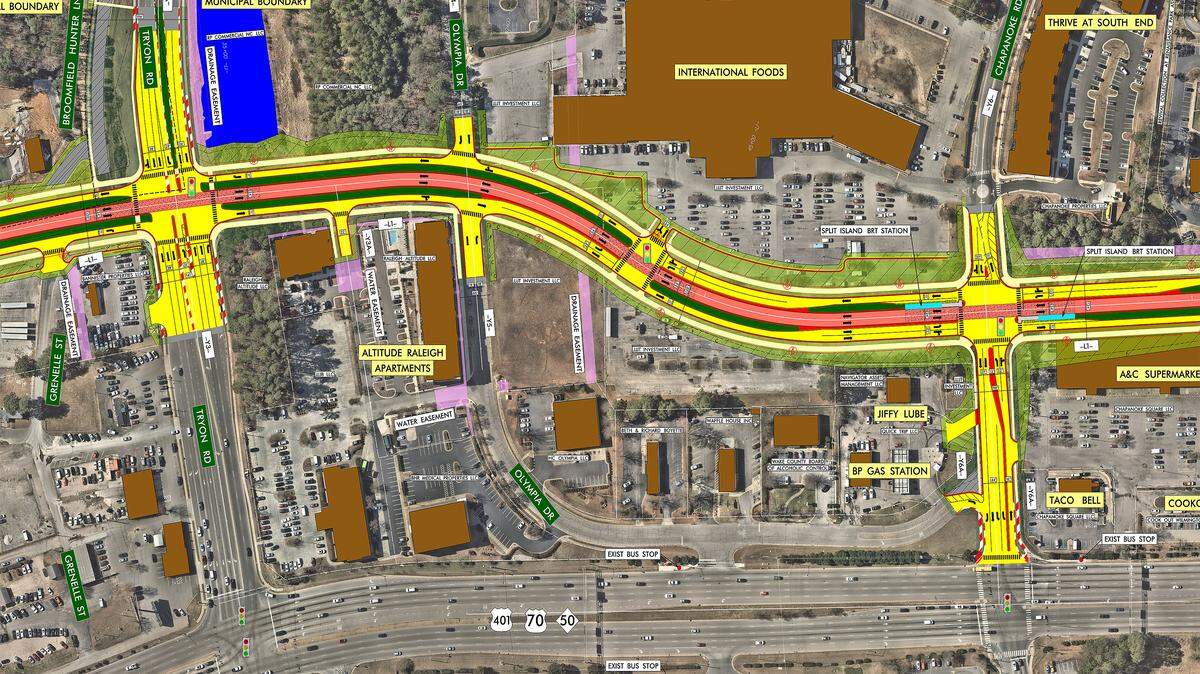
Those plans include extending Wilmington Street from where it now merges with South Saunders Street south of the Beltline. Wilmington would continue on a new path parallel to South Saunders across Tryon Road to Garner Station Boulevard.
The city has long planned to extend Wilmington Street south toward Garner, said Het Patel, Raleigh’s transit assistant director. As planners studied potential routes for the southern BRT line, they decided that the new street, parallel to busy U.S. 70/401, would serve transit riders best while building out the city’s street network, Patel said.
The city’s plans show Wilmington Street passing through the North Station plaza on Garner Station Boulevard, as well as through the building at Chapanoke Square that houses A&C Supermarket, Family Dollar and AutoZone.
David and Sol Dembinsky, the brothers who own Chapanoke Square, came down from their homes in New Jersey to see the city’s plans last week. They weren’t sure what it all means for them.
“If you’re asking what our thoughts are, we’re trying to figure it out,” David said.
“We don’t know yet what our options are,” Sol added. “We’ll work with them. If we’re compensated, no problem.”
Plan threatens 40 businesses and nonprofits, center owner says
Wilmington Street and the BRT line would also cross the parking lot of the shopping center that Tae Park has owned since 2007. Anchored by the International Foods grocery store, the plaza includes more than 40 tenants, most catering to Hispanic and Asian immigrants, including restaurants, salons, law offices, a walk-in clinic, a Pentecostal church and the Raleigh office of El Centro Hispano, the state’s largest Latino community organization.
Park says the city’s plan threatens those businesses and organizations.
“We are losing half our parking,” he said. “It’s going to hurt all those tenants, 100%.”
Park said he plans to submit a petition to the city to ask it to shift the road away from the lot or move the BRT line to South Saunders Street. He said he understands the city would compensate him for the property it would take but he’s more interested in serving his tenants and their customers and clients.
“Some people say, ‘OK, it’s a good opportunity to make money from the city.’ Not me,” he said. “Without receiving a penny, I’m happier.”
Patel, the transit assistant director, said the city is talking with property owners to find out how the new road and BRT line would affect their operations. He said the new road and bus line would also create opportunities to redevelop property in the corridor.
“We have looked at various iterations of how to thread the needle for a new roadway alignment that tries to minimize impacts,” he said. “But we also have been mindful of how it allows property owners to retain parcels that allow them to do some kind of redevelopment activity afterward.”
City plans four bus rapid transit lines
The southern BRT line would be 5.1 miles, mostly on Wilmington Street. Along 3.8 miles of the route, buses would have their own dedicated lanes. Plans call for 10 stations, including one downtown shared with the New Bern Avenue BRT line.
The city estimates the project will cost $220 million to $240 million, more than twice what it expects to spend building the New Bern line. The main reason for the higher cost is the Wilmington Street extension, Patel said.
The Federal Transit Administration has pledged nearly $86 million for the project; the rest would come from local sources, primarily Wake County’s half-cent transit tax that voters approved in 2016.
The city expects to finish the design and utility planning work for the southern BRT line by the summer of 2027, Patel said. Construction would begin when federal officials review the plans and release their share of the money, he said.
The Wake Transit Plan calls for four BRT lines radiating from downtown Raleigh. In addition to the New Bern line, which city officials say will be completed by summer 2030, two others are planned west and north.
The city expects to unveil preliminary plans for the western line next spring, Patel said. It would connect downtown Raleigh with downtown Cary and would also involve building a new stretch of road by extending Western Boulevard to Cary Towne Boulevard.
The city is in the early stages of planning the northern route, which would split north of downtown and extend both to the North Hills area and Triangle Town Center.
