
Raleigh father thought he’d die in a Georgia ICE facility. What happened next?
AI-generated summary reviewed by our newsroom.
- Benitez Diaz said the conditions of Folkston detention center were substandard.
- His wife gave birth while he was detained; ran his business while raising three kids.
- A judge blocked his attempt to stop the U.S. from removing him in March. He is appealing.
For a moment, Moises Benitez Diaz thought he was going to die.
Taken to a Folkston, Georgia, ICE detention center, Benitez Diaz said he was packed into tight quarters with more than 70 people. People were constantly getting sick. He vomited often.
One day, Benitez Diaz started choking on his vomit. He could barely breathe for two minutes. Other detainees called for a guard to help him.
“And the guard said, ‘OK, well, I’ll be there in a minute,’” Benitez Diaz said. “The guard never showed up.”
Benitez Diaz eventually got medical attention. By that point, though, he was feeling much better. It had been two and a half weeks since the worst of his illness.
U.S. Border Patrol agents arrested Benitez Diaz on Nov. 18, 2025, as he was working a construction job at Lightbridge Academy in Cary, The News & Observer previously reported. He was one of at least 370 people detained during an immigration sweep dubbed “Operation Charlotte’s Web” that started in Charlotte and came to the Triangle.
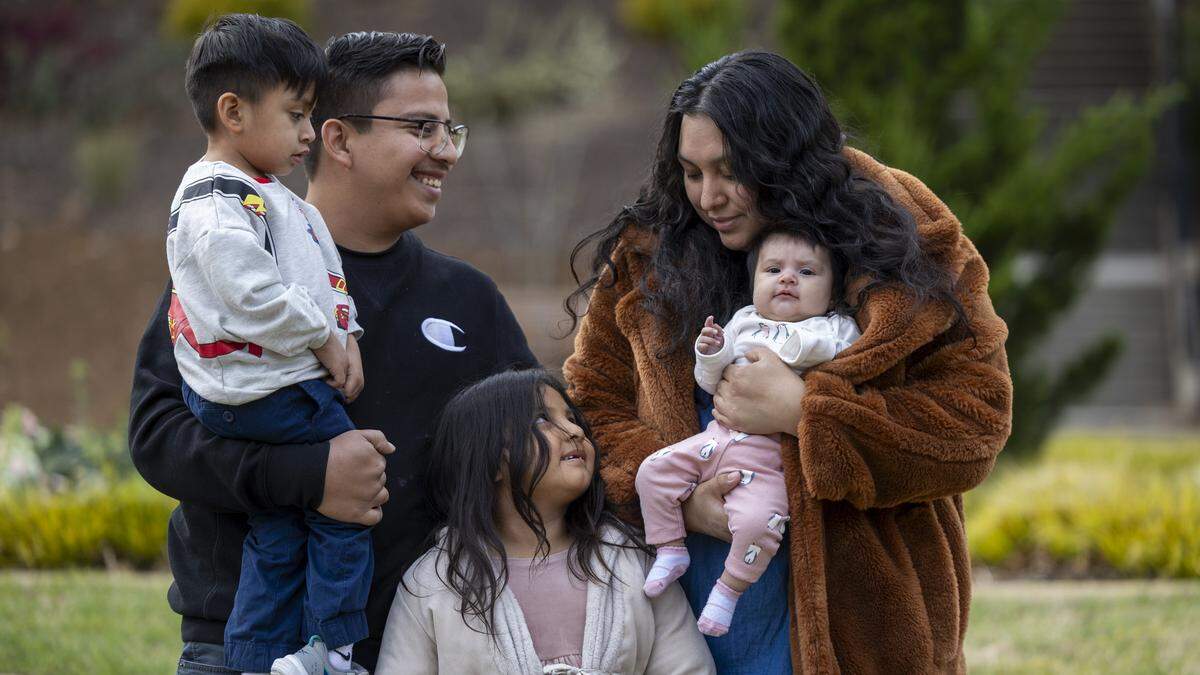
Benitez Diaz was held at the D. Ray James Processing Center in Georgia for the next three months. He was released Feb. 27 on an $8,500 bond. While in detention, Benitez Diaz missed the birth of his third child, Eliana, who was born on Dec. 9, 2025. Without him, his wife, Esmeralda Escobar, had to care for their three kids and run his construction business, Capitol Construction and Roofing.
Benitez Diaz and Escobar spoke to The N&O in March about Benitez Diaz’s experience in detention and how Escobar coped without her husband.
College dreams deferred
Benitez Diaz, 28, said he came to the Triangle with his parents from Mexico when he was 5 years old. During his senior year of high school at Wake Young Men’s Leadership Academy, he got a construction job at RCC Carolina to provide for his mother and eight siblings.
He worked his way up: first a framer, then an apprentice, then a foreman. But during the COVID-19 pandemic, work dried up and his hours were cut. So he took a risk and founded Capitol Construction and Roofing in 2020.
Benitez Diaz had little experience completing many of the skilled carpentry projects his clients asked for — only his memory of what other carpenters at his former employer had done. But he figured it out enough for his former boss, Chris Dupre, to tell The N&O in November few can do the carpentry work Benitez Diaz does.
The day he was detained
By Nov. 18, N.C. Gov. Josh Stein had said the Border Patrol’s “Operation Charlotte’s Web” was headed to the Triangle. Benitez Diaz still went to work that morning — wall renovations at Lightbridge Academy — precisely because everyone else was scared to go.
“I had a commitment to finish that job by a certain deadline,” Benitez Diaz said. “So as the owner, I felt responsible for going that day.”
Benitez Diaz and his brother Mario were completing the job when, he said, a black Chevy Suburban pulled up, followed by another SUV. Six Border Patrol agents popped out, and several others at the job site started running.
Immigration agents asked Mario and Moises in Spanish if they had papers. Moises said he asserted his right to remain silent.
“After that, one of the Border Patrol agents comes up to me specifically, and he says, ‘If you’re not going to cooperate, I’m going to take you for not cooperating,’” Benitez Diaz said.
Not long after, Benitez Diaz was handcuffed and put in the back of a gray Chevy Tahoe. As they rode, the agents came across a man with a baby in his arms. A good catch, one agent said. The other disagreed: If he dropped the baby while agents detained him, the media would be all over them.
“That made me cry even more just thinking about my kids and thinking about my baby that was going to be born pretty soon,” Benitez Diaz said.
In detention
Benitez Diaz entered another van in a Durham alley around noon, he said. From there, federal agents took him to a Wilmington jail, sent him on a plane from Charlotte to Jacksonville and put him on a bus to Folkston, where he stayed for the next three months.
In Folkston, so many people were being processed that Benitez Diaz said he and others had to sleep on the floor before they could get a bunk bed and clothing. Toilets regularly clogged, and the foul water spilled into the common area. The food sometimes had worms in it.
The GEO Group, which operates the D. Ray James Processing Center, did not directly answer The N&O’s questions about Benitez Diaz’s allegations but said in a statement its services are monitored by ICE, and the company resolves any concerns ICE brings up. ICE did not respond to The N&O’s request for comment.
“Health care staffing at GEO’s ICE Processing Center is more than double that of many states’ correctional facilities,” the company’s background on D. Ray James Processing Center reads.
A group of detainees had started a small prayer group by the time Benitez Diaz arrived and needed a preacher. So he stepped in, leading them through Bible passages of God releasing men from prison in various ways. Psalm 1 stuck with Benitez Diaz: It helped him believe if he remained grounded in his faith, the living waters of God would bear fruit in time.
“Even though I felt like I was broken, I was trying to help them be lifted up in some sort of way,” Benitez Diaz said.
At a hearing on Dec. 30, 2025, Benitez Diaz said he was denied bond when the immigration judge cited the Trump administration’s position that people like Benitez Diaz who entered the U.S. illegally could not be granted bond.
A California federal district court ruled on Dec. 18, 2025, that people who entered the United States illegally could receive bond, but a federal appeals court temporarily stopped the district court’s ruling from coming into effect nationwide on March 6.
Benitez Diaz applied for a writ of habeas corpus — effectively asking a judge to rule his detention illegal — in January. A federal court ruled that an immigration judge could grant him bond, so he got a second bond hearing. But a judge denied Benitez Diaz bond, concluding his traffic violations made him a danger to the community.
Court records show two traffic violations for Benitez Diaz: one for driving without a valid license in 2019 and one for unsafe tires in 2022.
The N&O made several attempts to reach Benitez Diaz’s lawyer, Ana Nunez, to discuss his case. She has yet to respond.
Back at home
Without Benitez Diaz in Raleigh, it was up to his wife, Escobar, and his brother, Mario, to run Capitol Construction and Roofing. But Escobar also had her two kids and a baby on the way to tend to. And herself.
The thought of giving birth without Benitez Diaz by her side spiked Escobar’s blood pressure. On Dec. 5, Escobar texted an N&O reporter that Benitez Diaz had told her he had maggots in his dinner and that “he didn’t notice until it was too late.” The same day, Escobar went to the hospital, not feeling well.
Nonetheless, Escobar gave birth to a girl, Eliana, on Dec. 9. But Eliana spent the next 21 days in the neonatal intensive care unit. Benitez Diaz said she was diagnosed with a grade two heart murmur.
When Eliana came home, Escobar now had to raise the children and figure out all the behind-the-scenes work of Moises’ business. Capitol Construction and Roofing lost a contract while Escobar split her time between the NICU and home and, by mid-January, all that Escobar had to pay employees was whatever was left in the bank.
Escobar never told her eldest daughter, Rochelle, exactly where Benitez Diaz was. Nor did her family members or even her church when they prayed for him. As far as Rochelle knew, her dad was on a work trip.
“But I think that because he called her on the video app a lot, I think she kind of understood that he was somewhere where he couldn’t come home,” Escobar said.
But Escobar wasn’t completely alone. Her sister-in-law moved in. Construction superintendent Chris Dupre, for whom Benitez Diaz is a regular subcontractor, suggested Escobar start a GoFundMe.
She did, aiming to cover a lawyer’s $26,000 asking price and Benitez Diaz’s bond. The fundraiser reached over $38,000 in donations. Dupre told The N&O in November members of his church and former clients of Benitez Diaz donated hundreds to the GoFundMe. One former client paid the consultation fee for the lawyer Escobar has now, she said.
To help him get bond, Benitez Diaz’s former high school classmates wrote letters attesting to his good character, Escobar said. One classmate even brought dinner for Escobar and her kids: chicken tortilla soup and Tostitos.
But as months passed by with Benitez Diaz still in detention, Rochelle was diagnosed with depression, anxiety and stress eating, Benitez Diaz said. Their son, Elijah, was diagnosed with OCD and ADHD. And Capitol Construction and Roofing struggled to make payments on anything.
As rare as it was for Folkston detainees to be released, Benitez Diaz and Escobar needed a miracle. Soon.
A miracle
Benitez Diaz got a third bond hearing on Feb. 23. There, government lawyers — as they had previously — argued he was a danger to society because of two felony larceny charges in 2022. Benitez Diaz said the charges came from a misunderstanding.
In 2022, Benitez Diaz offered to take a warehouse’s scraps from its yard and sell them. A warehouse worker told him it was OK. One day, he took a couple of empty containers that were not scraps, and the warehouse owner, who never authorized the worker to give scraps away to begin with, reported the containers stolen.
When Benitez Diaz went to the scrapyard the next day, police interrogated him and called the owner, he said. He returned the containers and explained what had happened, he said. The owner declined to press charges, and the charges were dismissed.
The N&O previously reported Benitez Diaz completed a misdemeanor diversion agreement to dismiss one count of misdemeanor possession of stolen goods.
Still, Benitez Diaz said, government lawyers tried repeatedly to use the charges against him, and the U.S. Department of Homeland Security highlighted the charges in a November press release touting Operation Charlotte’s Web catching the “worst of the worst.”
“It was hard to see me being posted on a website that said that I had two felony charges, which is really a misrepresentation of what happened, but also a misrepresentation of who I am,” Benitez Diaz said.
At the Feb. 23 bond hearing, Benitez Diaz’s lawyer successfully deflected the dismissed charges, he said. And the judge, having read letters of support for him, believed Benitez Diaz was a benefit to his community. The judge granted Benitez Diaz bail of $8,500.
To get Benitez Diaz back to North Carolina, though, Escobar had to post bail in person. She drove over 400 miles from Raleigh to Atlanta on Feb. 27, taking Benitez Diaz’s sister and her boyfriend with her. The bond could only be paid with a check from a U.S. citizen. (Escobar is a U visa holder.)
The crew got to Folkston around 5:50 p.m. After five or six calls, the detention center staff confirmed Benitez Diaz would be out shortly.
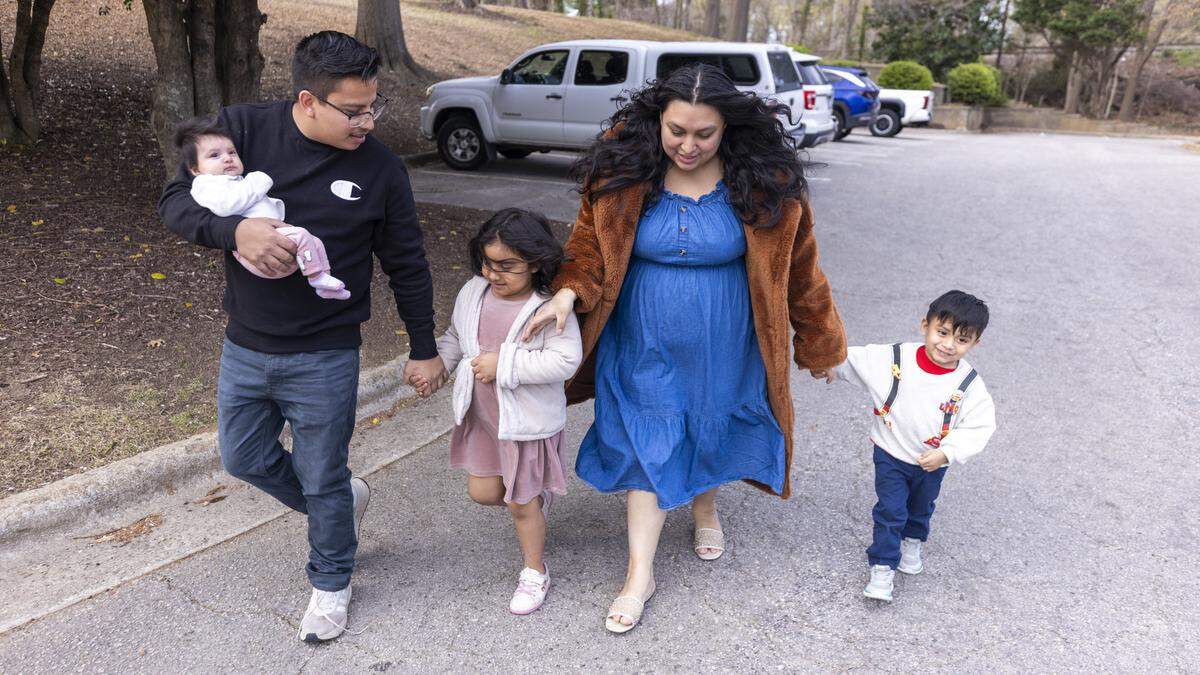
Escobar then heard doors open, and the two were reunited. Baby Eliana saw her father in the flesh for the first time, bringing him to tears.
“In the video call, she looked so much bigger,” Benitez Diaz said. “I had missed two months of that time of being with her, but when I held her, she was so much smaller, and she was such a baby.”
An uncertain future
Benitez Diaz is now fighting to stay in the U.S. on two fronts. The first is applying for a cancellation of removal to stop the federal government from deporting him.
Benitez Diaz said a Georgia judge denied his application in March because of his dismissed felony charges, that he didn’t apply for the U.S. Selective Service — demonstrating a lack of moral character — and that his removal from the United States would not cause his family hardship.
The last one shocked Benitez Diaz. In addition to Rochelle and Elijah’s mental health diagnoses and the stress on his wife, Eliana was diagnosed with a grade two heart murmur. None of it convinced the judge. Benitez Diaz appealed the decision, hoping to move the case to North Carolina.
The second front: gaining legal status. Through her U visa, Escobar can file an I-929 form for a qualifying family member, like a spouse, to obtain permanent residency. Escobar said she filed the form in January, but DHS informed her processing it could take up to three years.
As someone who came to the U.S. as a minor, Benitez Diaz was eligible for the Deferred Action for Childhood Arrivals (DACA) program. In an April text message to The N&O, Benitez Diaz said his parents were not well-informed at first, believing DACA would cause immigration trouble and not protect him from being detained.
Benitez Diaz’s parents started helping him apply for DACA in 2017 — around the same time ICE detained his father, Benitez Diaz wrote. His family focused first on getting his father released — he got out after three months in custody — then sought a pro bono lawyer to file Benitez Diaz’s paperwork.
A few days after Benitez Diaz applied, U.S. Citizenship and Immigration Services (USCIS) stopped accepting new DACA applicants, and USCIS never processed his application, Benitez Diaz wrote.
For now, Benitez Diaz’s future in the U.S. remains uncertain. Nightmares tether him to the past. When he sleeps, he can still feel the handcuffs officers put on him the first night — they were so tight.
But Benitez Diaz salvaged positives as he looked back. He made friends with those he met in detention. A Colombian man named Camilo who sought asylum after he and his family got death threats for his political activity. A man in his 60s, Benjamin Huerta, who Benitez Diaz said became like his grandfather. Even with his own case, he’s still helping Huerta and others find representation.
While he was detained, Escobar read to him over 15 letters of support that his former teachers and classmates wrote for him. They made him cry. As he looks forward, those letters give Benitez Diaz the confidence he can prove his moral character to a court.
“They wrote them with so much passion that it made me realize that I really had impacted their life just [like] they had impacted mine,” Benitez Diaz said. “That our connection and our bond wasn’t just momentary, but it was a lifelong connection.”
In the Spotlight designates ongoing topics of high interest that are driven by The News & Observer’s focus on accountability reporting.
This story was originally published April 17, 2026 at 5:30 AM.
.jpg)