Opponents urge Wake commissioners to block WakeMed merger with Atrium Health
AI-generated summary reviewed by our newsroom.
- Opponents warned the WakeMed–Atrium merger could raise local health costs.
- Brown report says the merger could reduce WakeMed's charity care.
- Wake commissioners delayed a decision for 90 days to let WakeMed answer questions.
Wake County commissioners on Monday heard two contrasting visions for what WakeMed’s proposed merger with Atrium Health would mean for the community.
Supporters, including an ICU doctor and WakeMed executives, said joining with a larger nonprofit would allow WakeMed to continue performing its role as the county’s safety-net medical center that treats people regardless of their ability to pay.
“It’s essential for our county — for future growth, for the quality of life for all residents — to make sure that there is an adequate safety net that is growing,” said Pete Tannenbaum, executive director of Alliance Medical Ministry, a nonprofit clinic based in Southeast Raleigh. “And that’s why I’m in favor of this proposed merger. It allows WakeMed to grow and to serve our growing county.”
But a coalition of community groups say they think the combination would lead to higher healthcare costs, the potential loss of local control and less care for low-income or uninsured patients. They call the proposed merger a “takeover” by the Charlotte-based nonprofit and urged commissioners to block it.
“By now the public has had the opportunity to review it,” said the Rev. Frank White of Antioch Bible Fellowship in Raleigh. “And many of us believe at the end of the day this is a rotten deal for us and our community.”
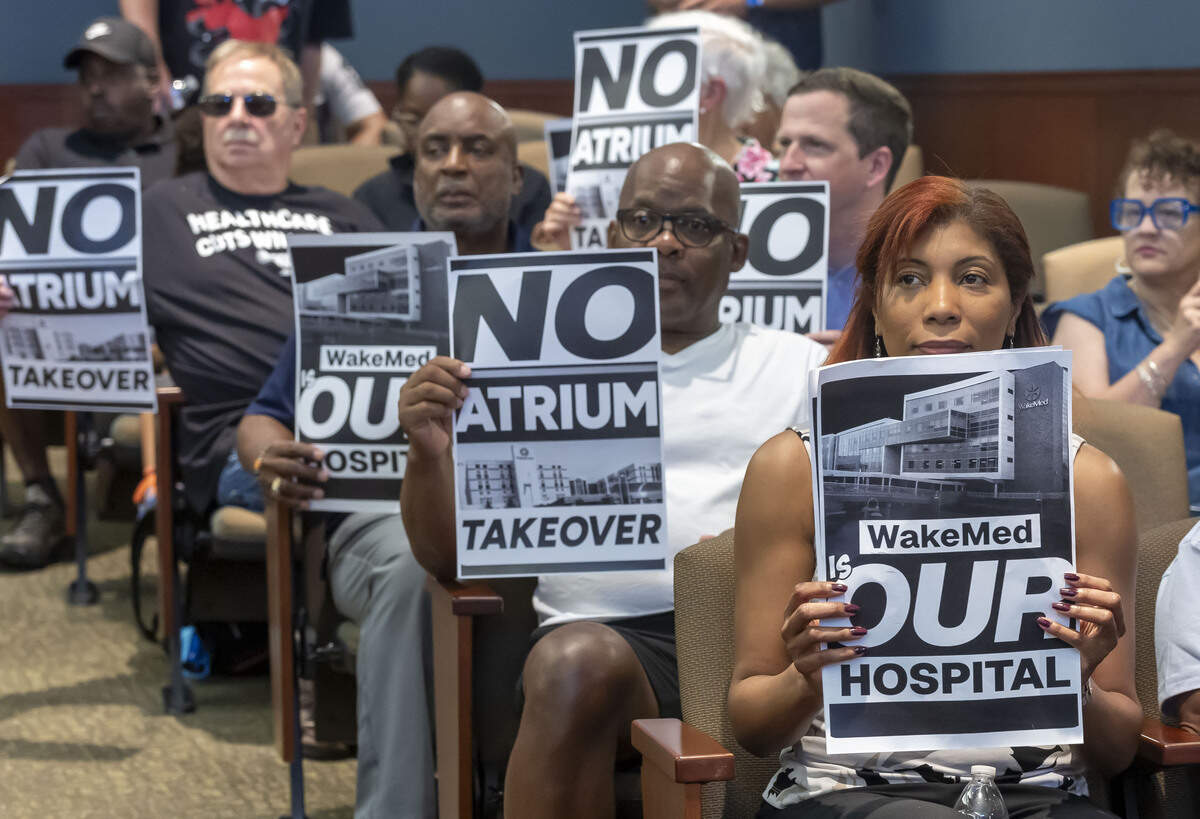
Before the merger can proceed, WakeMed needs Wake commissioners to approve changes to the documents that allowed the county-owned Wake Medical Center to become a private nonprofit in 1997. Those changes were before the board on May 4, but it opted to delay a decision for 90 days to give WakeMed more time to answer questions. No vote has been scheduled.
Early on, county officials downplayed their role in approving the merger; the document changes appeared on the board’s consent agenda, normally reserved for routine items that don’t require public discussion.
“A consent agenda is for fixing potholes,” said the Rev. Rob Stephens of The Patients Union, which helped organize a press conference by opponents Monday. “Not the most consequential decision that these county commissioners will make during their tenure.”
Contentious report at the heart of the dispute
The groups opposing the merger presented Wake commissioners with a 13-page report written by researchers at the Brown University School of Public Health highlighting potential downsides.
Among them is the potential for higher costs. The report cites studies that show that “cross-market mergers” of health systems based in different metro areas push up patients’ costs by 7% to 17%, echoing concerns raised by State Treasurer Brad Briner the day the deal was announced.
The Brown researchers also concluded that the merger could reduce the amount of charity care WakeMed offers because Atrium and its parent company, Advocate Health, have different policies. While WakeMed provides charity care for “medically necessary” services, the report said, Atrium and Advocate limit it to urgent or emergency services, excluding those that can be safely postponed.
“Only if a patient’s condition deteriorates to the point of becoming urgent would the Atrium/Advocate policy clearly apply,” the Brown researchers wrote. “Thus, as written, their policy would not cover serious and correctible chronic conditions that are not life threatening or actively worsening.”
That’s not true, said Advocate Health spokesman Chris Berger, who said the Brown report mischaracterizes Atrium’s financial assistance policy.
“The current policy does not limit financial assistance to emergency or urgent care,” Berger wrote in an email. “It expressly covers both emergency services and medically necessary services, which are broadly defined as services a provider, exercising prudent clinical judgment, determines are appropriate to evaluate, diagnose or treat an illness, injury or disease.”
The Wake commissioners will need to sort through the conflicting arguments and opinions before making a decision about the merger. If they approve, the Federal Trade Commission, along with the N.C. attorney general’s office, must agree the merger doesn’t violate state and federal antitrust laws that protect consumers from unfair business practices.