
Brad Cooper pleads guilty to second-degree murder; gets at least 12 years in prison
The family of Nancy Cooper wanted to hear Brad Cooper say it.
They wanted him to acknowledge that he killed his wife of seven years, the mother of his daughters, Katie, now 8, and Bella, 10.
On Monday, as part of a plea deal worked out between Wake County prosecutors and defense attorney James Freeman, Bradley Graham Cooper, 40, uttered a quiet “yes” that spoke volumes for a family seeking closure.
Cooper, who had maintained for six years that he was not guilty of first-degree murder in the July 2008 death of his wife, pleaded guilty on Monday to second-degree murder, avoiding a second trial in the case.
The former Cisco employee hesitated initially when Judge Paul Gessner asked him as part of the plea proceedings: “Did you, in fact, kill Nancy Cooper and dump her body on Fielding Drive?”
Cooper, a native of Canada who moved to Cary in 2001 as part of a tech migration to this area, looked at his attorney.
Freeman and the prosecutors asked to approach Gessner at the bench. They had a private conversation and returned to the table.
Then for the first time publicly since July 12, 2008, when investigators believe Nancy Cooper was strangled to death and her partially clad body dumped in a remote area about 3 miles from her Cary home, Brad Cooper acknowledged his involvement in the domestic violence.
He did not elaborate on what happened.
Nor did he offer any apologies.
“When we started this process years ago, I said I wished the person responsible for this crime would come forward and acknowledge guilt and own up to their behavior,” Garry Rentz, the father of Nancy Cooper, said after the hearing. “That’s happened today.”
No parental rights
As part of the plea arrangement, Brad Cooper also consented to relinquishing his parental rights, making it possible for Krista Lister, Nancy Cooper’s twin sister, to adopt the girls she has cared for since 2008.
From the bench, Gessner said he found it “repulsive” that Cooper would “bargain away his rights as a parent” to spend less time behind bars. But the Rentzes sought such an agreement.
“It’s total relief,” Lister said afterward. “He doesn’t deserve them. He doesn’t deserve to know them, and I’m very happy about it.”
The girls, Lister said, have not had an easy time accepting their mother’s death. The older girl has taken it especially hard, she said.
“It devastated her for many years,” Lister said.
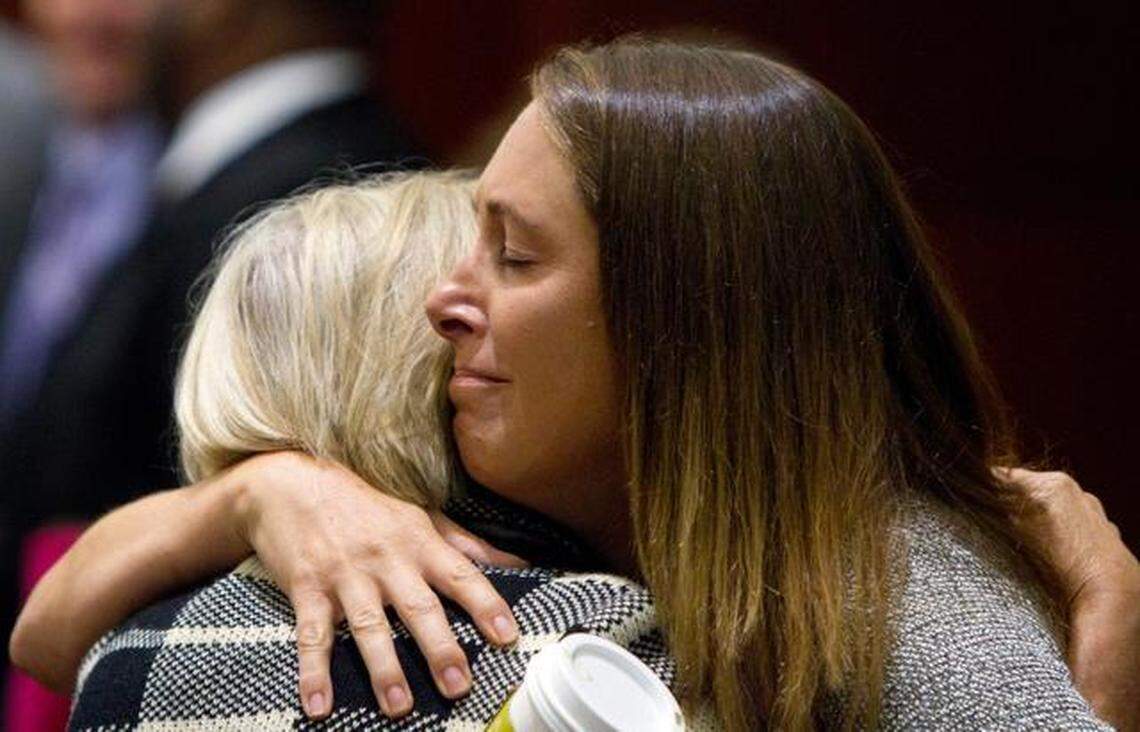
Garry Rentz said he was glad that Gessner’s question forced Brad Cooper to admit a tough fact that he and the family will share with the girls as their questions and curiosity about the situation grow.
“It acknowledges that he, in fact, did what what we all thought all along,” Rentz said. “We can close this chapter and mourn.”
Cooper was sentenced to at least 12 years in prison and will get credit for the 2,156 days, or a little more than five years, that he has already served. He could be released in seven years.
Rentz said his granddaughters would be teenagers by then and could decide for themselves what type of relationship, if any, they wanted to have with their father.
Brad Cooper was arrested in November 2008, nearly four months after Nancy Cooper’s partially clad body was found in a remote part of a construction area nearly three miles from the Cary home where the couple lived.
Brad Cooper, who reported his wife missing on July 12, 2008, maintained that his wife went jogging and never returned home.
A disputed result
In 2011, after one of Wake County’s most protracted trials, a jury convicted Brad Cooper of first-degree murder.
That verdict came after nearly 36 days of testimony with almost 100 witnesses.
The trial exposed a social scene among the big houses of Cary, where neighbors fell into duplicitous relationships or extramarital trysts after getting together for board-game nights, backyard barbecues or Halloween parties.
The N.C. Court of Appeals overturned the verdict in April 2013, and the N.C. Supreme Court refused to review the case despite a request from the state attorney general.
The evidence in the case was largely circumstantial. Jurors said afterward that prosecutors won with computer evidence that defense lawyers tried to quash.
The defense argued that the police investigation of Nancy Cooper’s death in July 2008 was inept. They had hoped to argue before the jury that the crucial computer evidence could have been tampered with and perhaps planted by investigators – arguments that they planned to introduce through their own expert witnesses.
Gessner, who also presided over the trial in 2011, allowed prosecutors to introduce evidence of a Google Maps search of the site where Nancy Cooper’s body had been found. Prosecutors argued that the map search and time stamps associated with it showed that Brad Cooper had searched for a site to dump his wife’s body.
The defense team at trial, however, raised questions about the validity of the time stamps on the laptop files.
Gessner ruled against the defense’s attempt to classify two witnesses as forensics experts to raise questions about the computer evidence.
The appeals court judges noted that the “sole physical evidence linking” Brad Cooper to the homicide was the Google Maps search. “Absent this evidence, the evidence connecting Defendant to this crime was primarily potential motive, opportunity, and testimony of suspicious behavior,” the ruling stated.
Further, the appeals court panel added that “whether the error was constitutional or not,” failure to let Brad Cooper use his experts was a key error that warranted a new trial.
Since then, Brad Cooper got a new defense team and Freeman, his attorney, talked with prosecutors about plea offerings that had been on the table since 2008.
Couple’s marriage crumbled
Wake County Assistant District Attorney Howard Cummings offered a broad-brush overview of the case on Monday. He described Nancy Cooper’s death as a case of “mental and physical domestic violence.”
Nancy and Brad Cooper moved to Cary in 2001 after getting married in Canada.
Brad Cooper had a work visa, but his wife did not have the papers to work in this country.
Over the years, Cummings said, the couple’s relationship crumbled to a point where Nancy Cooper, the more outspoken of the two, had told many people that she wanted out of her marriage and planned to return to her native Canada with their two children.
Defense attorneys contended at the trial in 2011 that Nancy Cooper spent beyond the family’s means and that her husband instituted financial controls to protect their assets.
Friends described Nancy Cooper as an emotionally battered wife, a former career woman in Canada who had to rely on her husband for her financial well-being. Friends testified that her husband gave her an allowance but cut off her access to the couple’s bank accounts.
Initially, Brad Cooper supported his wife’s planned return to Canada, Cummings said Monday. He had an extramarital affair and told some he was in love with the other woman.
But Cummings said Brad Cooper, a man who took home nearly $17,000 a month, changed his mind.
“What he did was prevent her from leaving, for among other reasons, because it was going to cost too much,” Cummings said.
Both Cummings and Gessner mentioned costs when they explained their reasons for accepting the second-degree plea on Monday.
A second trial would have an emotional cost on Nancy Cooper’s family and they were seeking closure.
They also talked about the financial cost of a new trial and the toll it could have on the Cary police department, which, according to Cummings, was run “through the mill the likes (of which) I’ve never seen.”
When asked by TV news crews whether justice had been served, Cummings hesitated.
“It depends on how you measure justice,” Cummings said. “Justice is never reached for a person who is a victim of domestic violence. The justice would have been if it could have been prevented.”
This story was originally published September 22, 2014 at 10:22 AM.