
Witness tells NC Innocence Commission she lied in murder case that sent teens to prison
A key witness who helped send five teenagers to prison for murder 18 years ago apologized Tuesday for giving false testimony
Jessicah Black, who was 16 at the time, answered questions from the North Carolina Innocence Inquiry Commission during a hearing in Raleigh.
Five teens were convicted in the 2002 killing of 61-year-old Nathaniel Jones, NBA star Chris Paul’s grandfather, after their attorney said they were coerced into confessing at the police station in Winston-Salem.
Jones was beaten and pushed to the ground, his hands taped together and mouth taped shut. His assailants took his wallet and left him bound on the ground, where he died of a heart attack.
Nathaniel Arnold Cauthen, 15, and his 14-year-old brother, Rayshawn Denard Banner, were convicted of first-degree murder.
Dorrell Brayboy, Christopher Levon Bryant and Jermal Tolliver — all 15 years old — were convicted of second-degree murder.
Brayboy, Bryant and Tolliver were released after serving time in prison.
Brayboy was fatally stabbed outside a Food Lion supermarket in 2019, according to The Winston-Salem Journal.
But the remaining four, now in their 30s, filed claims with the Innocence Inquiry Commission, which began a hearing Monday.
At the time of the killing, Black told police she had driven the teens around and dropped them off that night to wait for Jones to return home from work. She said she then heard them beating Jones..
Today, as an adult, Black says her testimony was coerced at the police station and in court.
“I’m sorry that I gave false testimony,” she said Tuesday at the N.C. Judicial Center, tearing up.
Commissioners questioned Black’s credibility, asking about her drug use.
Black first recanted her testimony during an interview at an iHop restaurant in Winston Salem with Hunter Atkins, a reporter at the Houston Chronicle. Atkins also testified Tuesday.
Black was questioned about her marijuana use and the times she tried cocaine and pain pills. She said she only used them to deal with the pain from a hip surgery.
“I did not do cocaine until I was 28 years old,” she said.
Black also was asked if she began therapy as a result of the case. She said it was one of the reasons. The commission then asked Black if she would sign a waiver letting members speak to her therapist. Black said she would but did not remember who her therapist was at the time.
The night of the killing
On the night of the killing, Black said Tuesday, she got out of school, went by her grandparents’ house where she was staying, drove right around the block where the teens were usually walking and picked them up.
The boys wanted to go to a party and change their clothes, but didn’t end up going. They went to a bowling alley, but got kicked out. They also went to the mall – the only place where Black was not with them.
Black then drove them to a park, where she said they saw police cars.
“We rolled up, and nobody knew what happened,” she said. “They (the boys) got out to see what was going on.”
When commissioners asked whether Black regretted what she did, she said, “I stay apart from everybody and cry, so yeah it bothers me.” Her voice broke and she started crying, dabbing at her eyes.
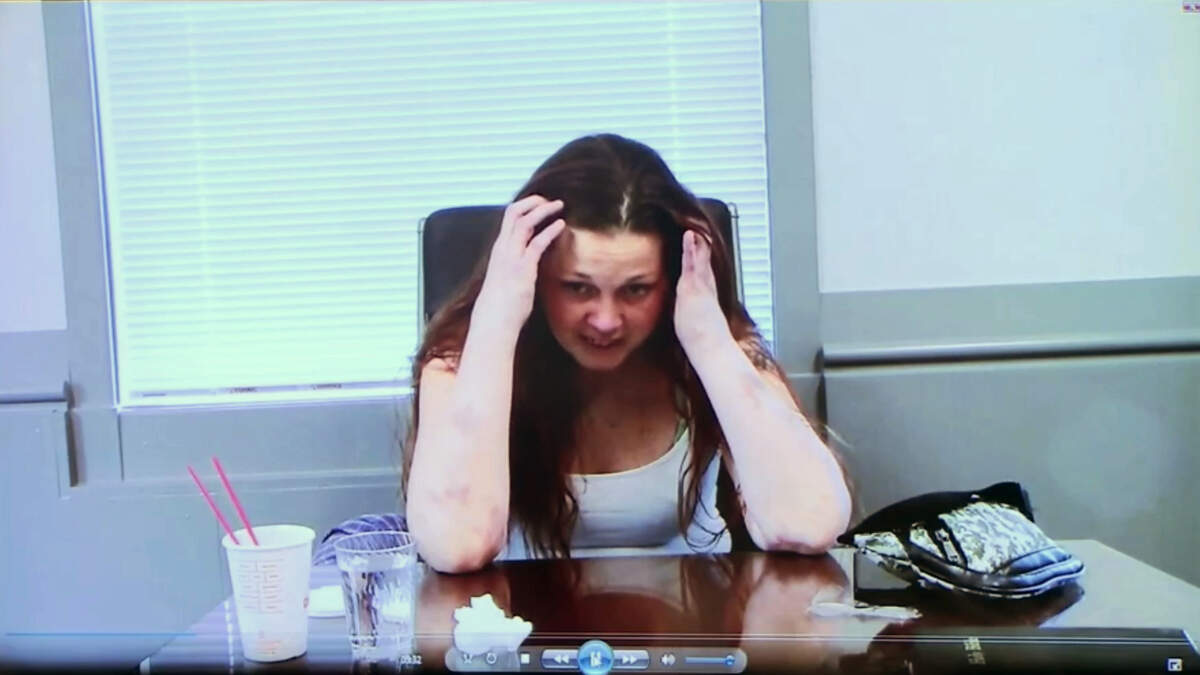
According to court documents, Black testified that the boys had talked about robbing someone and that she drove them to a park near Jones’ home where they waited for him to come home. She said the boys picked up sticks and she heard them beat Jones.
She now maintains police coerced her into implicating the boys, saying they had found skin DNA evidence in her car and had surveillance footage. But after material from her car was sent to the state crime lab, no DNA match was found, Julia Bridenstine, the commission’s staff attorney and evidence custodian, told the commissioners.
In a video deposition played for the commission Monday, Black said 11 or 12 officers interrogated her and that they kept her there for eight or nine hours. Bridenstine said Black was questioned for more than three hours.
“I was so scared of going to jail,” Black said in a taped testimony. “They weren’t satisfied until I gave them the answer they wanted.”
The commission was the first of its kind in the nation, created in 2006 to seek the truth when there are credible claims of innocence in North Carolina, according to its website.It has received more than 2,700 claims and has conducted 15 hearings, 12 of which have led to exoneration.
At least five of the eight commissioners must find evidence of innocence to send the case to a panel of three superior court judges. That panel would then decide whether to exonerate any of the defendants.
This story was originally published March 10, 2020 at 5:34 PM.