Raleigh police raided wrong home in 2021. Judge denies public release of body-cam video
A Wake County judge has denied the public release of body-camera footage from a Raleigh police raid on the wrong home three years ago.
Superior Court Judge Matthew Houston issued his decision late Thursday, rejecting arguments made Tuesday by UNC law students Morgan Schriner and Jack Salt to release the footage.
Amir Abboud and Marian Ibrahim Abboud, the couple suing the city, say the Raleigh Police Department owes the public transparency for officers’ actions on April 7, 2021, after they allegedly broke the law governing police raids while serving warrants.
They filed a complaint, along with with news outlets INDY Week and The Assembly, in December 2023 to make public the footage from the “quick knock” warrant on their home, which was erroneously entered by officers with rifles drawn.
But Houston said the events occurred nearly three years ago and that the “public interest to be advanced by release are diminished by the relative age of the recordings and the delay in seeking a general public release.”
He also wrote that the Abbouds had already released home security footage of the events of April 7, 2021.
City attorney Sherita Walton and the State Bureau of Investigation objected to the release.
The Abbouds previously filed a petition requesting personal release — not public, general release — of the footage in 2022 and reviewed it privately, according to Elizabeth Simpson, an adjunct law professor and director of the civil legal assistance clinic at UNC.
“A main driver for the Abboud family’s petition for general public release of the body-camera footage is to make other families aware of what’s going on in their neighborhoods, and to pressure the police into higher standards that would prevent situations like what occurred at the Abbouds’ residence that day,” the plaintiffs’ legal defense said in a statement.
Simpson supervised Schriner and Salt in the proceedings.
Arguments for release of footage
Legislation signed into law in 2016 requires the state or law enforcement agencies to petition the court to release dashboard and body camera footage. A court hearing is held, after which a judge makes the decision.
“Why was the statute enacted in the first place?” Schriner asked during the hearing. “Why do officers wear body cameras in the first place? To hold them accountable.”
The Abbouds previously filed a separate civil lawsuit against the State Bureau of Investigation for damages related to the raid. An SBI narcotics investigation resulted in a search warrant, meant for a neighbor of the Abbouds, which Raleigh police executed.
“The police are paid by taxpayers, and the public deserves to know what they are doing,” Salt argued. “Taxpayers are paying for footage they never get to see. Government secrecy is anti-democratic.”
But city attorney Walton argued there is insufficient public interest in the footage and that it would not reveal important information about the incident.
Abboud was never charged with any crimes, said Walton, and no one was injured in the raid, although it was done in error.
“It is not a compelling public interest for the Abbouds to take control of the narrative … to advance whatever interest they’re espousing,” said Walton. “There’s already information in the public forum with respect to how entry was made in this particular case.”
Walton argued there must be an “extraordinary situation” to satisfy the threshold for the release of the footage.
In response, Schriner noted that Walton’s interpretation is not included in the general statute or in case law surrounding law enforcement recordings.
The level of public interest is demonstrated by two media plaintiffs petitioning for the release, and the raid being reported by a national media outlet, Rolling Stone, Schriner argued.
Additionally, Walton said the footage shows no criminal wrongdoing.
But Simpson maintained not only was the raid wrongful, it was illegal.
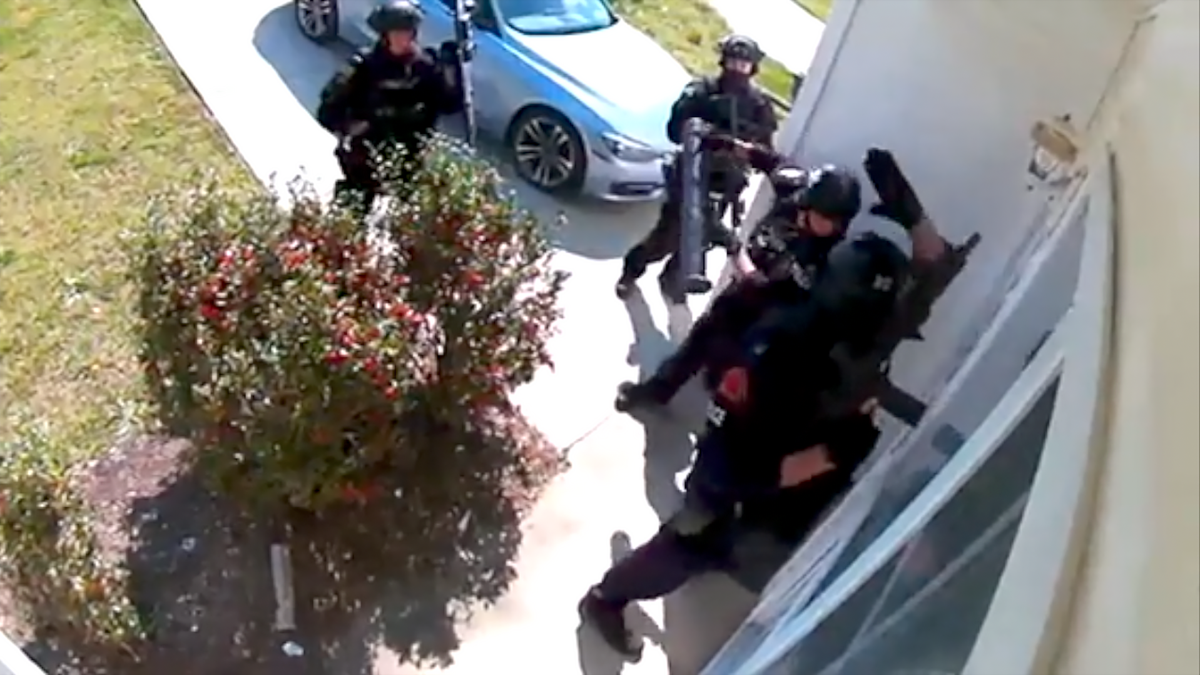
The Abbouds’ home security footage shows police officers simultaneously announcing themselves, knocking on the door and also proceeding to knock it down. State law requires officers to knock, and then announce their presence, before entering.
“They are knocking and almost immediately knocking down his door,” said Simpson. “If they had knocked and waited ... Abboud would have answered the door and said, ‘Hey, you’re looking for Mr. so and so. That’s not me.’”
Raleigh police raid wrong home
A complaint filed to the city and police states the following:
- Abboud arrived home from work on April 7, 2021, to his then-pregnant wife and 11-month-old son shortly before officers stormed in.
- Officers pointed rifles at the family for several minutes before they realized they had the wrong home, their attorneys said Tuesday.
- Police handcuffed Abboud and questioned him, and an officer showed him an image of a man named Abdullah they were looking for, “an Arab who bore little resemblance to him.”
- Severe damage was done to their door frame, but that police have declined to pay for this since it was done during an execution of a valid search warrant, despite the incorrect address.
A portion of incident was captured on the Abbouds’ security camera outside of their home and shared online by Durham civil rights attorney Abraham Rubert-Schewel.
The footage generated additional controversy for the Raleigh Police Department, which was already facing scrutiny for a 2020 no-knock raid led by Omar Abdullah, a now-fired police detective.
The Abbouds also allege racial discrimination, since they say they were the only family of Arab descent in the area besides the person that police were actually seeking, who lived a few doors down.
Rolling Stone covered the quick-knock raid in an investigative story published last year about the wrongful raids on the homes of Yolanda Irving and Kenya Walton, with whom the city settled last year for $350,000.
Irving, her family and another family are currently plaintiffs in another federal lawsuit against Raleigh seeking damages and changes in department policy concerning no-knock and quick-knock raids. They declined to settle with the city after Raleigh officials said they wanted to focus on the money and not change any policies, The News & Observer reported.
“You got pictures, you got videos, look at ’em and make sure you’re doing the right thing,” Abboud told Rolling Stone. “They’re getting paid by our tax money. I’m paying their salary.”
Emancipate NC, a local civil rights organization, criticized the city of Raleigh’s fighting a lawsuit from Irving and Walton, who say they were traumatized by the erroneous no-knock police raids.
Since 2012, the city of Raleigh has paid nearly $4.3 million in settlements to 47 individuals, families and estates over instances of its police department using excessive force and violating constitutional rights of people in public and in their homes, according to an exclusive N&O investigation published this month.
NC Reality Check is an N&O series holding those in power accountable and shining a light on public issues that affect the Triangle or North Carolina. Have a suggestion for a future story? Email realitycheck@newsobserver.com
This story was originally published March 27, 2024 at 3:08 PM.