
In Harnett shooting, key evidence hasn’t been evaluated
Within hours after Harnett County sheriff’s deputy Nicholas Kehagias shot and killed John Livingston early on the morning of Nov. 15, two very different stories about what happened began to emerge.
Two deputies offered one version. Three friends of Livingston offered another.
Though State Bureau of Investigation agents have the ability – and the mandate – to seek forensic analysis to determine which version was closer to the truth, they have not done so.
Kehagias went to Livingston’s home at 3:40 a.m. looking for someone else. He had no warrant. Livingston told him to leave and went to shut the door, which Kehagias was blocking with his foot. Kehagias said that was assault and gave him the right to arrest Livingston. A 10-minute struggle ended when Kehagias shot Livingston three times in the arms and chest.
Though the case was being evaluated as a possible crime, investigators failed to submit evidence for forensic analysis that would have tested Kehagias’ explanation. Kehagias said he feared for his life when he shot Livingston; he said they were locked in hand-to-hand combat when Livingston gained control of his Taser, pressed the device into his stomach and stunned him.
No one tested Livingston’s clothing for gunpowder residue, which experts say would likely be present if he was shot from close range, as Kehagias contends.
A state medical examiner, however, did examine Livingston’s body. She concluded that all three entrance wounds were “without evidence of contact or close-range firing.” That would be closer to the version of events offered by Livingston’s friends, who have said Kehagias was several feet away from Livingston when he fired his gun.
Grand jurors were asked to determine whether Kehagias committed a crime by killing Livingston. They heard competing narratives about that night. But they didn’t hear all the science that could have helped them figure out which story to believe. The medical examiner did not testify.
The grand jury declined to charge Kehagias with a crime.
Much of the focus on whether Kehagias was justified to shoot Livingston has centered around whether he had the right to step inside Livingston’s home. Unless responding to a pressing emergency, officers must have warrants or a resident’s permission before entering.
But an accepted standard for officers who shoot civilians measures another critical moment: Did Kehagias legitimately fear for his life when he decided to fire his gun at Livingston?
Attorneys for Livingston secured a judge’s order last month to get access to the entire investigation into Livingston’s death. District Attorney Vernon Stewart has fought disclosure and is now appealing the judge’s order to release his files.
Robert Zaytoun, a Raleigh lawyer representing Livingston’s family, said the revelations about how far investigators went in their inquiry into the deputy-involved shooting makes disclosure imperative.
“In this day and time, the public deserves to know it can trust law enforcement to zealously investigate cases in which law enforcement shoot and kill,” Zaytoun said. “To not have tested John’s clothing raises the question of why not? What is to hide?”
Kehagias declined to be interviewed for this report.
‘He’s got my Taser’
Livingston’s friends and family believe Kehagias is a killer who has escaped justice.
The U.S. Department of Justice is now investigating the incident to determine if Kehagias should be criminally prosecuted for a violation of Livingston’s civil rights.
Sheriff Wayne Coats has backed Kehagias, clearing him after an internal investigation and saying he would have a job in his department when he returns from medical leave because of a shoulder injury.
Kehagias resigned his job Thursday. In a letter to Coats, he attributed his decision to a “dishonest media” and “baseless lawsuit.”
The News & Observer examined Livingston’s death and other incidents of alleged misconduct by the Harnett sheriff’s office in a four-part series in May. The reports called into question Kehagias’ behavior and pattern of arrests in his two years of service with the sheriff’s office.
Kehagias told The N&O in an interview in April that he was a “proactive” officer who often found himself dealing with hostile subjects.
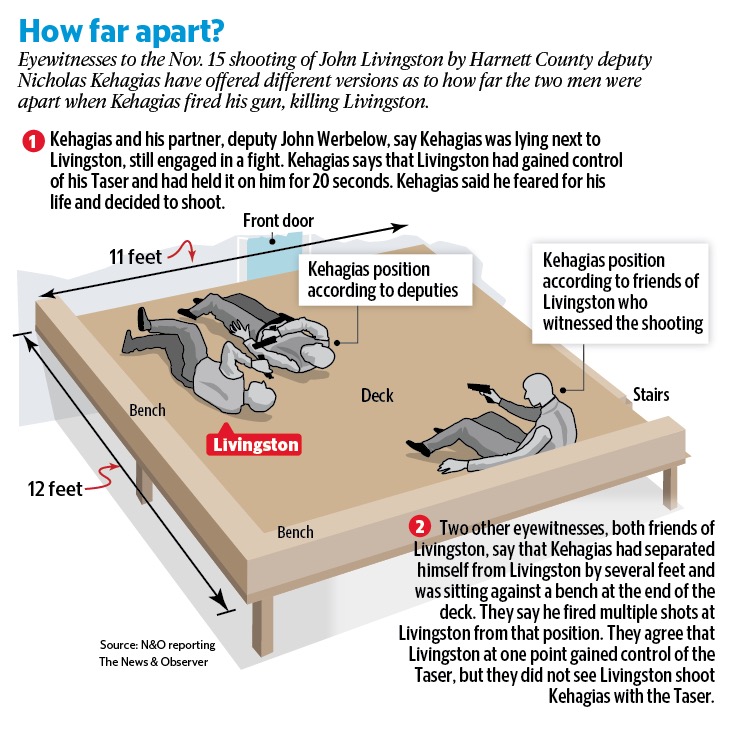
The two narratives from that night offer competing observations about the distance that Kehagias was from Livingston when he fired his gun. After Kehagias entered the home, a protracted fight ensued, and the two men eventually spilled outside onto the deck on the front of the trailer.
In the version Kehagias and Deputy John Werbelow offered, Kehagias was within arm’s reach of Livingston when he fired. In an interview in April, Kehagias described Livingston pushing the end of his Taser into Kehagias’ abdominal area for more than 20 seconds; he said that’s what he was told by sheriff’s investigators who had examined the Taser records.
In those moments, Kehagias said he reached for his gun, then flung his right arm across his body and fired at Livingston.
“He is still tasing me when I am shooting ... It was all I could do to even draw my weapon,” Kehagias said in April.
Three witnesses described to investigators Kehagias being farther away, roughly six feet. Clayton Carroll, Livingston’s roommate, recalls hearing Kehagias yell “he’s got my Taser” before rolling off of Livingston and coming to rest on the opposite side of the deck, which measures 12 feet long by 11 feet wide. Two of the witnesses gave the same description to The N&O.
Checking the wounds
Two types of analysis help investigators figure out the distance between the muzzle of a gun and the victim.
A pathologist studies the entrance wound for indications of close contact, evidence of stippling, or tiny abrasions caused by unburnt or partially burnt gunpowder emitted when a bullet is fired. These particles weigh little, so the farther the gun is from the victim, the less likely medical examiners are to see these abrasions near the bullet entrance point.
In Livingston’s case, a state medical examiner determined all three entrance wounds were “without evidence of contact or close-range firing.”
The proximity Kehagias and Werbelow describe would be considered close contact, according to crime scene experts, firearms analysts and a pathologist interviewed by The N&O.
Greg Davis, chief medical examiner in Birmingham, Ala., said he expects to see evidence on a victim’s skin when the gun is less than a foot away. Sometimes, he said, he sees evidence on the skin at distances up to three feet away. Beyond five feet away, Davis said pathologists don’t expect to see any markings or evidence of gun powder on the victim or clothing.
Brian Crump, a private investigator and crime scene expert from Union County, said Kehagias’ story does not sound accurate based on the pathologist’s findings.
“I don’t think he could have been shot at close proximity,” Crump said.
No tests of clothes
To better determine how far the gun may have been from the victim when fired, forensic scientists study clothing around the entry point for evidence of gunshot residue. The closer the gun is to the person, the more powder analysts expect to see.
When the exact type of gun and ammunition is known, firearms analysts will test-fire the gun to estimate proximity based on the pattern and amount of residue found on the clothes.
That examination was not requested or performed on the clothes Livingston wore that night. Test firings by firearms examiners was not requested either.
Though the State Bureau of Investigation’s manual on how to perform investigations into officer-involved shootings says such tests should be requested, they were not in the Livingston case.
Immediately after Livingston’s death, the SBI was asked to handle the criminal investigation into the shooting. The SBI relied upon Harnett County sheriff’s employees to handle, transport and store crime scene evidence.
Shannon O’Toole, a spokesman from the SBI, said the clothing items and weapon were not submitted as evidence to firearms examiners because of limits put on such testing by the State Crime Lab.
Noelle Talley, a spokeswoman for the State Crime Lab, said that though the firearms unit has put a temporary limit on such testing, it will make exceptions if requested by the district attorney.
District Attorney Vernon Stewart did not request such an exception, Talley said. Stewart did not respond to calls for comment.
Within an hour of Livingston’s death, Harnett deputies established a crime scene perimeter on the deck of Livingston’s home.
The next day, as a medical examiner for the state performed an autopsy on Livingston, Harnett deputy David Hildreth looked on. When the pathologist completed the exam, Hildreth took control of Livingston’s clothes and the bullets that killed him.
According to reports submitted during the sheriff’s internal affairs investigation into the shooting, Hildreth then took the items to the sheriff’s evidence room. A clerk signed them in.
O’Toole, the SBI spokesman, said Stewart, the DA, conferred with the SBI agents about storing the evidence at the sheriff’s office.
Coats, the Harnett sheriff, would not answer questions about why the evidence was not submitted for testing, saying only in a written statement that the SBI was called in and was in charge of the investigation.
Locke: 919-829-8927 or @MandyLockeNews
This story was originally published June 24, 2016 at 4:41 PM with the headline "In Harnett shooting, key evidence hasn’t been evaluated."