North Carolina teachers may go on strike for higher pay and Medicaid expansion
Updated at 11:40 am on Jan. 23 with new NCAE statement
North Carolina teachers are considering going on strike to try to force state leaders to provide pay raises and increased Medicaid funding.
The NCAE Organize 2020 Racial & Social Justice Caucus is surveying school employees across the state about how many days of work they’re willing to miss to pressure the General Assembly to meet their funding demands. The survey gives options ranging from missing zero days to up to 10 days.
The survey is taking place even though it’s against state law for teachers and other public employees to go on strike.
Mark Jewell, president of the North Carolina Association of Educators, said Thursday that the group hasn’t called for a statewide walkout yet. But he left open that possibility based on the results of a new survey that NCAE will conduct of its members instead of relying on the survey being done by Organize 2020.
“The disrespect shown to North Carolina educators over the past year has been unparalleled in scope, and it is clear that what educators have done to this point is insufficient to make our needs heard by leaders at the General Assembly,” Jewell said in a statement. “Last night, the NCAE Board of Directors met to consider options.
“The Board has decided not to authorize any statewide action at this time and to engage in a comprehensive NCAE member survey designed to gauge support for a variety of actions, including, but not limited to, a possible walk-out. Depending on the outcome of the survey, the NCAE Board of Directors will discuss possible next steps to ensure our members’ voices are being heard.”
The survey drew criticism from Republican legislative leaders, who’ve been at odds with NCAE since taking control of the General Assembly in 2011.
“It is increasingly obvious why NCAE’s contributing members represent just 5% of North Carolina teachers – their partisan leadership is more focused on opposing voter ID, supporting illegal immigration, expanding federal entitlements, and blocking legislative pay increases for their own colleagues, than actually benefiting educators and students in this state,” Joseph Kyzer, a spokesman for House Speaker Tim Moore, said in a statement Wednesday.
Misdemeanor for teachers to strike
Teachers who go on strike could be charged with a Class 1 misdemeanor under state law. They could also face losing their jobs and potentially their teaching license.
“What we need to know in order to plan our escalations is: What are you willing to risk to help us win the funding that we all deserve?” Organize 2020 says in the survey.
But the statewide strike ban only has teeth if governments and school districts have the will to enforce it, said the Asheville Citizen-Times, which first reported on the survey on Friday.
Jeffrey Hirsch, professor at the UNC School of Law, cited how teachers in other states with similar bans went on strike and were not punished. If there are any consequences, he said it would be more likely that a North Carolina school district targeted the ringleaders for punishment.
“Going after a large group of teachers would be very, very unlikely,” Hirsch said in an interview Wednesday.
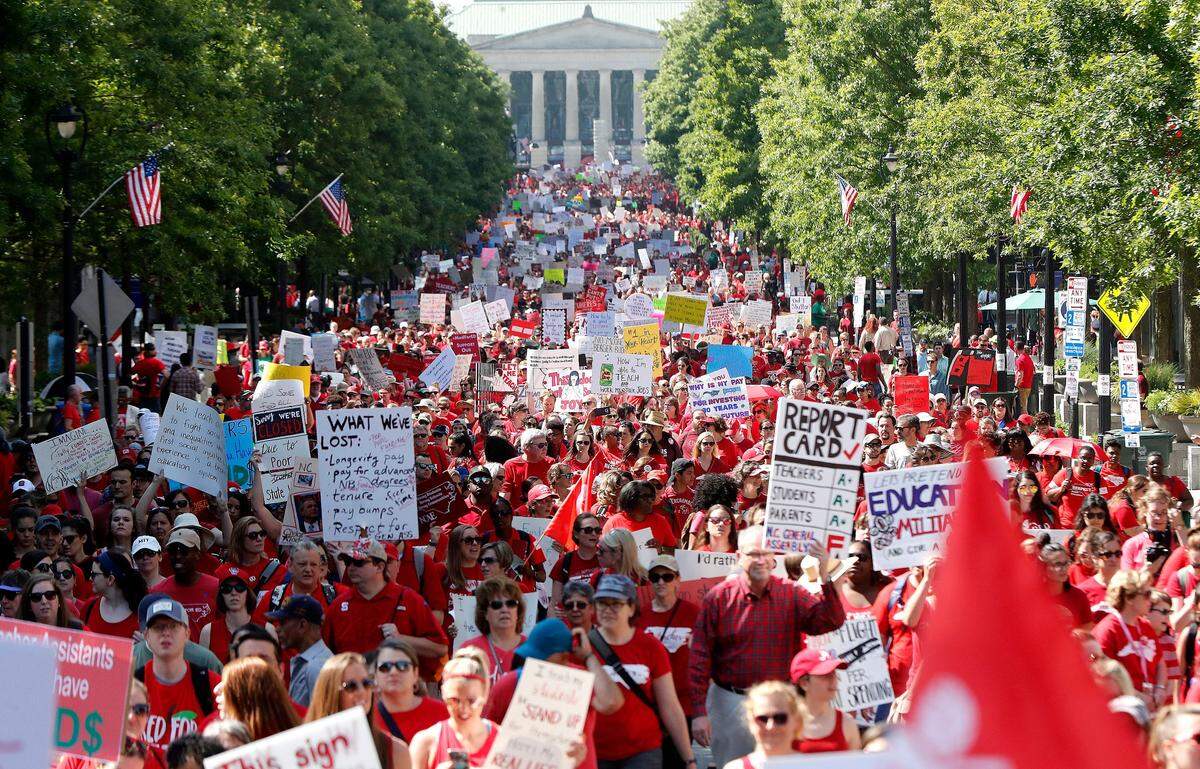
A multi-day work stoppage would be a major escalation over the one-day walkouts that have been held each of the past two years. The protests, which saw thousands of teachers march on lawmakers in Raleigh, caused the majority of the state’s students to miss a day of class when schools closed because they did not have enough substitutes available.
Strike threat comes after budget stalemate
The Organize 2020 survey comes after months of fighting between Democratic Gov. Roy Cooper and the Republican-led state legislature over the budget. Cooper vetoed the legislature’s budget, citing the lack of Medicaid expansion and what he felt weren’t large enough raises for school employees.
NCAE, which has backed Cooper’s vetoes, wants a 5% raise for all school employees and a minimum $15 an hour salary for school support staff.
“There’s enough money in North Carolina to provide instructional materials for our students and to provide fair raises for the people who work in the school systems,” Kristin Beller, president of Wake NCAE, said in an interview. “There are corporate tax cuts that have happened that have stolen away revenue that could be used to make sure that we do both.”
NCAE should be marching on Cooper for vetoing the pay raises provided by lawmakers, according to Pat Ryan, a spokesman for Senate leader Phil Berger.
“It’s shocking and disappointing that there would be a push to illegally strike even though teachers have received the third-highest pay raise in the entire country,” Ryan said in a statement Wednesday. “The NCAE’s own parent organization reports that average teacher pay in North Carolina is $54,000 per year, good for second in the Southeast.
“It’s clear that a small, radicalized minority cares more about a political agenda than about teaching children.”
Beller said people are starting to feel polarized with some who don’t think they can do anything else to make things better. But she said there are others who are willing to take more action beyond the one-day walkouts.
Beller said all Wake County school employees, not just those who are NCAE members, are being asked to take the Organize 2020 survey. She said they want to hear from all sides, including those who are uncomfortable with a work stoppage.
“Our goal is to get true honest feedback, an honest assessment,” Beller said. “We’re not looking for a certain outcome.”
How likely is a teacher strike?
Terry Stoops, vice president of research for the John Locke Foundation, predicts that, once you get outside of Wake County and the urban areas, “you will find a great reluctance” for going on strike.
“The survey is a symbolic action meant to signal that the teachers are serious about union-like activity,” Stoops said in an interview. “But I don’t think it’s a precursor to a strike because NCAE doesn’t have the resources.”
But Stoops said he expects NCAE to hold at least another one-day walkout because it’s an election year where the governor’s mansion and the General Assembly seats are on the ballot.
“An extended walkout would inconvenience parents,” Stoops said. “That would limit their support for teachers. They’d have to balance their activity with public sentiment.”
This story was originally published January 22, 2020 at 1:10 PM.