NC needs 2 million people with post-high school degrees by 2030. The workforce demands it.
North Carolina has plenty of good jobs. What it doesn’t have is enough people with the education to fill all of those jobs.
Less than half of the state’s residents ages 25 to 44 have a college degree or professional credential.
Education leaders across North Carolina are trying to fix that by setting a very ambitious goal: that 2 million residents will have a high-quality postsecondary degree or credential by 2030.
The statewide educational attainment goal, signed into law in 2019, came about because the majority of jobs across the state require more than a high school diploma. And people simply aren’t qualified for them.
“If we had that skilled workforce in North Carolina, people would be better positioned for changes in the economy, better jobs and careers for their lives,” said Peter Hans, co-chair of the Board of Directors of MyFutureNC. “It would be a competitive advantage for North Carolina in terms of economic development.”
MyFutureNC is a statewide nonprofit organization created to reach the 2030 goal through collaboration between North Carolina leaders in education, business and government.
“Those areas of the state that are struggling will certainly see a benefit from this, because it’s hard to grow a business or create jobs in an area that doesn’t have a skilled workforce,” Hans said.
With just regular growth and no significant changes in policy over the next 10 years, the state would have about 1.6 million adults who have the required level of education the workforce needs. But with the goal set at 2 million by 2030, the state needs to help about 400,000 people get those degrees and credentials.
It won’t be easy.
Where NC is succeeding — and where it’s not
Right now, higher education attainment is 49% across the state, with 44% earning an associate’s degree or higher and 5% earning professional credentials, according to census data and state researchers. Hans said that puts North Carolina in the middle of the pack nationally.
But those achievements vary in different regions of North Carolina.
The educational attainment levels are the lowest in Hyde, Tyrrell, Allegheny and Jones counties. Each county has less than 20% of its residents earning an associates degree or higher. The figure is 25% or less in 19 other counties.
Those living in Orange, Wake, Durham, Mecklenburg and Watauga counties are among the most highly-educated.
The Triangle has a higher proportion of bachelor’s and advanced degrees than other parts of the state, likely because of the concentration of colleges and universities that not only educate North Carolinians but bring in highly-educated people from other states.
For the counties that don’t have a UNC System institution in them, it’ll be short-term credentials that boost the educational attainment numbers, Hans said.
“If we’re going to address the urban-rural divide in the state and the questions about socioeconomic mobility it’s through education,” said Hans, who is also the president of the North Carolina Community Colleges System.
A degree or professional credential can give people higher salaries, better positions and access to new jobs they didn’t know existed. But getting that credential takes money and time that some people don’t have.
“A real impediment to this goal is the rising cost of higher education coupled with the fact that many families are living on the edge financially,” North Carolina Governor Roy Cooper said.
Investment from the state plays a big role in making college accessible for people, Cooper said.
Finish line grants provide financial help to students who come close to finishing a degree or credential but hit an unexpected financial roadblock, like major car repairs or medical bills. Using federal money, the state offers these grants to students who are more than halfway to finishing their education. The grants have helped hundreds since 2018.
Cooper also mentioned last dollar community college scholarships, which help students pursuing jobs in high-demand fields cover remaining tuition and fees.

Community colleges are key
Nearly 70% of jobs in North Carolina require a post-secondary credential or degree, according to MyFutureNC. Cooper and Hans say community colleges are going to help move the needle with short-term, affordable education options.
“At the end of this it’s going to be the community colleges that make the difference whether we meet the goal or not,” Hans said. “We’ve got the size and the scale and the depth with 700,000 residents coming through the community colleges every year.”
The North Carolina Community College System is made up of 58 schools. At least one community college is within a 30-minute drive of 90% of the state population.
Most community college students are part-time and pay $76 per credit hour. The cost is about $2,400 per year for full-time students living in North Carolina. Meanwhile, the annual in-state tuition and fees at a four-year UNC System institution ranges between $3,200 and $9,000 per year.
Someone can earn a 2-year degree in an applied science program and immediately enter the workforce or transfer to a UNC System university and cut the cost of a 4-year degree basically in half.
“In these days of deep, deep student loan debt, that’s a pretty attractive proposition,” Hans said.
Community colleges also offer industry-recognized professional credentials that can lead to well-paying jobs in many high-demand fields such as information technology, healthcare, construction, transportation, advanced manufacturing and public safety.
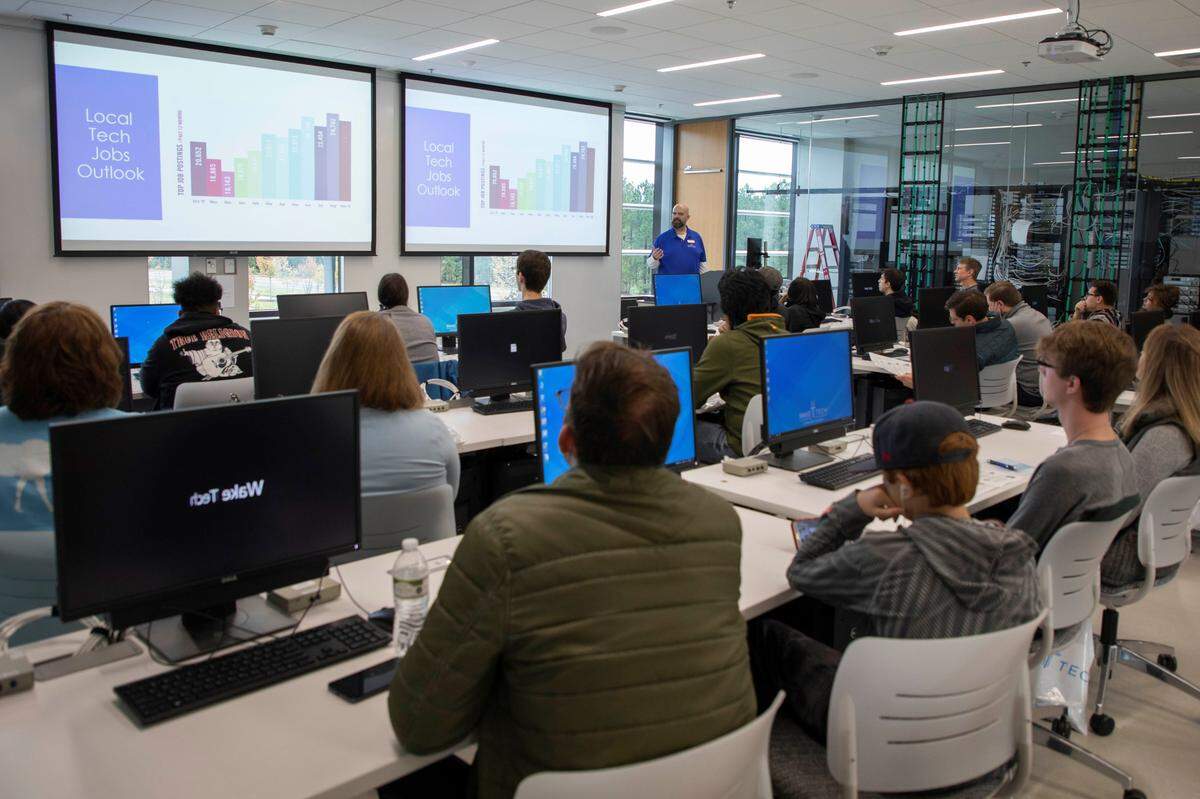
They are uniquely propositioned to address workforce needs because they can quickly add or adjust programs to keep up with the inevitable changes in the labor market, Hans said. Some of the training programs are as short as 12 weeks.
Mariia Kozlovskaia, 28, moved to Raleigh from Russia, but she said her bachelor’s degree in law from Moscow Witte University couldn’t help her get a job in the United States. So she applied for an IT program at Wake Technical Community College, where her husband was taking English classes.
The short-term IT training was free through a US Dept. of Labor grant called TechHire aimed at filling high-demand jobs. Kozlovskaia was offered her first job in IT support when she was halfway through the program, which was about 2 months long.
“The most important thing for me was it’s faster,” Kozlovskaia said. “You really can get employed in less than a year and start making money and then keep going to class and keep studying and get experience at the same time.”
In addition to the professional skills, professors and staff at Wake Tech helped Kozlovskaia understand what she wanted to do and the path to a career. She continued taking courses to expand her skills to earn four certificates and was offered a higher-paying job with better benefits as a desktop support specialist with Bandwidth Inc.
“It makes you more valuable for your company and your future employer,” Kozlovskaia said. “It helps you get a better job and a better opportunity for yourself and improve your quality of life.”
The community college system also deploys career coaches into high schools to help students understand what academic and career options are available through community colleges. In addition to advising, the coaches connect students with resources related to financial aid or health concerns. They’re placed in counties across the state, from Carteret to Wilkes to Henderson.
Hans said they emphasize that there are multiple paths to success and it’s not “a four-year-degree or failure.”
Colleges and universities work to reach more diverse students
The UNC System, which is made up of 16 public universities, is focusing on helping more rural and low-income students not just enroll in college but complete their degrees
One of the system’s goals is to get more students into the pipeline who may not think of UNC as an option for them, said Andrew Kelly, UNC System senior vice president for strategy and policy.
Rural and low-income students have lower rates of completion compared to their peers, according to Kelly. He said high school graduates’ “readiness” needs to improve, so that they can succeed in college once they get accepted.
About 25% of 4-year college students don’t complete their degree, according to MyFutureNC. Kelly said the UNC System has an opportunity to serve those nearly 1 million adults around the state who have some college, but no degree. Flexible academic programs, expanded digital learning and tighter partnerships with community colleges can help the UNC System meet working adults and parents where they are and convince them to return to school, Kelly said.
North Carolina’s 36 private colleges and universities are also critical to reaching the state’s goal and award 1 in 3 of the bachelor’s degrees in the state.
Many of them also offer adult degree completion programs and have agreements with the NC Community College System to help students transition from two-year to four-year institutions. In an effort to make higher education more accessible, the North Carolina Independent Colleges and Universities campuses provide more than $700 million in financial aid each year to help alleviate the costs of college.
Rural high school makes college more accessible
Perquimans County High School knows the difference that grants can make in sending students off to college.
Perquimans was awarded the GEAR UP grant about eight years ago, and almost every year during that time its graduation rate was around 90% for all students and higher than the state’s average, according to Assistant Superintendent James Bunch. He said student applications to colleges have gone up, and the school continues to meet academic growth on the NC Report Card.
The impact is apparent every day for the small rural community in Eastern North Carolina, which has less than 1,700 K-12 students and only one high school. And it’s not just the numbers where Bunch sees the difference.
“I know from talking with folks on the phone and at the grocery store that our community knows more about college access, college applications and attendance at college,” Bunch said.
Bunch said the county uses the grant money to offer FAFSA financial aid workshops, work with students on ACT test prep and help pay for the exam and create summer academic programs. The grant also focuses on measuring and improving the academic proficiency in individual students and provides annual professional development opportunities for guidance counselors and principals.
“We have more students now who are taking college courses through the career and college program than we’ve ever had in history,” Bunch said.
The Career and College Promise program offers North Carolina high school students the chance to earn free college credits through a community college campus.
Faith Christian, a 16-year-old junior at Perquimans High, didn’t know whether she wanted to spend four years away at college and go into debt trying to pay for it. But with the career promise program, she’ll earn an associate’s degree along with her high school diploma.
“I think a lot of parents look at it as saving money,” Christian said. “The best part about it to me is saving the time it takes by doing it in high school. You could go out and get a job because you have a degree right now.”
It’s not easy for her balancing College of The Albemarle online courses with high school classes, softball practice and student government meetings, but for Christian it’s worth it.
Her parents didn’t go to college, and this program is encouraging her to get a four-year degree while setting her up to be more successful once she gets there.
When the program started three years ago, about 30 students were in it. Now, there are more than 120, according to Principal Wayne Price. He said 18 students will earn their associate’s degrees this spring, and next year the number will be even higher.
“If you look at students who participate, there are students who didn’t think they could go to college,” Price said. Others doubted they could afford it.
If a student meets the GPA or testing requirements for this program, their tuition and books are paid for. Price said he wants to make sure his students have every opportunity that students in a more wealthy county like Wake County have for their college aspirations.
Working toward a college degree at Wake schools
Wake Young Men’s Leadership Academy in Raleigh is also working to be part of the solution. The school helps local students from 6th grade to 12th grade work toward a college degree in high school for free, through a partnership with Saint Augustine’s University.
“Every family wants their son or sons to have more options and better options than they did,” Principal Xavier King said. “What we’re providing will change the trajectory of their life.”
Wake Young Women’s Leadership Academy, also in Raleigh, has a similar early college program for girls in partnership with St. Augustine’s.
The schools are particularly helpful for students whose families didn’t go to college or are economically disadvantaged. Students get the education and support services throughout middle and high school to prepare them to graduate with some of their college courses already done, which saves time and money.
When students leave the academy, they will be about 3 credits short of graduating from a university, King said. They can stay at St. Augustine’s or transfer to a community college like Wake Tech or any UNC System university to earn their degree and then pursue their careers.
“This is a viable option to help level the playing field,” King said. “The young men also feel more confident about what they can contribute in an academic setting.”
The application process for the magnet school is open to all young men that live in Wake County. About 50 students are admitted in each grade level through a lottery system.
King said they strategically target elementary and middle schools in under-served neighborhoods that may be overlooked and are likely to have first generation college students.
Xavier Landeo, 19, is enrolled in what Wake Young Men’s Leadership Academy calls the “13th grade level.” He moved to Morrisville just before 6th grade and saw this school as an opportunity to find a brotherhood and be the first person in his immediate family to go to college.
“It helps you get the extra education, and the teachers are amazing,” Landeo said. “It’s a really good foundation to start from.”
The program stays with students throughout the first year of college and makes the transition easier
Landeo is studying audio engineering and wants to transfer to Wake Tech and then the Berklee College of Music, with plans to become an audio technician.
While Wake Young Men’s Leadership Academy is opening doors for a few dozen students each year, MyFutureNC partners are working to scale that success across the state and raise North Carolina’s education standard. The group set up a website to measure the progress toward the 2030 statewide attainment goal and how individual counties are performing.
“We have to be willing to invest in education significantly in order to reach this goal,” Governor Cooper said.
It’s good that they’ve all agreed on a goal, he said, but actually reaching it is going to be a lot harder.
This story was originally published February 26, 2020 at 5:30 AM.