Black and Hispanic students are less likely to take top classes. Wake wants more equity.
Wide racial disparities still exist in enrollment in Wake County’s top academic classes, but school leaders say they’re trying to make access to the courses more equitable for all students.
Enrollment data presented this week shows that Asian and white students are more likely to be identified as academically gifted and to take advanced courses in Wake County than black and Hispanic students.
School administrators outlined steps being taken to prepare more students to take rigorous courses and to support them once they’re enrolled. School leaders say that ensuring access to rigorous learning experiences for all students matters.
“We know we’re not where we need to be on a lot of these things,” Brad McMillen, assistant superintendent for data, research and accountability, told a school board committee on Monday. “But there are some areas where we have seen improvement in recent years .... while still acknowledging that’s there’s obviously a lot of work to do in this space for us.”
Like schools across the country and in North Carolina, those in Wake County have wide racial disparities in participation in advanced courses.
N&O/Observer series highlights inequities in access
A News & Observer and Charlotte Observer series in 2017 showed that thousands of bright, low-income North Carolina students were being excluded from advanced classes.
“Counted Out” showed that as bright children from low-income families start fourth grade, they are much more likely to be excluded from the more rigorous classes than their peers from families with higher incomes.
State lawmakers credited the series with them passing a law in 2018 requiring high-scoring math students to be placed in advanced courses. School districts were given time to phase in the law.
“There are a lot of parents of color who know they have a bright child and their child is repeatedly denied the opportunities,” said school board member Heather Scott, chairwoman of the board’s student achievement committee.
Wake school officials on Monday pointed to data showing how more high school students are taking honors courses and Advanced Placement courses — classes that students can take to try to get college credit.
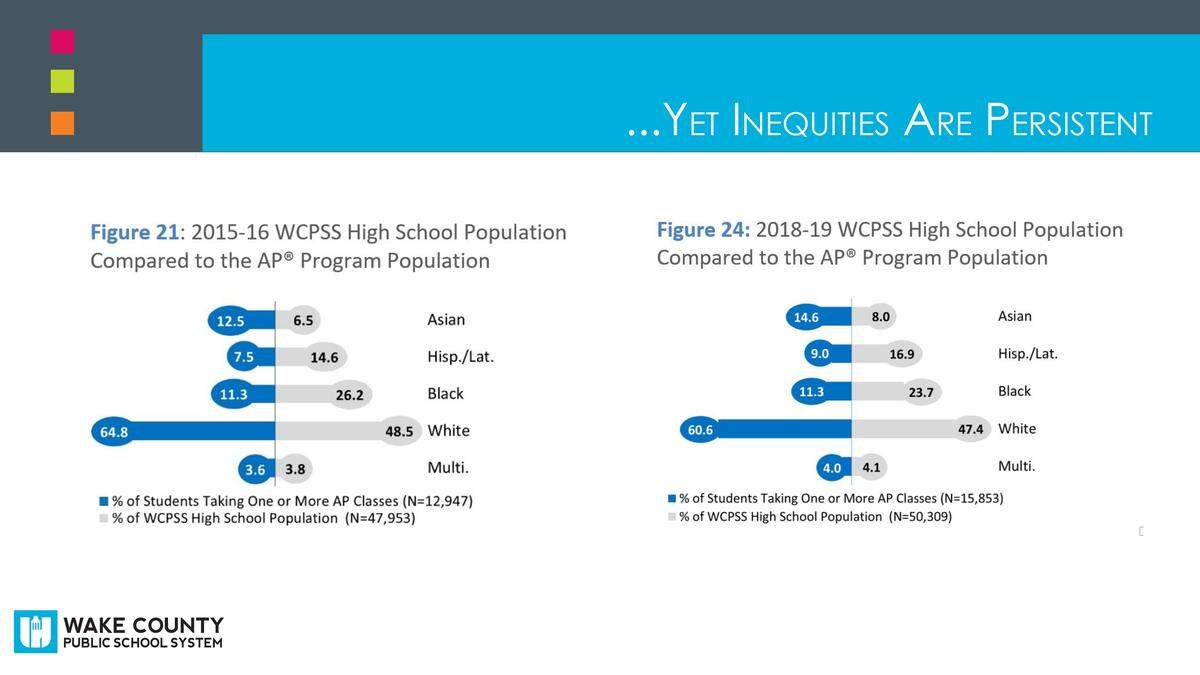
The number of Wake high school students taking AP courses has increased 22% since 2015. But school officials say inequities still exist there and at the elementary school level.
Racial disparities in Wake’s advanced classes
▪ Asian and white enrollment in AP courses are at much higher rates than compared to black and Hispanic enrollment.
▪ Asian and white students are both more likely to take multiple honors courses and less likely to take no honors classes than black and Hispanic students.
▪ Eligible Asian and white students are more likely to be placed in Honors English 1 in 9th grade than eligible black and Hispanic students. Students are eligible if they had an A or B grade in 8th-grade language arts or scored a Level 4 or Level 5 on the state’s end-of-grade reading exam.
▪ White and Asian students are much more likely to be identified as academically and intellectually gifted in elementary school than black and Hispanic students.
But administrators laid out several steps being taken to improve equity in access, including programs in elementary and middle school to identify more students as being academically gifted and to give them support.
Getting more students into advanced classes
In high schools, Drew Cook, assistant superintendent for academics, said ninth grade is so critical as a gateway to taking advanced classes that they want to get as many eligible students as possible into honors courses. He said schools are being asked to provide documentation when these eligible freshmen don’t take honors courses.
“We want to flip the paradigm from opting in to you have to opt out and make it more of an automatic, so if you make the A or the B you’re going to land in the honors level course in the ninth grade in English 1,” Cook said. “Parents would then have to opt their students out for whatever reason if they feel like they’re not ready.”
Other steps include having high school teachers meet with middle school teachers to talk with them about the skills students will need in ninth grade and helping high schools identify students who’d benefit from taking AP courses.
Brian Pittman, senior director of high school programs, said the district recognizes some students will choose alternatives to AP courses, such as internships, apprenticeships or advanced studies in other courses.
School board member Jim Martin cautioned that colleges are finding AP courses to be less useful in preparing students for college level work. Martin said he wants all classes to be rigorous while avoiding having Wake be trapped in the “Lake Wobegon” syndrome where everyone is above average.
“To act as though everybody should be in the honors class or everybody should be in the AG (academically gifted) class I think actually disadvantages our top learners,” Martin said. “We wouldn’t do that for sports. Why do we do that for academics?”
This story was originally published February 25, 2020 at 2:57 PM.