For many of NC’s private schools, the classrooms are opening for in-person learning
As a growing number of North Carolina public schools decide to start the school year with online classes because of the COVID-19 pandemic, many of the state’s private schools are planning to reopen with face-to-face classes.
Private schools aren’t subject to the same rules that govern how the K-12 public schools can reopen, such as limits on building capacity and the requirement that face coverings be worn by all students and teachers. Still, private school leaders say they’ll use many of the same safety measures that public schools must do, such as daily temperature checks, increased cleanings and maintaining social distancing.
“We have a tremendous amount of autonomy,” Linda Nelson, executive director of the North Carolina Association of Independent Schools, said in an interview. “That certainly extends to returning to school in these circumstances. But our schools approach it from a perspective that we’ve got to do what’s safe.”
The schools in Nelson’s association are among the largest in the state and account for 40% of North Carolina’s 103,959 private school students. She said a lot of her group’s schools are reopening for face-to-face instruction as opposed to the virtual-only plans that will be used by a number of public schools.
Many private schools are also providing distance learning options for students who don’t feel comfortable with being back on campus.
Some of the first students to start the new school year began Monday at Thales Academy’s eight private school locations in North Carolina.
“We strongly believe that providing an in-person educational experience is of utmost importance for the well-being of our students and families, Josh Herring, dean of students at Thales, said in a news release. “Returning to school helps students to continue progressing academically and socially, promotes positive mental health, and allows our working parents to focus on their obligations to their employers.”
Families were notified that a staff member at Thales Academy Raleigh who had been training on campus Monday had tested positive for COVID-19. Parents were told that a deep cleaning of the school would be done Thursday night.
Berger asks families to consider private schools
The divide between how public schools and private schools are handling the opening of school has become a political issue.
Citing unfavorable COVID-19 trends, Democratic Gov. Roy Cooper announced last week that K-12 public schools could reopen under Plan B, which requires “moderate social distancing” such as limiting how many students can be in school and ride the bus. He also allowed districts to reopen under Plan C, which is remote-only instruction.
At least 37 school districts and 28 charter schools, based on an unofficial tally compiled by The News & Observer, have decided to reopen with remote instruction. Those schools account for 45% of the state’s K-12 public school enrollment.
In a news release this week, Republican Senate leader Phil Berger criticized public schools for not reopening for in-person instruction. He urged families to apply for the state voucher program that provides $4,200 per year to help low-to-middle income families pay for tuition at private schools.
“The public school establishment is failing the very children it is supposed to serve,” Berger said in the news release. “At-risk kids may be out of school from March 2020 through September 2021 — many of them don’t have a chance of catching up.”
“Meanwhile, children from well-off families can learn in-person at private school. I urge concerned parents to take advantage of the Opportunity Scholarship program so their kids can get the same private school education as other children.”
Defending public schools
Ford Porter, a spokesman for Cooper, tweeted that Berger was trying to divert funds from public schools to private schools.
Mary Ann Wolf, executive director of the Public School Forum of North Carolina, said public schools are dealing with how many families across the state aren’t ready to return to school buildings. She said state leaders should be trying to help public schools during the coronavirus pandemic.
“Instead of directing taxpayer dollars into private settings that are not required to demonstrate to the public that they are ensuring each and every child is accessing a sound basic education, let’s ensure that our system of public schools — one of our state’s greatest and most important assets — has the funding necessary to safely begin the 2020-21 school year,” Wolf said in a statement.
Private schools may be benefiting from offering in-person classes. Kelly Ellis, a spokeswoman for Thales, said they’ve seen a “drastic increase” in applications in the last few weeks.
Caroline Barnhill, a spokeswoman for GRACE Christian School near Raleigh, said the school is capped and has had to turn down some applications from families trying to leave public schools. She said the school has increased its enrollment this year.
Private schools vary on face mask rules
One of the biggest differences between public schools and private schools is how they’re handling the face mask requirement.
The state Department of Health and Human Services is requiring all students, staff and visitors in K-12 public schools to wear face coverings. How individual private schools are handling the face mask issue varies.
Schools in the Roman Catholic Diocese of Raleigh are voluntarily following the DHHS guidelines for Plan B school reopening, according to Lytia Reese, the superintendent of schools.
“Our decision was to really try to balance the health and safety of the community, so we’re trying to be as careful as we can with the requirements for returning to school,” Reese said.
At Providence Day School in Charlotte, the state’s largest private school, face coverings will be required to be worn whenever two or more people are in the same area.
Students at GRACE Christian School will be required to wear face masks when changing classes. They’re not required to wear them in class unless they’re working closely with another student. Teachers don’t have to wear face coverings during classes unless they’re working closely with a student.
Thales Academy is only requiring masks for staff and students ages 11 and up. Even though public school elementary students must wear masks at school, Cooper’s executive order doesn’t require them to be worn in public by children under age 11.
“Masks are not required for students under the age of 11, but we encourage them for all students, in the event that social distancing is difficult at any point during the school day.,” Ellis said in an email. “We are also following the state and county mandates in our out-of-state schools.”
Thales has taken several safety steps to reassure families, including requiring daily temperature checks, keeping the same group of students and teachers together during the day and installing advanced HVAC units to bring in outside air.
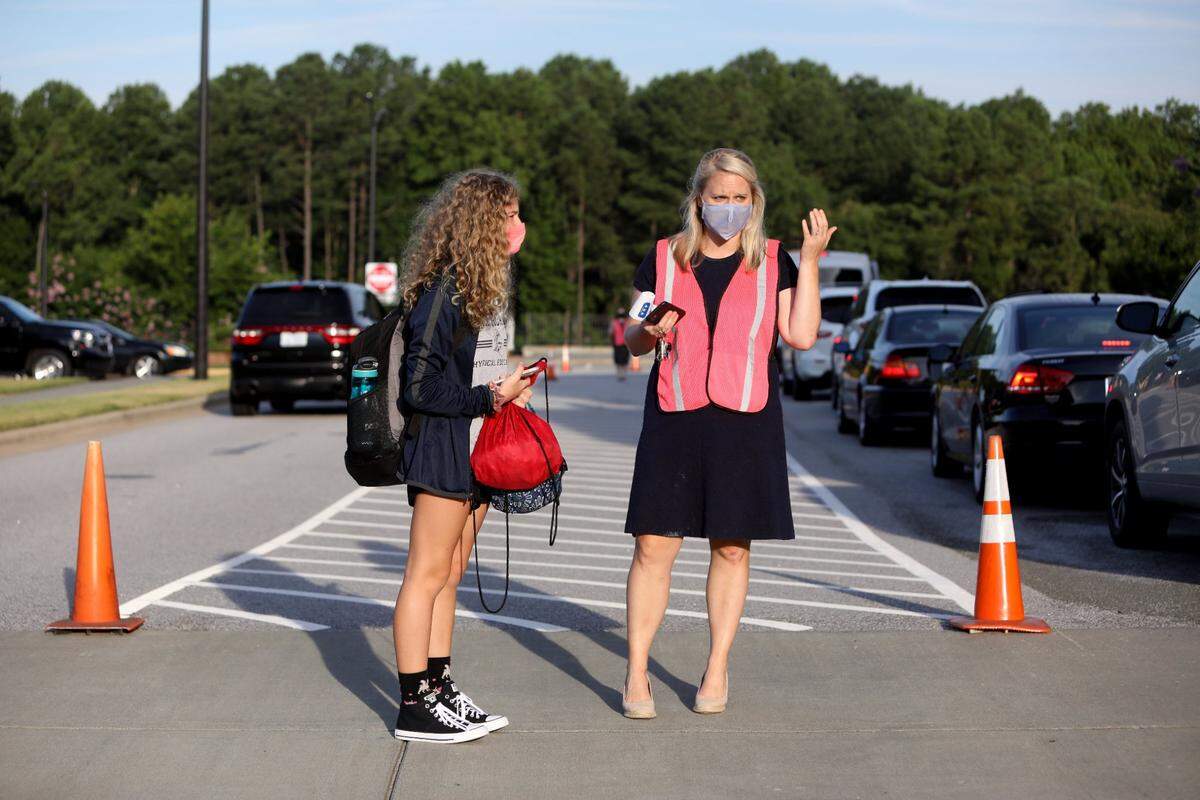
Brad Walker’s two children attend high school at Thales’ Rolesville campus. The Wake Forest father says his wife is a “germophobe,” but all the steps Thales has taken were enough to reassure them to send their children back on campus.
“They’re going over and beyond what they needed to do to make us feel safer and better about going to school,” Walker said.
Private schools ready to reopen
Some public school students, such as in Wake, Durham, Chapel Hill and Charlotte may not go back to face-to-face classes on a daily or semi-regular basis until October or even later.
In contrast, many private schools are set to begin face-to-face classes in August on either a daily basis or on a rotational system that will have students take a mix of in-person and remote courses.
GRACE Christian is preparing to reopen at 100% capacity while still maintaining social distancing, as well as other new safety measures. But the school could switch to a plan where K-3 students would get daily instruction with students in grades 4-12 alternating between classes in school and at home.
“We’re smaller and we’re more spread out,” said Barnhill, the GRACE spokeswoman. “It’s why we feel we can do it well and safely.”
The Catholic Diocese of Raleigh spans the state’s 54 eastern counties and has around 9,000 students in 29 schools. Reese, the superintendent of schools, said all 29 schools are planning to reopen with face-to-face classes adjusted to meet the COVID-19 conditions in their area.
Some diocesan schools like Cardinal Gibbons High School in Raleigh will use a hybrid learning plan. Cardinal Gibbons, one of the state’s largest private schools, will split students into two groups that go on a rotating system of two days on campus followed by two days of remote learning.
But with so many area school districts opting to delay in-person classes, Cardinal Gibbons administrators sent a message to families Wednesday saying they still plan to use the hybrid learning model.
“Our position will not change so long as we feel confident that we can provide a safe environment for our students and educators,” Jeff Bell, head of school of Cardinal Gibbons, said in the message.
Reese said some of the other schools in the diocese have enough space to open at full capacity while maintaining social distancing. Reese said schools are much better prepared now to deal with COVID-19 risks than in the spring when both public and private schools closed due to the pandemic.
“We’ve had several months to plan, to really look at the logistics in providing those environments,” Reese said. “We feel like we’ve done a really good job of preparing our schools.”
This story was originally published July 23, 2020 at 3:20 PM.