Wake wants school cops to use the ‘minimum amount of force’ needed on students
Updated May 30 with Raleigh Police response.
Wake County school leaders want to put in new rules to limit when school resource officers get involved and how much force they should use on students.
The Wake County school board has proposed multiple changes to the memorandum of understanding that governs how law enforcement agencies provide school resource officers. The changes represent Wake’s efforts to balance the concerns of those who feel police need to be on campus with those who feel officers create a hostile environment for students of color.
The board is now getting comment from police and the public on the proposed changes. The public has until Tuesday to review the agreement and provide feedback.
“This is a continuing conversation and we continue to look for ways to strengthen the program, but I think more importantly strengthen relationships,” school board chairman Keith Sutton said at Wednesday’s safety and security committee meeting. “Because at the end of the day that’s what it’s really about is having genuine, authentic relationships with law enforcement in our schools.”
The county’s 11 law enforcement agencies currently provide 75 armed officers at high schools, middle schools and some elementary schools across the county. The district pays $1.1 million a year for the officers.
The Wake County Black Student Coalition has held multiple protests over the past year calling for “counselors, not cops.” The coalition wants Wake to pay for the California-based PeaceBuilders program. For a fee, PeaceBuilders trains school staff on how to promote a positive school environment.
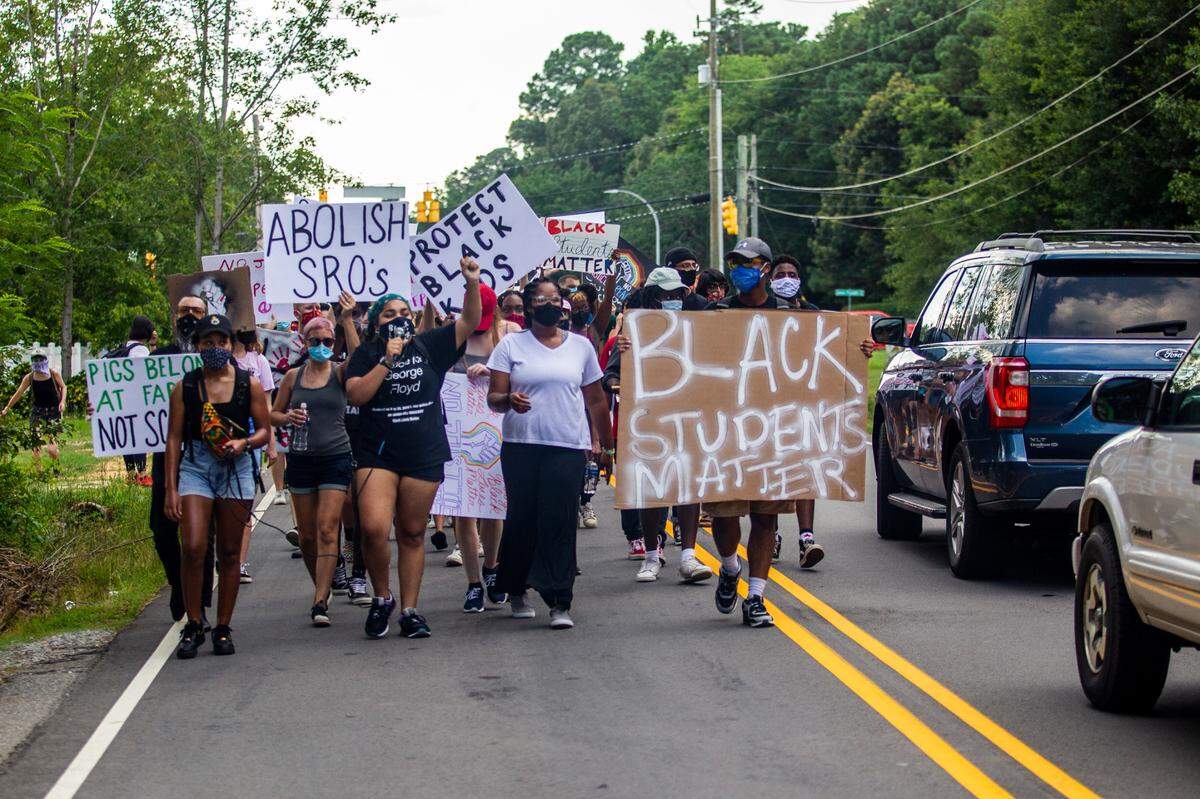
But the school board has decided to keep the school resource officers while trying to address the concerns of the critics.
The current agreement governing the duties of school resource officers expires June 30, along with the contracts that Wake has with different law enforcement agencies to pay for the officers.
Listing when SROs should intervene
One of the sections with the most extensive changes proposed by the school board covers when officers are expected to get involved. The new agreement adds wording about the five levels of student misconduct in school board policy.
Proposed changes include telling police that Level I offenses “will rarely, if ever, constitute a threat to health or safety necessitating involvement of the SRO.” Examples of Level I offenses include non-compliance with directives, inappropriate language, dress code violations and trespassing.
The agreement says Level II offenses “may intermittently constitute a threat to health or safety necessitating involvement of the SRO.” Level II offenses include substantially disruptive or dangerous behavior, property damage, theft, indecent exposure or sexual behavior and making a threat or false threat.
It’s misconduct in Levels III, IV and V, the agreement says, that “should constitute the majority of occasions when SRO intervention is necessary.” Examples of these offenses include possession of controlled substances, gang and gang related activity; possession of weapons, assault on a student or adult and threats of mass violence.
“Law enforcement and SRO intervention should be limited to those instances of student misconduct that present an imminent threat to health and safety in the school environment and that are not more appropriately handled through another school resource,” school board attorney Patricia Robinson said at the May 18 school board meeting.
Minimum amount of force to be used
The school board has also added proposed changes around the use of force. They’ve added wording saying use of force by school resource officers “shall be consistent with the specific revisions recommended by Governor Roy Cooper’s Task Force on Racial Equity in Law Enforcement.”
The task force’s recommendations include:
▪ Require that officers use the minimum amount of force reasonably necessary to apprehend a suspect.
▪ Require that officers use de-escalation tactics when reasonable instead of using force.
▪ Prohibit neck holds.
▪ Ban of hog-tying subjects.
▪ Prohibit use of force to retaliate against a subject for talking back or running away.
“This is a living, breathing document and will always continue to evolve and make changes, both to the document and its program,” said Sutton, who also chairs the safety and security committee.
Getting law enforcement support
Other changes proposed include increased communication between police, schools and the public, increased monitoring of the program and new language around training requirements for officers.
The school board also wants to add wording creating an online form that any member of the public can use to report concerns about individual school resource officers.
It’s unclear whether the law enforcement agencies will agree to the changes. Robinson said the new wording had been added after consulting with the Raleigh Police and the Wake County Sheriff’s Office
An email to the the Wake County Sheriff’s Office was not immediately returned. .But Donna-maria Harris, a spokeswoman for the Raleigh Police Department, said in an email they will continue to support the Wake County Public Schools System SRO Program.
“We have met and met and met with law enforcement and representatives and their agencies really trying to hammer out an agreement that we all can live with and abide by,” Sutton said.
This story was originally published May 27, 2021 at 8:00 AM.