Wake gives early warning to parents: School test scores may be ‘less accurate’ this year
Wake County school leaders are warning that this year’s state test scores might not provide an accurate reflection of how well schools taught students during the coronavirus pandemic.
The statewide release of school and district results on Sept. 1 will offer the public a look at how North Carolina public school students have fared academically since COVID-19 disrupted how education is provided. But Wake County school administrators said this week that the larger number of students than normal who skipped the state tests will lower the accuracy of those results.
“As those participation rates fall below 100%, some of those aggregations that they report — district level scores, school level scores, subgroup scores — are going to be less and less accurate, and we don’t know how that’s going to vary by different parts of the state,” Brad McMillen, Wake’s assistant superintendent for data, research and accountability, told a school board committee on Monday.
“We know that different parts of the state were impacted differently in terms of the amount of in-person instruction they had during the pandemic and that may have affected what the percent tested rates were in different pockets in the mountains and the coast and where we are.”
McMillen didn’t say what those school and district results will look like when they’re officially released.
But some early statewide figures showed more students than normal had failing grades this school year. Additionally, the majority of high school students who took state exams last fall didn’t pass them.
Record numbers of students are attending summer school programs across North Carolina, including more than 19,000 students in Wake County.
Fewer students take state tests
Each year, the U.S. Department of Education requires public schools to give standardized tests to students. The exams were waived last year but were required by the federal government this year.
North Carolina gives state end-of-grade exams in reading, math and science in the spring to elementary and middle school students. The state also gives high school end-of-course exams at the end of the fall and spring semesters.
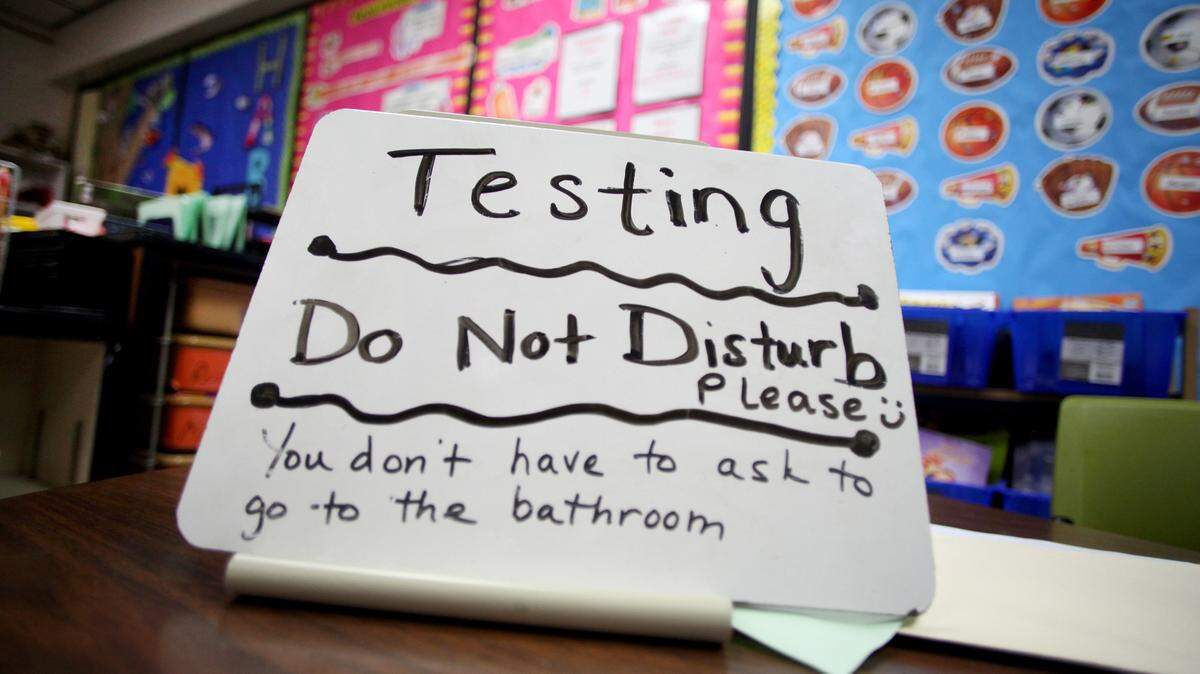
To ensure test security, the state Department of Public Instruction required the state exams to be taken in-person. Many students only took virtual classes this school year so Wake and other school districts said they wouldn’t penalize students who didn’t take the state exams.
McMillen said about 85% of Wake high school students and an even lower percentage in elementary and middle schools took state exams this year. He said it likely won’t be valid to compare this year’s school results with prior years.
“We’re going to get data back this year and if School A tested 80% of their students, they’re going to get a certain number of students that will be proficient on say the math test,” McMillen said. “But can you really compare that to data from two years ago when you tested every single student?”
Trust individual student scores
Despite concerns about the school-level data, McMillen said parents can trust the test scores for individual students.
“We don’t want to leave people with the impression that if I get a student report home in a few weeks and it says that my student got this particular score that somehow that’s not their real score,” McMillen said. “It is an accurate representation of how well that student did.”
McMillen said they’ll work with schools to help explain the test results to parents when they’re mailed to parents in July. The reading end-of-grade results won’t be sent before August because the State Board of Education hasn’t yet set the passing scores for the new tests.
“We know that opportunity to learn was a struggle for some kids this year,” McMIllen said. “We know that internet connectivity for kids who were engaging in remote learning was a struggle for a while, so we need to remind people of all of those factors.”
School board member Heather Scott said the public needs to get as much information as possible about why this year’s test results will be different.
“We always hope it doesn’t happen, but sometimes people use numbers in a bad-faith sort of way,” said Scott, chairwoman of the board’s student achievement committee. “I think anything we can do to stay on top of that and share that this is the reality of this.”
State may waive school grades
Another wild card this year is the uncertainty about how the state will mathematically calculate the “growth score” on the state exams.
Growth is typically based on how students did compared to the past school year. But there were no state tests given last year to use as a baseline.
McMillen said that the state hasn’t determined yet how growth will be calculated this year.
The state uses the growth results, along with the passing rates on the exams, to award an A through F performance grade to each school annually. The grades weren’t given last year when the exams were postponed.
State lawmakers are considering legislation that would again waive giving the A through F school performance grades this year. The legislation does not deal with letter grades given to students.