Experts say UNC, NC State campuses are safer this fall. But COVID fears remain for some
Last fall, it only took a week and 135 COVID-19 cases for UNC-Chapel Hill to abandon its plan for in-person classes and dorms, sending classes online and students home.
But this year, after two weeks, 394 cases and growing anxiety among students and faculty, UNC-CH is staying the course.
Why is this year different?
Vaccines, testing and a better understanding of the virus now means that the numbers this fall have to be seen through a different lens, campus medical experts say.
“The game has completely changed,” said Dr. Amir Barzin, director and lead physician of the Carolina Together testing program on the Chapel Hill campus. He said he and his colleagues are they’re trying to educate the community that while numbers of positives are important, the context now has changed around what those numbers mean.
“When you have the utilization of all the tools in your toolbelt, what are the things that help the most? Vaccinations, masking, testing for those that are unvaccinated or higher risk, and then treatment and early intervention,” Barzin said. “And that’s what we do.”
But that message isn’t calming the anxiety of some students and faculty members. On Friday, a group of UNC-CH students spoke out against the school, which they say is doing enough to keep them safe. And faculty members at UNC-CH and other universities are advocating for halting in-person instruction until COVID-19 numbers go down.
Why vaccines are ‘critical’ and ‘effective’
Last fall, there was no clear understanding of what the disease spread meant or the risk of severe illness for specific populations, Bazrin said. Now, it’s a different landscape.
Vaccines have proven to be effective at preventing people from getting the disease. They are even better at preventing severe illness or even death, Barzin said.
If you’re unvaccinated, you have a 15 times higher risk of being severely ill from COVID, he said. But if you’re vaccinated, your risk of being hospitalized is really low.
“We’re not having severe cases that end up in the ICUs to the same extent as unvaccinated people,” Barzin said.
In August 2020, UNC-CH reported 913 total positive student cases. In August 2021, UNC-CH reported about 400.
There will inevitably be COVID-19 cases on campus, Barzin said. But the number of positives is not the driving force behind decisions like it once was, he said.
Vaccines are not required at UNC System schools, but each university is tracking vaccination rates and encouraging vaccinations through policy and promotion. Across the system, unvaccinated students and employees must participate in COVID-19 testing at least once a week. And in Chapel Hill, it’s twice weekly.
The vaccines are available for free for all students and employees on campus.
At UNC-CH, 90% of students, 95% of faculty and 83% of staff report being vaccinated as of Friday. Orange County, where UNC-CH is located, is the most vaccinated county in the state and community spread is relatively low. Face masks are also required in campus buildings and around town at local restaurants, grocery stores and other businesses.
Those high vaccination rates and safety measures make the Chapel Hill community “extremely safe,” Barzin said.
At N.C. State University in Raleigh, 68% of students, 85% of faculty and 67% of staff members report being vaccinated.
Julie Casani, director and medical director of N.C. State’s Student Health Services, said she’s happy with those numbers, though she’d like them to be higher.
The majority of positive cases at NCSU are among unvaccinated individuals, with a small percentage of people who are fully vaccinated testing positive.
“The vaccines are very effective,” Casani said. “I think they’ve held up pretty well against the variants. It’s also keeping the severity of illness down.”
Not all students are satisfied
A group of about a dozen UNC-CH student leaders met at the student union Friday afternoon to discuss their grievances with campus administrators and the university’s decisions related to COVID-19.
“I, like many other students here, have no desire to sacrifice my college experience for a world of online college,” senior Collyn Smith said. “However, the current risk being taken with our community’s livelihoods are not worth preserving the traditional Carolina experience.”
Smith, the undergraduate student body vice president, said the steps are clear and administrators are choosing not to take them. Graduate and undergraduate student leaders are advocating for:
- a vaccine mandate.
- weekly testing for all students and employees, regardless of vaccination status.
- more frequent testing for unvaccinated students, which includes re-opening additional testing sites around campus.
- an outdoor mask mandate.
- every class should have a virtual and/or hybrid option to ensure students who do not or cannot attend class are not penalized and can receive all course material.
More than 230 people, including students, professors and teaching assistants, signed a statement from student government leaders criticizing UNC administrators and outlining these needs.
“In response to the continued onslaught of COVID-19 cases and community spread on and off-campus, the value of the safety of the Carolina community — our Carolina — has been used as a prop — as a negotiable — for the self-serving purpose of heightening public-facing institutional ‘reputation’ and ‘integrity,’” the statement says.
“What becomes clear, however, is that our community is not safe,” the statement continues. “It is not secure. And it is not well.”
Meanwhile, just outside the meeting Friday afternoon, hundreds of students were hanging out in The Pit area. Mask use was mixed. Cheerleaders greeted students in front of giant blow-up U-N-C letters as pop music blasted through speakers. The sidewalks were packed with students meeting up with friends for lunch and asking others about their majors while waiting in line for free T-shirts and other prizes.
N.C. State’s campus also has had some similar feelings of normalcy for students since the first day of classes. On Thursday, students and fans tailgated and packed Carter-Finley Stadium for the Wolfpack’s first home football game of the season, a tradition that’s been long-awaited.
“Students want to be here, and they know now what it’s going to take to keep that happening,” Casani said.
Frequent testing on campus
Universities are using guidance from the CDC and governing bodies that look at campus health organizations across the nation to inform their testing protocols.
Last fall when campuses opened, many didn’t have the resources to test every student and employee. In the spring, UNC System schools opted to do re-entry testing and asymptomatic surveillance testing for students living on and off campus.
Now, colleges and universities are advised to do mass testing for unvaccinated individuals and not for those who are vaccinated, unless they develop symptoms or are identified as a close contact with someone who tested positive.
Barzin said the safest way to keep a campus community safe is to offer symptomatic testing to every single person, which is what they will continue to do.
“It doesn’t matter if you’re young, old, vaccinated, unvaccinated, coughing, sneezing, ” Barzin said. “If you’ve got symptoms, get tested.”
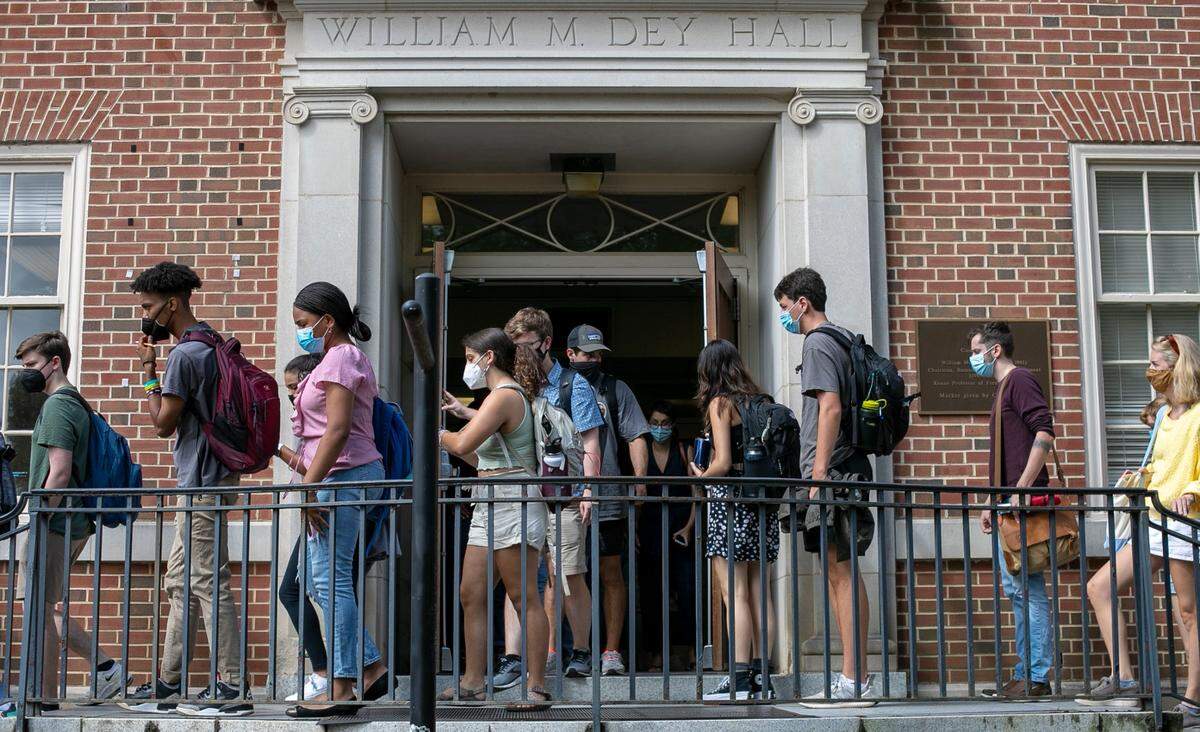
UNC-CH can test up to 10,000 per week and is averaging about 6,500 tests weekly. The university is also adjusting its testing program based on cases and clusters. Last month, UNC-CH saw an increase in the number of cases in certain dorms and certain floors. The university recommended that everyone on those floors get tested to identify potential clusters early, isolate those cases and preemptively limit the spread.
N.C. State has run more than 26,000 tests on campus and identified 246 cases through campus testing. The university has reported 388 total cases among students and employees.
Casani said they’re doing more than 2,000 tests per day and the lines to get tested are there all day, but they move quickly.
How are COVID-19 cases spreading?
At both UNC-CH and N.C. State, contact tracers have not found that cases are tied to particular events or parties, residence halls, or fraternity and sorority houses like they were last fall.
“All of a sudden we had tons of cases in one day, so I think that rate of rise is what scared us and made us go to the decision of [going remote],” Casani said of last fall.
“We have a year’s worth of experience knowing the level of cases that we’re seeing is probably natural given that we’ve brought a lot of people back to campus in a short period of time,” she said.
N.C. State hasn’t seen a rapid spike in cases or clusters this fall. The highest daily case count was 49 cases among students in the first week of classes. The rolling 7-day average is at about 12 new daily cases.
The campus isl not seeing spread in classrooms, officials say, because students are wearing masks. N.C. State has also adjusted its large classes so that they aren’t as crowded and added technology to make classrooms capable of offering remote and in-person at the same time. Some classes are rotating groups of students to be remote one day, in class the next.
Cases seem to be coming from students and employees just being out in the community, where social activity is higher than previous semesters. University leaders and medical experts expect to see these numbers because that’s what happens with a communicable disease when 50,000 people return to a college campus.
UNC-CH has reported clusters and N.C. State will inevitably report some too, because the delta variant is more contagious than previous strains. A cluster is defined as five or more cases that are linked to each other.
Casani and Barzin said there’s no need to panic when clusters are identified. In theory every single positive case is a member of a cluster, it’s just that the cluster hasn’t been identified, Casani said. Clusters are a sign of good contact tracing efforts.
“What the cluster really is is the reflection of the ability to tie multiple cases together to a single source, and that’s a success story,” Casani said.
Anxiety among some faculty
Across the UNC System, some faculty members are not confident that campuses are safe. At Appalachian State University in Boone, more than 200 professors signed a petition asking the chancellor to temporarily move classes online until at least 70% of students are vaccinated and Watauga County’s community transmission is below 5%.
As of Monday, 51% of students and 88% of faculty and staff at App State are fully vaccinated.
Days before the fall semester started, UNC-CH professors also petitioned university leaders to delay in-person classes for at least a month. They cited the rising severity of the pandemic due to the delta variant and said UNC-CH’s plans were “a formula for disaster.”
Two weeks into the semester, some faculty members remain frustrated because they say there’s no clear plan to switch gears from a fully in-person experience if necesssary. Professors also say there’s little communication about classroom policies related to contact tracing and a lack of flexibility to change their teaching methods.
UNC-CH professor Jennifer Larson said there’s a culture of distrust between faculty and administration that is quickly gaining momentum. And even with assurances from experts, Larson can’t shake the feeling that her classroom “just doesn’t feel safe” for her and her students.
“There is a lot of anxiety,” Larson said. “And it’s the feeling that we may know more, but there’s still a lot we do not know.”
Larson, a teaching professor in English and comparative literature, is a member of the UNC-CH Faculty Executive Committee, a group that has consistently shared concerns with administrators. Some professors are anxious when sitting in a small classroom with 30 or more students and you know that there are cases across campus, Larson said. People are wearing masks, but they are not six feet apart.
“We’ve been conditioned over the last year and a half to distance and not be in indoor areas and then here we are,” she said.
And many faculty and staff members have unvaccinated younger children who they’re worried about getting sick.
“Even though I’m fully vaccinated, I pick up COVID on campus and I’m asymptomatic, but I bring it home to my unvaccinated child who then brings it to his school,” Larson said.
At a faculty meeting Monday, professors talked about how the Equal Opportunity and Compliance Office is completely backed up on approving accommodations for those who want to switch to remote teaching. Larson said allowing and empowering faculty to use some of the tools for remote instruction mindfully would alleviate some of the pressure.
Administrators have told faculty to be flexible with students who need to miss class due to COVID-19 exposure. Students’ absences due to COVID-19 symptoms and quarantining will be excused.
Taliajah “Teddy” Vann, president of the Black Student Movement at UNC-CH, said she’s had several COVID scares since the school year started. She’s had to reach out to professors and miss several classes because she has self-quaranted so she doesn’t potentially expose others.
Vann said the majority of students want to be on campus, but the university has a responsibility to make campus safe or keep students away until it is.
“Nobody wants to die in college because our university mismanaged a pandemic two separate times in the exact same way,” Vann said.
The bottom line
The delta variant only takes three to five days after exposure for a person to test positive for the infection. That’s faster than previous strains, which typically saw upticks 10-14 days after an event.
So, the way Barzin sees it, the fact that this is where UNC-CH is two weeks into the semester in terms of cases and spread on campus is encouraging.
He’s confident the campus is a safe environment considering the university is:
▪ in the county with the highest vaccination rates and one of the lowest positivity rates in the state.
▪ the vast majority of students and employees are vaccinated.
▪ plus people are getting tested regularly and wearing face masks.
In addition to the safety concerns on the N.C. State campus, Casani said they also saw the other trauma last year of what it means to shut down suddenly for students, faculty and staff. It totally disrupts the university’s mission, she said.
“We want to try to get to our mission while we’re doing all of these other things, because that’s the point of resiliency,” Casani said. “We’re in for the long haul with COVID, might as well figure out how to do that without shutting down.”