NC abortion restrictions could hurt state’s ability to attract and keep OB-GYNs
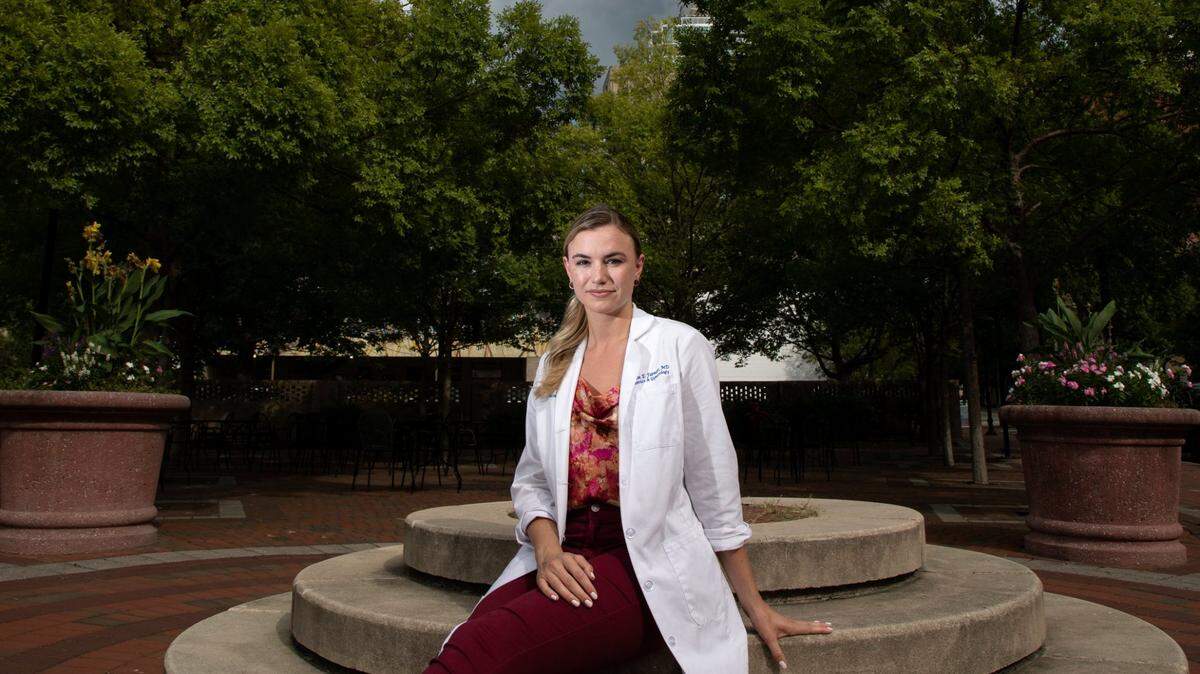
With two years left in her medical training at Duke, Dr. Lauren Farmer will soon be faced with a difficult decision: whether to leave North Carolina.
For a third-year doctor training to practice obstetrics and gynecology, the state has become an increasingly hostile place to start a career.
This month, a federal judge reversed a 2019 ruling, making abortion after 20 weeks of pregnancy illegal in North Carolina.
N.C. Republican leaders, who are just a seats away from obtaining a veto-proof majority in the House and Senate, have said they want to pass legislation that “protect(s) the life of the unborn.”
On one hand, Farmer feels an obligation to stay in the state to help fight to expand access to women’s health care.
“The other thought I have is, training under very restrictive policies for abortion and family planning is not a way that I want to practice medicine,” she said.
More than half of doctors stay in the state where they complete their residency, according to a survey from the Association of American Medical Colleges. Duke’s top-tier OB-GYN residency programs have produced a steady stream of accomplished doctors for patients in North Carolina — the program has produced 55 alumni since 2000 who now practice in the state, a large number considering the program accepts fewer than 10 residents a year.
But Dr. Beverly Gray, the director of Duke’s OB-GYN residency program, fears abortion restrictions could dissuade good doctors, like Farmer, from staying in North Carolina after their residency or even applying to the program in the first place.
“What I worry about is that we’ll lose a lot of talented physicians who want to have comprehensive OB-GYN training,” she said.
Spooking doctors
Just the threat of tightening abortion laws could be enough to spook a new class of doctors from applying to programs in the state, Gray said.
Farmer said state abortion laws were a large factor in where she decided to apply.
“Personally, I would not have come to Duke if we had restrictive abortion laws in North Carolina,” said Farmer, a Vermont native.
The University of North Carolina School of Medicine also has a highly ranked OB-GYN residency program that could be impacted by future abortion laws, but would not discuss the issue. Spokesman Alan Wolf said, “We can’t speculate on what changes may be made in the law and how those changes might impact education and training.”
UNC, unlike Duke, is a public school and relies on lawmakers who may be voting on abortion restrictions in the future for its funding.
Farmer said she only applied to institutions that had Ryan Programs, a designation given to residencies that comprehensively train doctors to perform abortions and family planning services.
On the Ryan Program website, the residency programs in North Carolina now have an asterisk next to their names, indicating that abortion training may be restricted.
Gray said the 20-week ban doesn’t disqualify Duke from being a Ryan Program — while residents can participate in these rare second-trimester procedures if they want experience handling complicated cases, it is not a mandatory part of the resident training.
Still, she worries about how future abortion laws could impact obstetric and gynecology training.
Doctors are required to complete a certain number of abortions set by the American Congress of Obstetricians and Gynecologists to complete their residency. If state laws make it untenable to meet that minimum, Gray said, they may have to consider sending residents to other states for that portion of their training.
Gray also worries that tightening abortion laws could cause fewer doctors to pursue OB-GYN as a specialty.
“I worry that some people might think, Do I really want to go into a field where I could potentially be prosecuted for for taking the best care of a patient?” she said.
Downstream consequences
Most parts of the United States, including North Carolina, cannot afford to lose OB-GYNs. The American Congress of Obstetricians and Gynecologists predicts there will be a shortfall of up to 22,000 OB-GYNs by 2050.
An OB-GYN shortage would not just impact women’s access to abortions — it could also make it difficult to get access to birth control counseling, prenatal care and reproductive cancer screenings.
“Most people who provide abortion care, also provide comprehensive OB-GYN care,” Gray said. “We have the potential to lose great physicians kind of all around.”
Farmer said she has already decided that she won’t apply to work in states with strict limitations on reproductive health services. That list could include North Carolina if state legislators further erode abortion access, she said.
“I would not want what I’ve learned and trained to do to be in conflict with the law,” she said, “I think that’d be a very stressful situation.”
This story was originally published August 30, 2022 at 5:45 AM.