Students doing a summer project alerted UNC to lead in campus water, records show
UNC-Chapel Hill officials were first made aware that there was lead in campus water fixtures by a professor at the university who had students test for the toxic metal as part of a summer project, records obtained by The News & Observer show.
George Battle, UNC vice chancellor for institutional integrity and risk management, confirmed the information to The N&O in an interview Tuesday.
“It was indeed a professor with a summer class,” Battle said.
In an email sent Aug. 1, professor Drew Coleman informed Kim Haley, industrial hygiene manager for the university’s Department of Environment, Health and Safety (EHS), that, through testing performed as part of a summer project, students had found “several” drinking fountains on campus with “dangerously high concentrations of lead.”
The discovery by Coleman’s students eventually led to EHS testing for lead in water fixtures around campus — a process that is ongoing, and that has thus far this semester revealed lead in water fixtures in more than a dozen campus buildings.
Coleman, a professor in the university’s Department of Earth, Marine and Environmental Sciences and the chair of the Environment, Ecology and Energy Program, said in the email that he runs “an isotope geochemistry lab that specializes in lead analyses.”
“As part of a summer project, we had students from Robeson Early College analyze lead in drinking fountains across campus,” Coleman wrote.
The N&O attempted to contact Coleman by phone Wednesday for additional information about his students’ tests, but has not heard back.
EHS tested for lead more than 20 days after Coleman’s email
It is unclear from the records whether Coleman performed additional testing or analysis, as he stated he would do in his original Aug. 1 email. In an email sent Aug. 9, Coleman informed Haley that he had “found an error in the calculations” and that he could “no longer use these results.”
An email sent by EHS executive director Cathy Brennan on Sept. 6 said Coleman “did not have new data” — though, by that point, EHS had already confirmed lead in building water fixtures through the department’s independent testing.
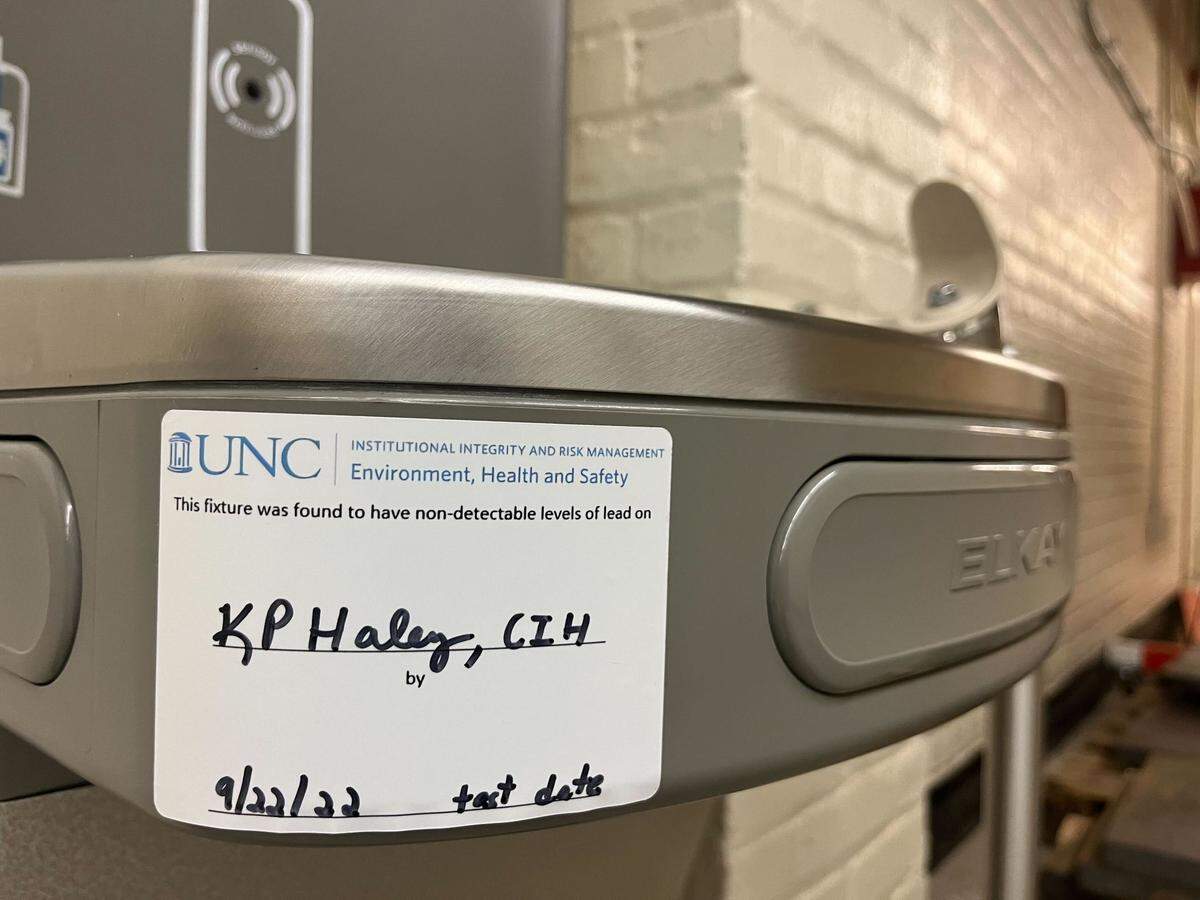
Battle on Tuesday told The N&O that Coleman’s first communication with EHS about his students’ test results prompted the department to “immediately” take action and perform testing to confirm the results.
Emails obtained by The N&O appear to show that Haley with EHS responded to Coleman on Aug. 8, one week after the professor’s initial email.
EHS first tested for lead in three drinking fountains in Wilson Library — one of the buildings where Coleman’s students identified potential lead — on Aug. 22, the emails show. Tests were returned to EHS on Aug. 29, confirming that lead was present in the fountains, and occupants of Wilson Library were first notified about the results on Aug. 30.
EHS then performed additional testing in Wilson Library, informing building occupants on Sept. 9 that an additional drinking fountain and several sinks had been found to have lead in the water.
Lead was then identified in seven other buildings in September, followed by multiple other buildings, including in residence halls and student rooms.
Universities are not required to test for lead in water
Unlike public water systems, which are required under the Environmental Protection Agency’s Lead and Copper Rule to regularly monitor customer water for lead, there are no federal requirements for universities to test for lead in campus water regularly, or at all.
“There is no guideline for when you test or how you test,” Battle told The N&O.
In an email sent on Sept. 2, Brennan said the university does not test “on a schedule” and that previous records of testing are for “just one offs when someone requested.” In a Sept. 20 email, Brennan told an occupant of Fordham Hall — where lead was found in one drinking fountain in September — that “we do test by request if someone believes there is a water quality issue.”
Since lead was discovered on campus this semester, UNC has implemented a three-phase approach to testing water fixtures on campus for lead. The phased approach to testing “is intended to find the fixtures that have the highest likelihood of containing lead first to mitigate the potentially highest health risks as quickly as possible,” UNC spokesperson Erin Spandorf previously told The N&O.
The university is currently in the second phase, which targets water fixtures in buildings that were built in or prior to 1930. The third phase will target buildings that were built in or prior to 1990.
“We really take the health and safety of the university community extremely seriously, and that’s why we’re moving so aggressively to do it,” Battle said of the university’s testing plan.
Health testing available on campus
Lead, even at low levels of exposure and ingestion, is known to cause adverse health effects, especially in children and pregnant women. In adults, the EPA says, lead exposure can lead to cardiovascular effects, increased blood pressure, hypertension, decreased kidney function and reproductive problems in both men and women.
Health testing is available at no cost to UNC faculty, staff and students who work or study in the affected buildings where lead has been identified.
To access health testing, students and post-doctoral fellows are instructed to contact UNC Campus Health at 919-966-2281. Faculty and staff seeking health testing should contact the University Employee Occupational Health Clinic by phone at 919-966-9119. Non-student and non-employee community members and visitors who have health concerns are instructed to consult with their physicians.
The university has thus far not reported any known adverse health effects or concerning blood lead levels related to the identification of lead on campus.
This story was originally published October 26, 2022 at 4:41 PM.