Wake school board backs new equity policy, saying it’s ‘long overdue’ step
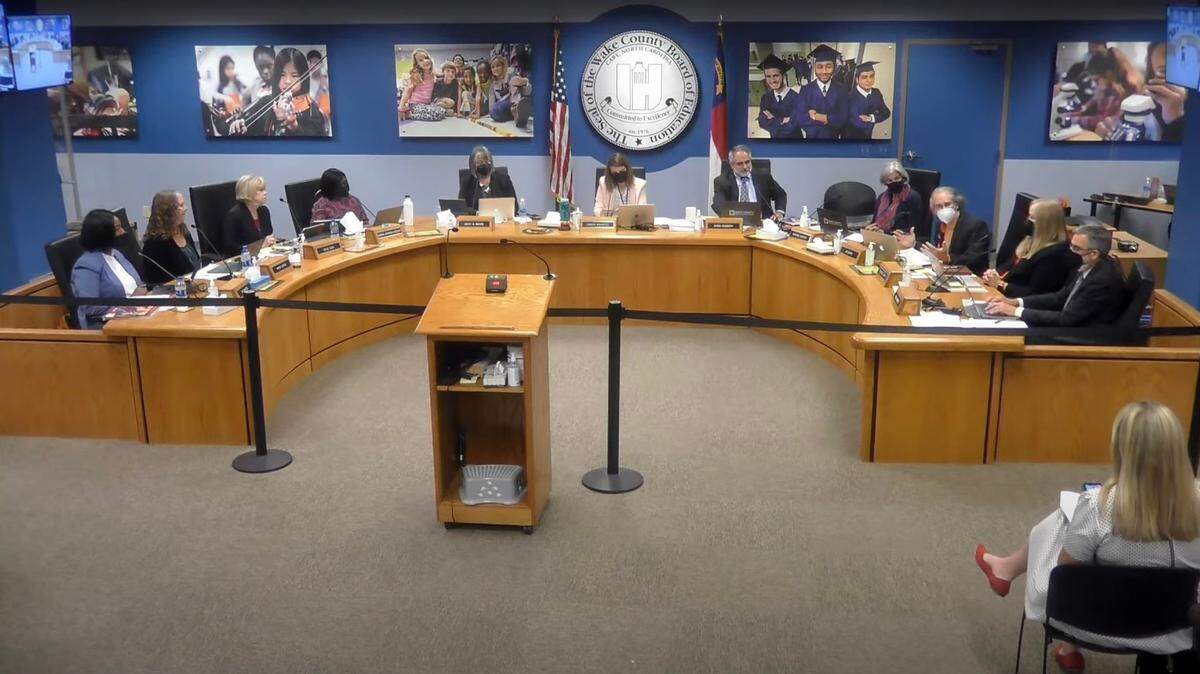
A week before Election Day, the Wake County school board gave unanimous initial approval Tuesday to a new equity policy that has generated debate in the community.
The equity policy calls for addressing disparities, reflecting on biases and recognizing the voices of marginalized groups in North Carolina’s largest school system. The policy says Wake will take steps like implementing diverse instructional materials, recruiting a more diverse workforce and questioning practices that lead to inequity.
“There is a need to address systemic inequities that have kept generations of students from achieving their full potential,” said school board member Tara Waters, who is Black. “I think this is overdue and I’m so excited for the opportunity to be able to give voice to students who look like me.”
The board is scheduled to give the policy final approval on Nov. 16 after deciding Tuesday not to suspend its rules to approve the policy in one vote. But the policy could be overturned if a new conservative board majority takes office after next week’s election.
Conservative school board candidates have frequently spoken at board meetings and criticized the board for its focus on equity. But none were at Tuesday’s meeting as the Triangle Education Coalition had urged people to sign up to speak to try to shut out the policy’s critics.
“This is a win for those of us on the left who organized to speak tonight,” the Triangle Education Coalition tweeted Tuesday. “The right wing is not here because they lost the speaking lottery. Otherwise they’d be here like every meeting to get their free advertising. Well done!”
‘Apply an equity lens’
Equity has become a hot button issue in school districts.
School districts say they need to change their practices to better meet the educational needs of an increasingly diverse student enrollment. Terms such as “culturally relevant teaching” are often used, which some critics say should instead be called Critical Race Theory.
The new policy defines equity as “the elimination of predictability and disproportionality of outcomes based on student characteristics.”
Examples of student characteristics are race, ethnicity, socioeconomic status, language of origin, disability, sex, gender identity and sexual orientation.
The policy calls for “applying an equity lens,” which mean asking teachers and other school employees to reflect on whether any of their practices and biases negatively impact students.
School employees are asked in the policy to reflect on how they can “interrupt inequity” and in what ways do they “affirm” the “lived experiences, culture and identities” of students.
School board member Jim Martin said it was “baffling” and “saddening” that some people don’t think schools should strive to achieve equity.
“It feels to me like those who are opposing equity see education as an entitlement to get ahead,” Martin said. “We used to say that the purpose of public education was to give every child an opportunity. That’s what public education should be: the great equalizer.”
Equity in action
The policy says Wake will take steps such as:
▪ Identifying and providing high-quality instructional materials and methods that “represent the rich diversity of our nation, respect the legitimacy of different cultures, and empower students to value diverse perspectives.”
▪ Recruiting and retaining racially and linguistically diverse and culturally competent administrative, instructional and support personnel.
▪ Eliminating practices that lead to the over- or under-representation of any student group compared to peers in areas such as special education, student discipline, academically or intellectually gifted programs, advanced coursework and Advanced Placement courses.
“This is not taking away to give because I would never do that,” said board member Roxie Cash. “I would never take away from those who’ve worked hard for what they have, or those families that are doing what they can.”
Support for equity policy
All of the written and in-person comments at Tuesday’s board meeting about the equity policy came from supporters. Those comments echoed remarks a group of principals, teachers, counselors and students gave to a board committee last week.
“As far as providing institution-based protections against the advancing threats of full-throated bigotry, to this unenthusiastic and yet still habitual Democratic voter, passing an equity policy is the most valuable use of you’alls remaining time on the board,” Stephanie Lormand said during public comment.
Christina Spears, president of the Wake County chapter of the North Carolina Association of Educators, said the policy is “aimed at addressing the educational debt owed to traditionally marginalized students and staff.”
“We recognize that this policy is long overdue, and my hope is that you don’t let rhetoric or language prevent this policy from moving to second reading very soon,” Spears told the board.
Some speakers argued Wake needs to expand the equity policy even more. Several speakers complained that the policy’s wording that says instructional material should be appropriate for the maturity levels of students will allow LGBTQ materials to be banned from classrooms.
“This age inappropriateness is a definite call-out to people who want to portray the existence of queer people as inherently pornographic, as inherently explicit, as inherently inappropriate for kids,” Drew Hicks told the board. “They want to make our school system a place where kids go out into the world after it and treat queer people like space aliens.”
This story was originally published November 1, 2022 at 9:30 PM.