Will NC Supreme Court overturn ruling that orders transfer of money to public schools?
The North Carolina Supreme Court is weighing whether to reverse a 2022 decision that allows judges to order the transfer of hundreds of millions — and potentially billions — of dollars to fund public schools.
In November 2022, the Supreme Court’s former Democratic majority ruled that the courts can order state officials to transfer funds to try to provide students their constitutional right to a sound basic education.
During oral arguments Thursday, an attorney for Republican legislative leaders Sen. Phil Berger and House Speaker Tim Moore asked the court’s current 5-2 GOP majority to overturn that 2022 ruling.
“The court has recognized time and time again that if a decision is wrongly decided, if it conflicts with the constitution, if it conflicts with prior precedent .... then it should be overturned and corrected at the next possible moment,” said attorney Matthew Tilley. “This is the next possible.”
Will court overturn precedent?
But attorneys representing school districts, the State Board of Education and the state urged the justices to stand by the 2022 decision.
“It has been the rule of this court for over 100 years that the court will not disturb its prior holding in the same case, even if it would have overturned that holding on a properly presented petition for rehearing,” said attorney Melanie Dubis. “We do not have a properly presented petition for rehearing in this case.
“Nevertheless, that is what the defendant-intervenors are blatantly asking this court to do, to go back and overturn Leandro IV, which is binding precedent cited merely 14 months ago.”
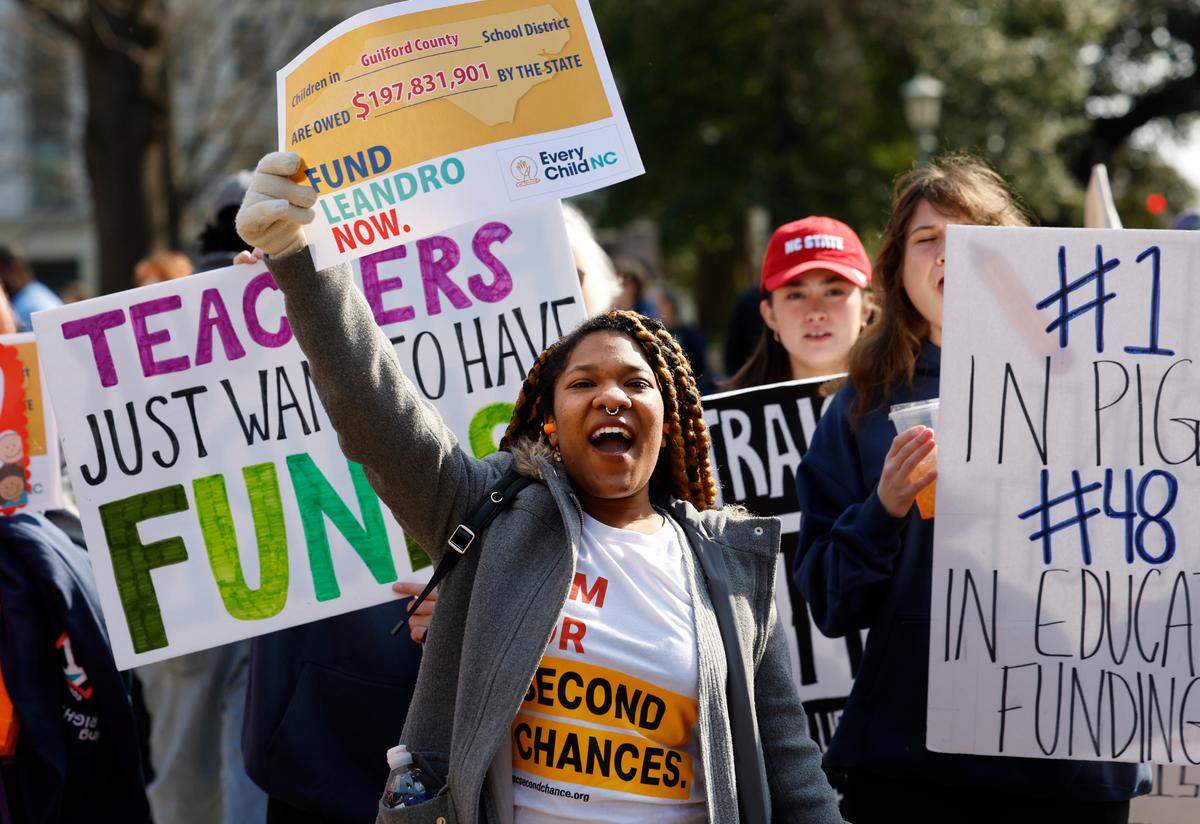
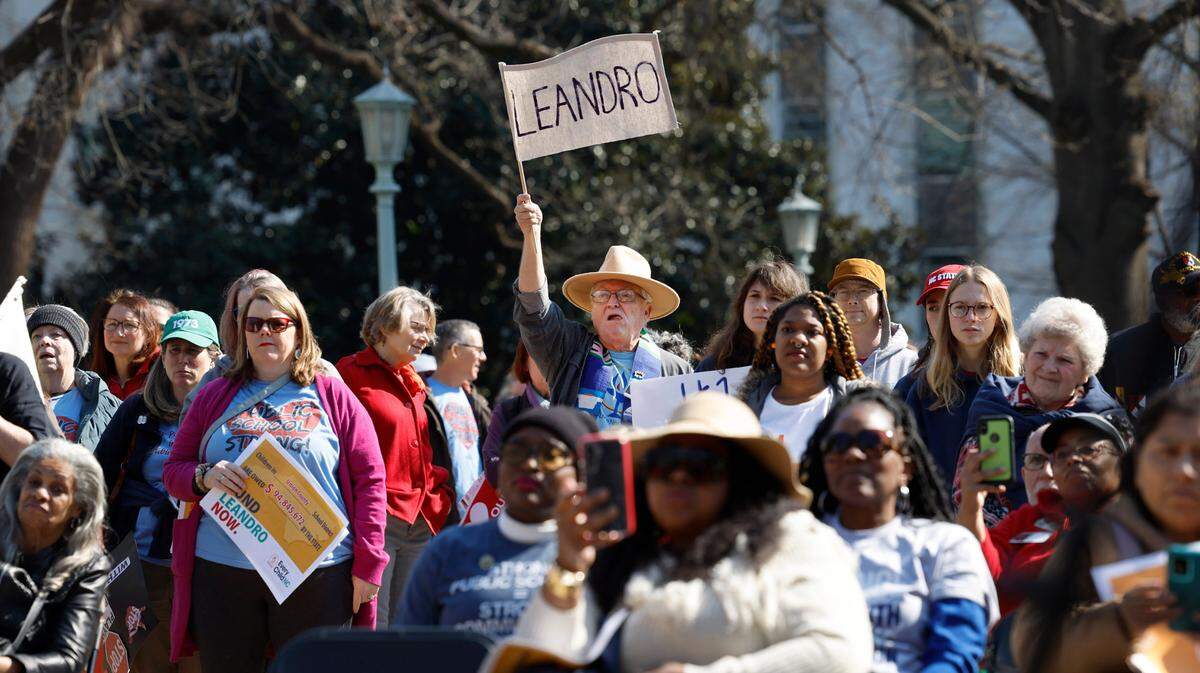
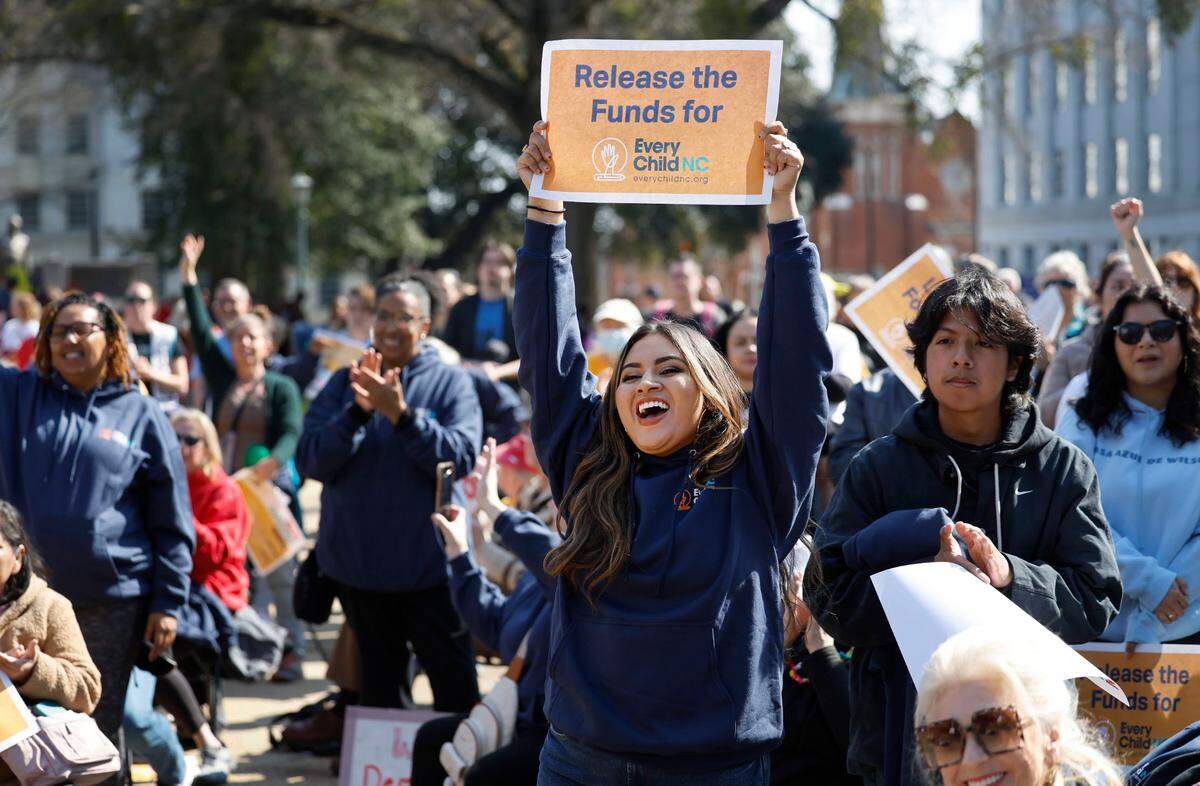
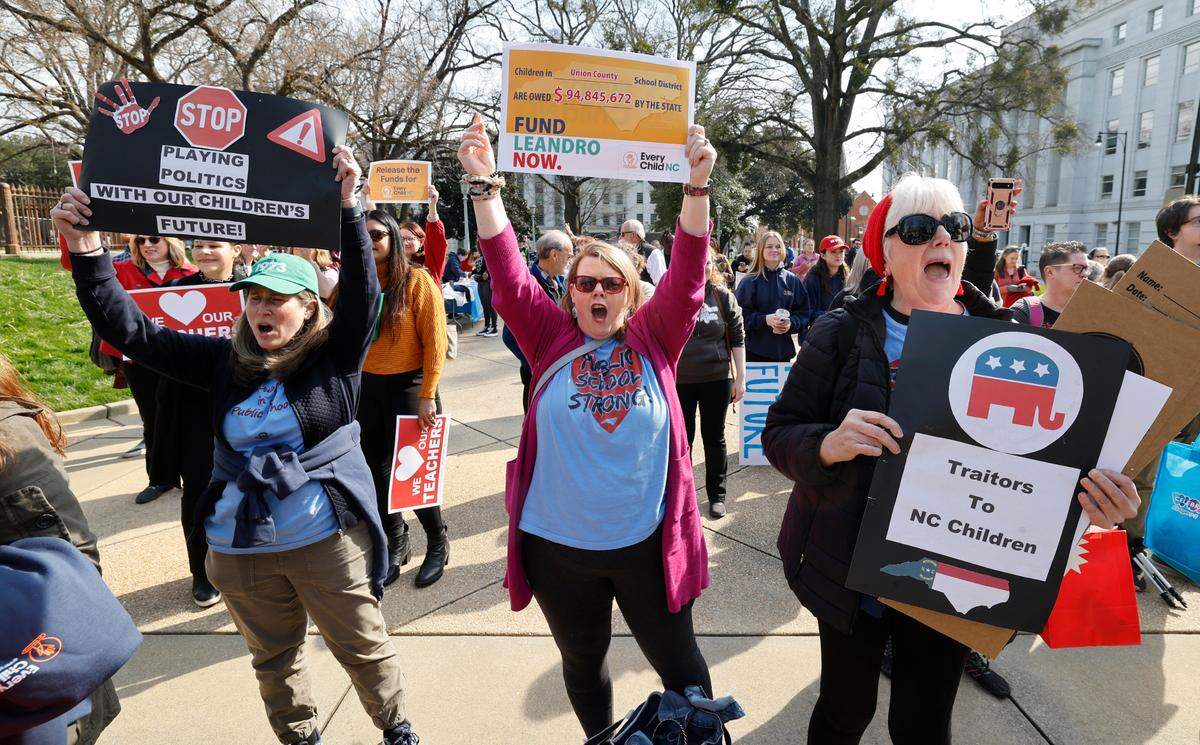
That view was echoed Thursday at a rally held across the street from the court hearing and in statements from Democratic Gov. Roy Cooper and the state’s Democratic legislative delegation.
“Public school children are at the most important crossroads in our history,” Cooper said in a statement Thursday. “Will our Supreme Court be courageous enough to protect those children, or will it once again protect the power of the politicians who would rather give billions in tax breaks and private school vouchers for the wealthy?”
The court is expected to issue a ruling this year.
Leandro case is now 30 years old
This week’s court hearing is the latest chapter in the now 30-year-old Leandro school funding lawsuit that was initially filed in 1994 by low-wealth school districts to get more state funding.
Over the years, the state Supreme Court has ruled that the state constitution guarantees every child “an opportunity to receive a sound basic education” and that the state was failing to meet that obligation.
In November 2021, Superior Court Judge David Lee ordered the state treasurer, controller and budget director to transfer $1.75 billion to fund the second and third years of an eight-year plan developed by a consultant. The plan is meant to try to provide every student with high-quality teachers and principals.
The eight-year plan is estimated to cost at least $5.6 billion.
Just days before the 2022 midterm elections flipped the court from Democratic to Republican control, the Supreme Court upheld Lee’s order. The Democratic justices said that the courts had deferred long enough for the state to implement a plan to provide a sound basic education.
Soon after taking control, the court’s GOP majority blocked enforcement of Lee’s order.
Lee has since passed away. In April, Superior Court Judge James Ammons issued an updated court order saying $677.8 million is still owed for the second and third years of the Leandro plan.
GOP disputes statewide remedy
Berger and Moore are appealing both Ammons’ authority to issue his order and the constitutional authority of the court’s 2022 decision.
Tilley told the justices that his clients aren’t disputing that the state constitution guarantees every child an opportunity to obtain a sound basic education. Instead, he said they’re questioning the authority of the court to order the implementation of the Leandro plan for the entire state.
GOP lawmakers have argued that the state constitution only empowers the General Assembly to spend state funds.
“The case is about whether the trial court, when presented only with district specific claims, had jurisdiction to issue sweeping statewide orders that required the comprehensive remedial plan,” Tilley said.
“A plan which dictates virtually every aspect of education and policy and funding not just for the districts that were plaintiffs but for all 115 school districts across the state, effectively removing those decisions from the political and democratic process.”
Tilley said any court remedy should have only applied to Hoke County, which is one of the named school districts in the lawsuit.
But the two Democratic justices questioned Tilley’s interpretation that prior Supreme Court decisions don’t allow for a statewide remedy.
“This issue of subject-matter jurisdiction was decided at multiple points it seems to me in this litigation, including with this court’s decision in 2004,” said Democratic Justice Anita Earls.
‘Remember’ the students
Dubis, the attorney for the school districts, accused Berger and Moore of engaging in “gamesmanship” by asking the court to ignore its own rules on rehearing decisions.
Dubis asked the justices to remember the 480,049 students in grades three through eight who are not considered sufficiently proficient in reading.
“(That is) 480,049 children who will become the third generation of children since this lawsuit was filed to pass through our state’s school system without the benefit of relief if this court takes away from them the relief that it finally delivered them 14 months ago,” Dubis said.
Most of the time for Dubis and state Solicitor General Ryan Park was spent fielding questions from Republican justices on topics such as the lack of current students as plaintiffs. The students who were originally part of the lawsuit, including the Leandro family which was the initial lead plaintiff, have long since aged out.
Dubis said it no longer matters if any students are plaintiffs because school boards have standing in the case.
Republican Justice Phil Berger Jr. asked if the plaintiffs would expect the court to step in if, for instance, a school district decided it would not teach reading. Park answered that it would be perfectly appropriate for the court to order relief.
“Once we step into that sphere are we not becoming mini-legislators in that respect?” Berger said. “We will no longer allow you to teach DEI (diversity, equity and inclusion) because it’s not related to reading, writing and math. Are those the types of decisions that we are called on to make now?”
Berger Jr. was asked to recuse himself by the plaintiffs because he is the son of Sen. Phil Berger.
Berger Jr. asked the other justices to decide if he should recuse himself. The justices voted along party lines to say he could hear the case.
GOP lawmakers asked Earls to recuse herself because she had served as an attorney in 2005 for Charlotte-Mecklenburg students who joined the case as plaintiffs. She declined the request.
This story was originally published February 22, 2024 at 1:03 PM.