UNC shares enrollment data for first post-affirmative action class. What does it show?
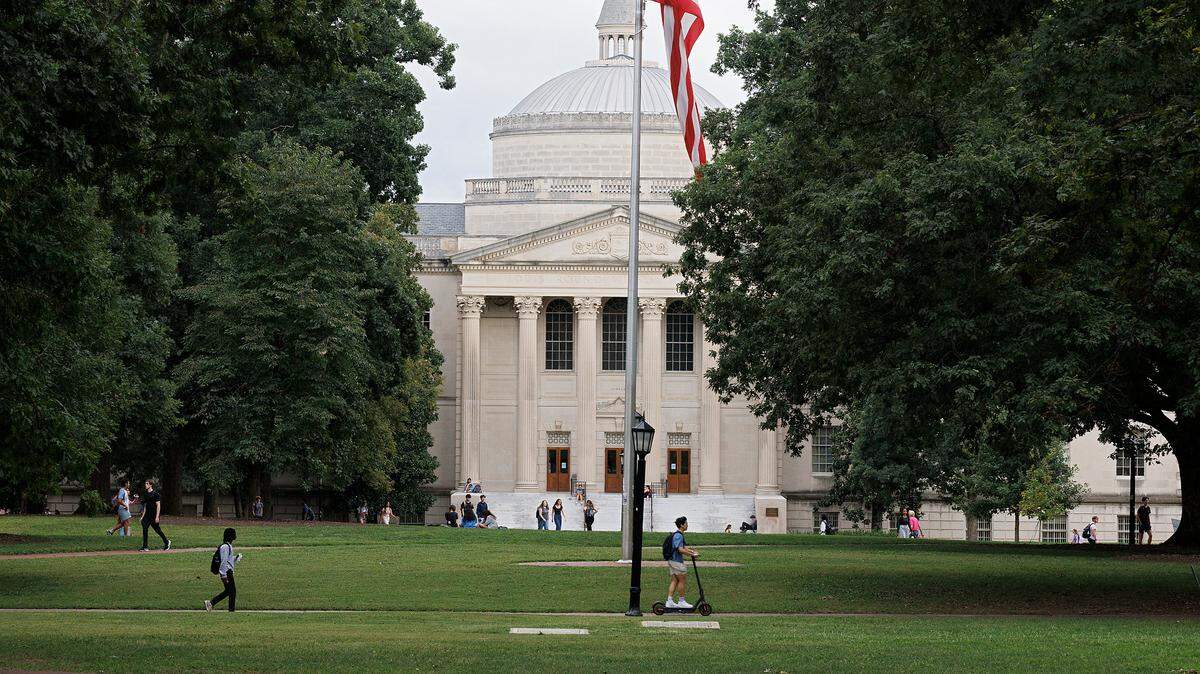
UNC-Chapel Hill’s newest first-year class includes a lower proportion of Black students compared to the previous year — a change that could stem from the U.S. Supreme Court’s decision last year to ban the consideration of race in college admissions.
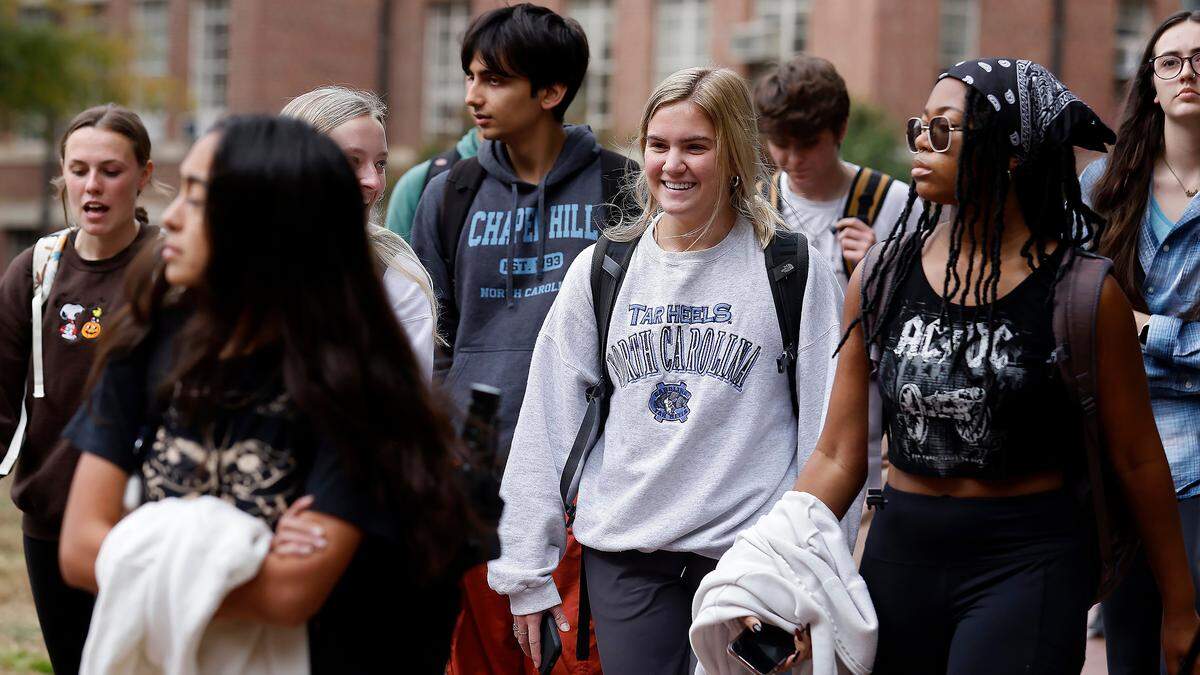
The undergraduate class of 2028 is about 64% white, 8% Black, 10% Hispanic or Latino, 26% Asian or Asian American and 1% American Indian, the university announced Thursday. (Students self-report their racial and ethnic identities when they apply for admission. Some students may select more than one identity, which can result in a total higher than 100%.)
When the class of 2027 — whose students are now sophomores — entered the university last fall, the university said the class was 63% white, 11% Black, 11% Hispanic or Latino, 25% Asian or Asian American and 2% American Indian.
In all, the university welcomed 4,641 first year students and 983 transfer students this fall, the university announced. The university received more than 73,000 applications for admission this cycle, an increase of more than 15% over the previous cycle.
The Supreme Court last June overturned race-conscious affirmative action — the practice that allowed colleges and universities to consider race as one factor in admissions decisions — in landmark rulings on cases in which UNC and Harvard University were defendants. The cases, brought by anti-affirmative action plaintiff Students for Fair Admissions against the universities, wound through the courts for nearly a decade before the nation’s highest court weighed in and banned the practice for colleges nationwide.
UNC maintained throughout its nine-year defense of its policy that the university did not make admissions decisions solely based on race, but instead considered the information as part of its “holistic approach to undergraduate admissions.” But in the 2023-24 admissions cycle, for the first time in decades, the university was not allowed to consider applicants’ race in any way.
The impacts of the ruling — which primarily affected the country’s most selective colleges — have been largely unclear until recent weeks, when universities began to release information about their incoming students. But they still remain somewhat murky.
“It’s too soon to see trends with just one year of data,” Rachelle Feldman, UNC vice provost for enrollment, said in a statement Thursday.
Effects of court decision remain unclear
Supporters of affirmative action predicted the Supreme Court’s decision would negatively impact the diversity of incoming classes after the ruling. And while that appears to be the case at several colleges, including UNC, it has not been so everywhere.
In its lawsuits, Students for Fair Admissions argued that race-conscious admissions policies were especially discriminatory against Asian American and white students. At UNC, specifically, SFFA alleged that the university gave under-represented minority students an advantage in the admissions process, while hindering “high-achieving” Asian American and white applicants.
The data UNC shared Thursday showed only modest increases in the proportion of white and Asian American students among its new class, with each group increasing their shares of students by about 1 percentage point.
Comparatively, Asian or Asian American students decreased in Duke University’s class of 2028, which otherwise has a similar racial breakdown to that of the university’s class of 2027.
Aside from race, UNC’s newest students hail from 95 of North Carolina’s 100 counties, up from 93 counties last year. They also represent all 50 states and Washington, D.C., plus 79 countries.
While universities are no longer allowed to consider race in admissions, experts have suggested that they could use “race-neutral alternatives” to continue achieving some level of diversity among their students. Such alternatives include geography, in which universities could add weight in the admissions process to a student’s home county or high school, for instance.
Asked by The N&O Thursday how the university considers geography in admissions, Feldman said there had not been major changes to that consideration since the Supreme Court’s decision, other than “being a lot more intentional” about recruiting students. Part of that effort includes six new outreach counselors the university hired after the decision, who are tasked with reaching students across the state.
“We really seek every year, and always have, to have representation from every county in North Carolina,” Feldman said, noting that she did not know whether “we’ve ever been 100% successful in making that happen” given that some counties are “very, very small.”
The university does not have quotas to admit students from different parts of the state, she said. Feldman said admissions staff look at the county distress rankings, as defined by the state Department of Commerce, for where a student lives.
“But we look a little more at their personal circumstance,” Feldman said, saying such factors could include the level of resources available to students at their high school or in their community, or whether they had to work while also attending school.
UNC’s announcement Thursday is notable on its own, particularly given that it comes as the university is expected in the coming days to announce how it will comply with a UNC System ban on diversity, equity and inclusion.
But it also comes as the university, under a new chancellor, is considering broader changes to its enrollment strategy — including a proposal to admit more out-of-state students.
Potential changes to UNC enrollment
This spring, UNC Chancellor Lee Roberts — then serving in the role in an interim capacity — established four working groups to explore areas at the university that had “emerged deserving of focused attention” following conversations he’d had around campus.
Among the areas was “enrollment planning,” with its committee tasked with identifying “opportunities and challenges related to serving the needs of a vibrant, fast-growing state.”
Speaking to reporters last month after being elected chancellor, Roberts summed up one of those key challenges by saying: “The state is growing very rapidly, as we all know. Carolina has not grown very much.”

The enrollment committee’s report, submitted to Roberts on Aug. 1 and released Wednesday, further explained the dichotomy by stating that, since 1980, the university’s in-state enrollment has grown slower than the state’s high school population.
“In 1980, Carolina’s total resident undergraduate enrollment equaled 19% of the number of NC high school graduates, compared to 15% today,” the report stated.
To address the issue and to grow the university’s enrollment, the committee recommended adding 5,000 undergraduates over the next five years, equally divided among in-state and out-of-state students. In order to accommodate the increased costs and required resources that would create, the committee also recommended raising the out-of-state enrollment cap in each incoming class from 18% to 25%.
That would be the first increase to the cap at UNC since the UNC System instituted it in 1986. The university is one of just five in the 16-university system that still adhere to the 18% cap, with the others now capped between 25% to 50% after a series of increases in recent years.
Feldman told reporters Thursday that adding more out-of-state students would allow “us to open up the university to more North Carolinians.”
“The plan was never to displace any students from North Carolina, but, in fact, use students from out of state to help us grow,” she said.
The class of 2028 and incoming transfer students include more than 4,600 students from North Carolina and about 1,000 from out-of-state, the university said Thursday.
Feldman said the proposal, as it stands, is “an early recommendation in its infancy.”
Impacts of FAFSA on enrollment
The report also stated that an increase in out-of-state students would allow the university to continue its freeze on tuition, which has not increased for nearly a decade.
After the Supreme Court’s decision last summer, former Chancellor Kevin Guskiewicz announced the university would offer free tuition to incoming in-state students whose families make less than $80,000 per year. Increasing financial aid and considering socioeconomic status in admissions had been proposed as one way for colleges to continue to achieve diversity on their campuses without considering race.
UNC spokesperson Kevin Best told The N&O Thursday that more than 1,200 of this year’s first-year and transfer students have at least the full cost of tuition and fees covered through grants and scholarships, including the “Tar Heel Guarantee” free tuition offer. The university offers a variety of additional financial aid programs, including the Carolina Covenant, which offers students the opportunity to graduate from the university debt-free, if they are from families whose income is at or below 200% of the federal poverty level, or $31,200 for a family of four in 2024.
Financial aid offers at UNC and across the country were severely delayed this year due to widespread issues with the Free Application for Federal Student Aid (FAFSA).
The university’s announcement Thursday said that the FAFSA delays “may have had an impact on Carolina’s incoming class.”
“Many students may not have had the information they needed about their eligibility for financial aid until very late in the admissions cycle,” the announcement said “The University does not know the extent those issues had on its applicant pool.”
For nearly two decades, UNC has held the top spot among public universities in U.S. News & World Report’s list of “best value” colleges.
This story was originally published September 5, 2024 at 8:13 AM.