After spring ‘chaos,’ UNC System board considers drafting policy for future protests
After a spring semester that saw pro-Palestinian tent encampments pop up on college campuses around the country, the board that governs North Carolina’s public universities could move to draft a policy setting standards for protests that would apply to all 17 campuses under its jurisdiction.
Currently, there is not a single, UNC System-wide policy on “mass gatherings” and any student-conduct violations that occur during the events. Instead, each campus has the purview to set its own policies using guidelines on student conduct and free expression that are set forth in the system policy manual.
Soon, that could be changing — though system leaders are cautioning that such a decision is not close to being final.
A committee of the UNC System Board of Governors on Wednesday discussed several “best practices” for how the system’s universities currently handle the issues, based on a survey of campuses conducted by system legal staff that began after the board’s May meetings. The six “best practices” included in a presentation that general counsel Andrew Tripp gave to the committee were:
- Requiring protesters to submit prior notice if they plan to gather in indoor spaces or in “high traffic” outdoor space;
- Restricting gatherings within 50 feet of classroom buildings and regulating overnight camping on campus;
- Ensuring that each chancellor’s “highest designee” for questions regarding gatherings is part of the university’s public safety department;
- Establishing that any UNC System student who engages in misconduct at another system campus would face discipline at the school where they are enrolled;
- Establishing that if a student violates state or federal law, the violation is also considered a violation of student conduct;
- and ensuring that the student-discipline process is overseen by university employees, not students.
During the roughly 50-minute discussion, some members of the board expressed interest in having those practices codified into a system-wide policy that would apply equally to all campuses.
“We talk a lot about our freedoms, and the freedom to gather and expression and free speech and all that is certainly important, but the ones that are not gathering, trying to go to class, we’ve got to take care of those students, too,” Board of Governors Chair Wendy Murphy said during Wednesday’s committee meeting. “So, we’ve got to come up with guardrails and common sense practices that take out all that chaos that we have had, and the expectations need to be clear across the system.”
But other board members —and some university chancellors — expressed hesitation with the idea and some of the specific “best practices” Tripp described.
UNC Pembroke Chancellor Robin Cummings, for instance, noted that “UNC Pembroke is very different from UNC-Chapel Hill” and “one size doesn’t fit all in this situation.”
“I don’t disagree with the need for this,” Cummings said, “but the implementation, to me, is going to be the key to success.”
Discussion follows spring protests
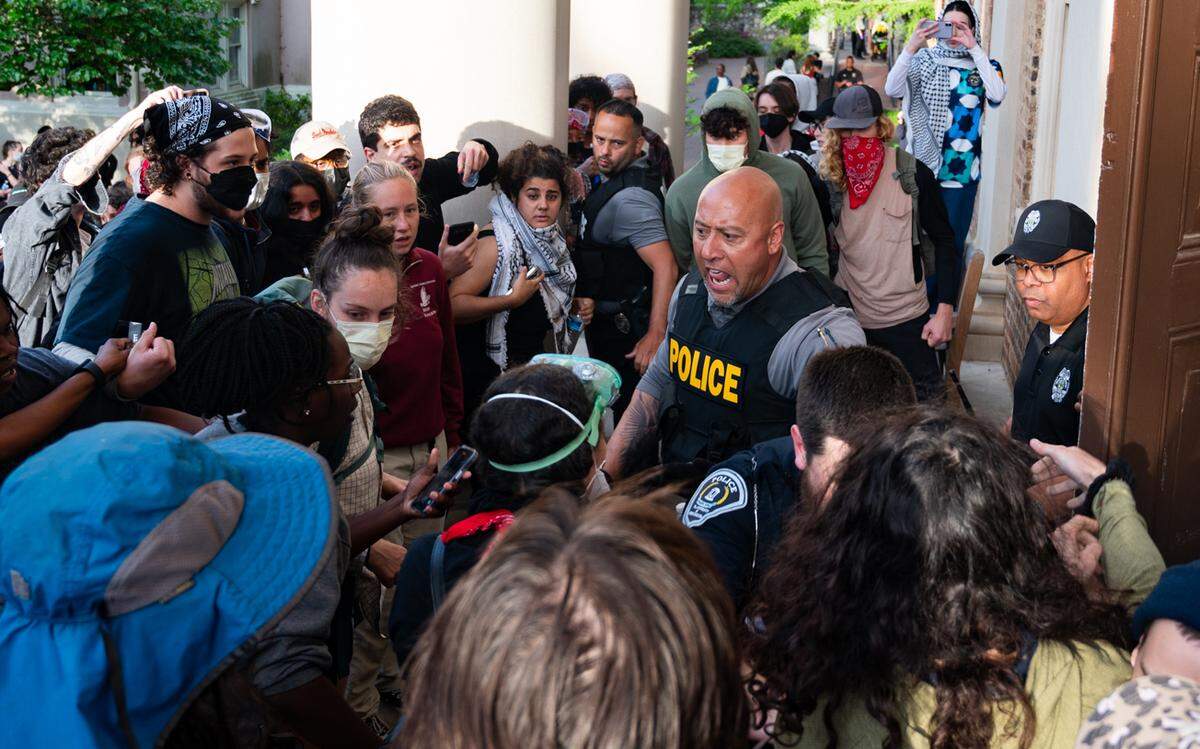
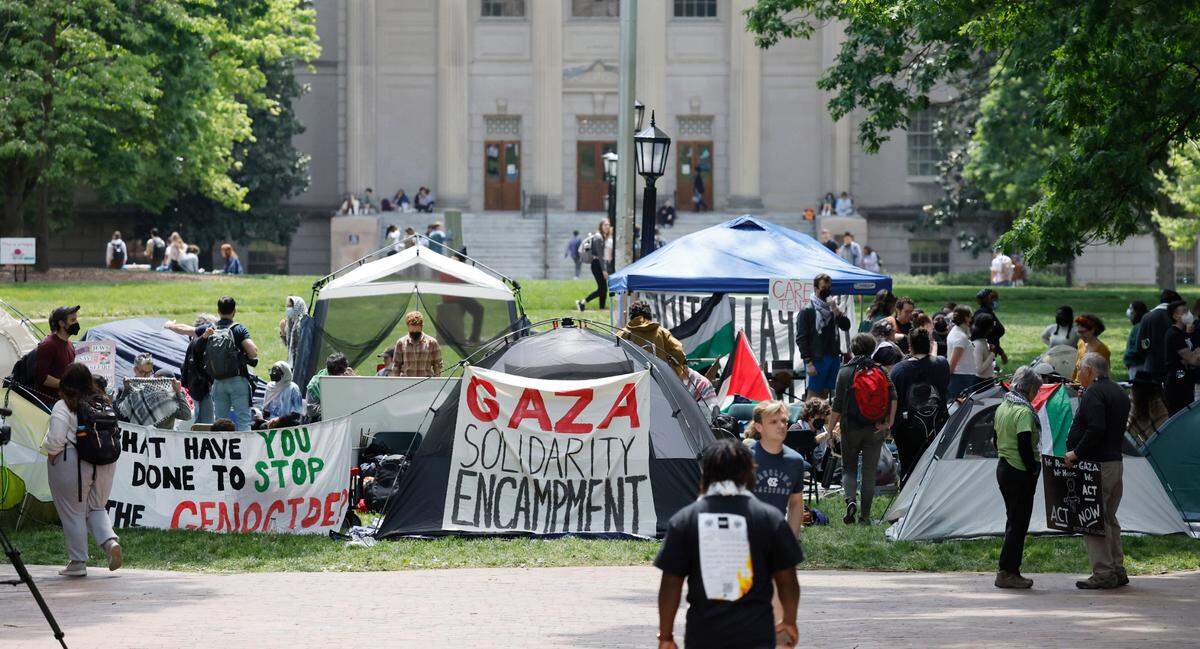
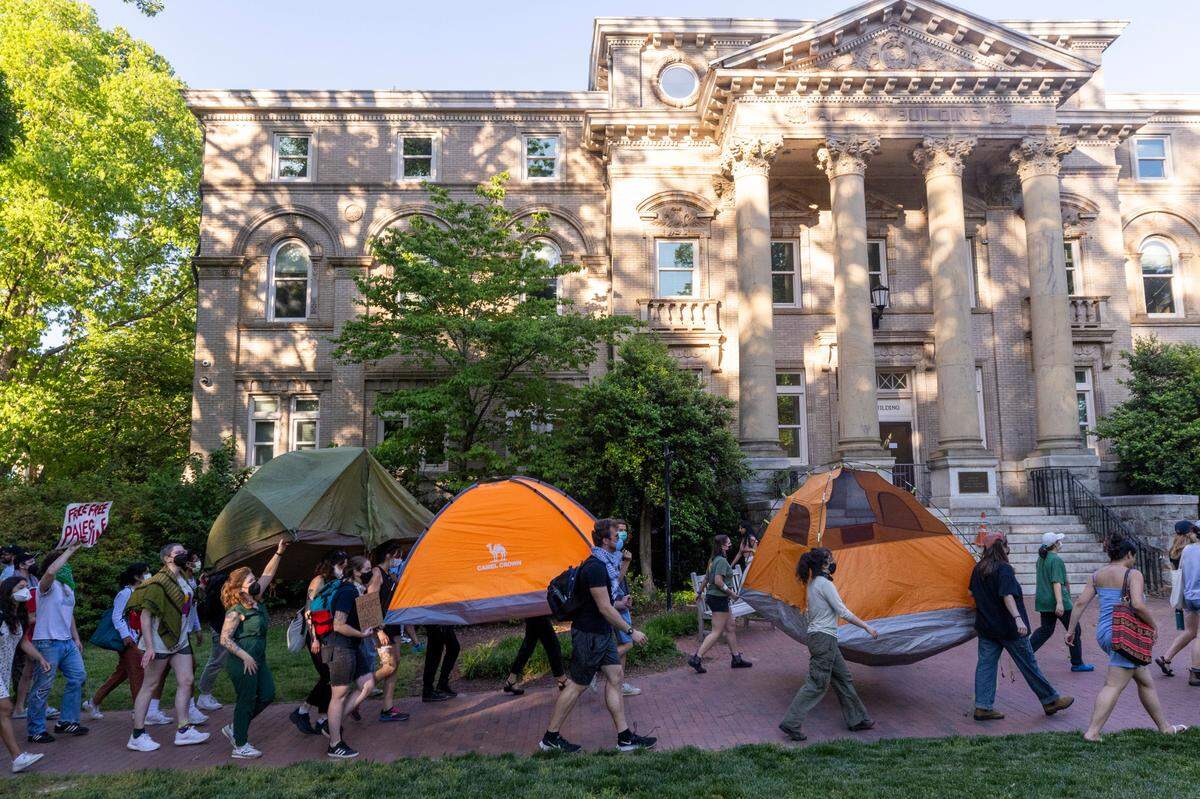
Wednesday’s committee meeting and discussion came several months after students at the UNC System campuses of UNC-Chapel Hill, UNC Asheville and UNC Charlotte staged multi-day protests over the ongoing Israel-Hamas war. Protesters pitched tents and camped on the campuses for at least part of their respective protests.
In each instance, university administrators or police eventually ordered the gatherings to disperse because they violated university policies.
At UNC-Chapel Hill, police charged three dozen protesters on April 30 for refusing to comply with orders to disband the gathering. The gathering regrouped in a new protest later that day without tents, then garnered national attention after protesters removed the American flag from a campus flagpole and replaced it with the Palestinian flag.
Students from other Triangle universities, including Duke University and NC State University, joined the protests at UNC-Chapel Hill. While Duke is a private university, NC State, like UNC-Chapel Hill, is public and part of the UNC System.
Several committee members and chancellors voiced their support of the “best practice” that would apply student-conduct policies to students even if they commit violations of their university’s code of conduct while they are at another university in the system.
“I understand the argument that certain things might work at one campus that are not necessary at another, but bad behavior and chaos and vandalism is bad across the system and should be handled the same way,” Murphy said.
Similarly, there appeared to be broad support for creating a system-wide policy prohibiting overnight camping on campuses.
“If a student can’t camp on my campus, but they can camp somewhere else overnight without permission, then that’s an issue,” UNC Asheville Chancellor Kimberly van Noort said.
Debate over some provisions
But other “best practices” were met with more debate from the committee and chancellors — namely, the idea that any violation of federal or state law would automatically be considered a student-conduct violation.
Some committee members said they would prefer that provision to be narrowed, either to set a bar for the type of legal infractions that would be considered a violation of student conduct or to hinge the conduct violation on whether the student is convicted of a crime. Otherwise, some committee members noted, students could be accused of violating the code of conduct for minor infractions like traffic tickets.
“Federal violations and state violations can be very minor things,” board member Swadesh Chatterjee said.
Bonita Brown, chancellor of the historically Black Winston-Salem State University, also cautioned against the idea, which she said “really caused concern” for her. Brown said that “best practice,” as written, is “very, very broad” and she would prefer the violations be more clearly defined if an official policy is drafted.
Otherwise, “it would just tie up our resources all the time, probably endangering some of our students,” Brown said.
Committee chair Alex Mitchell said he believes “the specifics” of how campuses handle protests and conduct violations “should stay on campuses.” But the board might want to consider implementing some of the practices Tripp presented “on a systemic level,” he added.
Wednesday marked the first time that many chancellors and members of the board reviewed Tripp’s presentation. Mitchell asked UNC System President Peter Hans to instruct all 17 chancellors to compile feedback on the suggested practices and report back before the committee’s next meeting in January, which Hans said he would “absolutely” do.
It is unclear when, or if, that feedback will be used to draft a proposed policy.
“We’re going to hear some feedback in January and see what works. We don’t know that there will be a system-wide policy,” Murphy told reporters after Thursday’s full-board meeting. She added: “More to come.”
This story was originally published November 14, 2024 at 4:36 PM.