How Wake plans to feed hungry students and reduce school food waste with leftovers
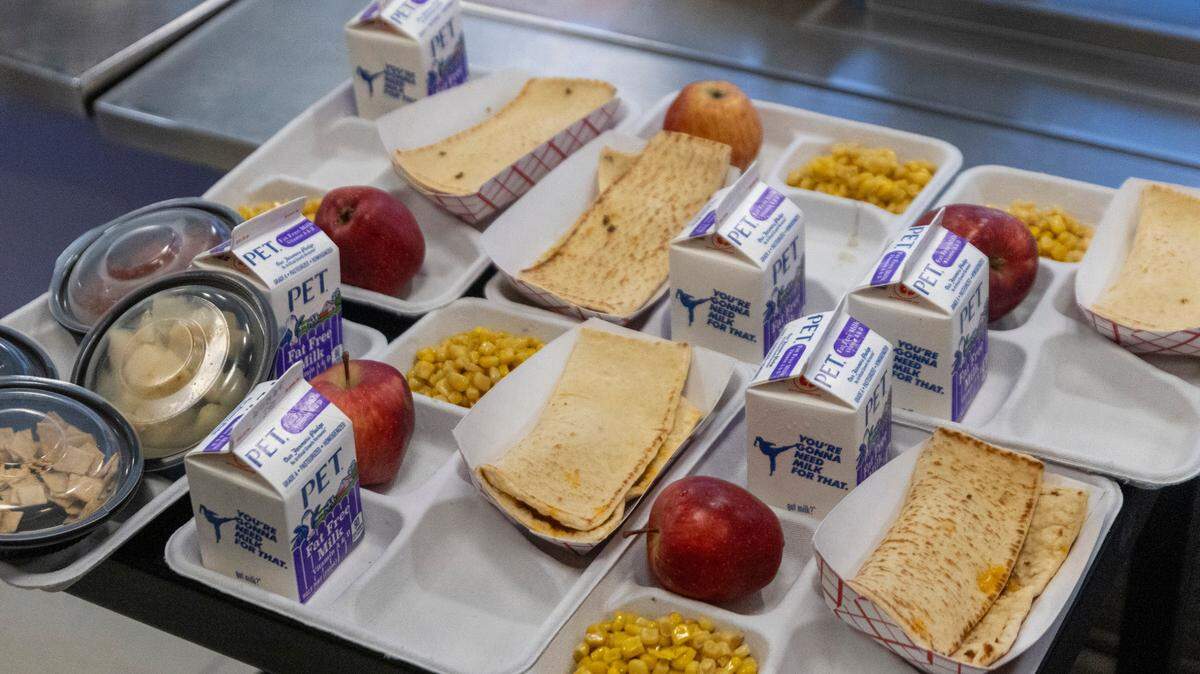
A new program aims to reduce food waste in Wake County schools by recovering leftovers that can be given later to hungry students and community members.
The Wake County school system plans to partner with Toward Zero Waste to save unopened packages of prepackaged food and certain fruits that would normally be thrown away at eight elementary schools. The food would be given to families at the school and local food pantries.
“I know it’s been a sore spot for a lot of parents and for teachers and principals how much food we’re throwing away,” Sam Hershey, the chair of the school board’s facilities committee said during a presentation Tuesday on the pilot program. “So the ability the capture some of that and provide it for students and staff if they need it is fantastic.”
The exact start date for the pilot program hasn’t been set yet. But the goal is to begin it this school year.
Reducing the amount of wasted school food
Toward Zero Waste is a Cary-based nonprofit group that says its goal is to reduce unnecessary waste. Its work includes collaborating with the Town of Cary on its food waste recycling drop-off program
Megan Holler, Toward Zero Waste’s Cary Community co-director, said people reached out to the group to ask if something could be done about all the food that was being thrown out at schools.
A 2023 study found many unopened single-serving packages of vegetables and fruit were being thrown out by Wake students. A 2024 audit of lunch waste of Olds and Wiley elementary schools in Raleigh found that 20% to 35% of waste, by weight, was recoverable food, according to Holler.
Holler said Wake’s 199 schools could produce thousands of pounds per month of saved and redistributed food.
“A food recovery program in our district could have a significant impact not only on food waste reduction but on food insecurity,” Holler told the facilities committee.
After studying programs in other states, Toward Zero Waste wants to start the SHARE program (Stop Hunger and Restore Earth). The group wants to pilot it in eight schools this semester and then potentially expand throughout the district.
Food for students and food pantries
North Carolina food and health regulations prevent time and temperature-controlled foods such as milk and yogurt from being saved. But Holler said many items can be recovered, including:
▪ Packaged snacks such as graham crackers, cookies, pastries, muffins, cereal, granola bars and chips.
▪ Condiments and utensils such as packages of forks and spoons and packets of ketchup and hot sauce.
▪ Fresh fruit with non-edible peels such as bananas and uncut oranges.
▪ Cold foods such as cartons of fruit juice, sealed fruit cups such as diced peaches and apple sauce, hummus cups, Uncrustables and bags of fresh fruits or vegetables.
Holler said students would be able to donate or pick up recovered items from a collection cart in the cafeteria. There would also be a fridge and pantry cart where students could pick up food if they miss breakfast, don’t have classroom snacks, are hungry, are waiting for dismissal or are at after-school activities.
Any leftover food at the end of the week could be given to local food pantries, Holler said.
Can schools staff the program?
Under the pilot program, Toward Zero will provide schools with supplies such as a refrigerator, a rolling collection cart and a rolling pantry cart.
Schools would be expected to provide people to supervise the collection cart and check if items are valid before taking them to the refrigerator and pantry cart. Someone would need to check the freshness of the food at the end of the week and clean the fridge.
A school employee would need to be the program administrator at each site. The other duties could be done by a school employee or a volunteer, such as a PTA member.
School cafeteria staff would not be asked to take on these additional duties.
Holler said all eight schools want to be in the pilot program and take it on.
School board members were generally supportive of the program but raised concerns about more work being potentially added on to school employees.
‘As wonderful and noble a program as it is, we have teachers that would do it as volunteers and would be tremendous advocates,” said school board chair Chris Heagarty. “But I want to make sure that it doesn’t fall on a teacher to do it when they have other student duties they need to do.”
Superintendent Robert Taylor told the board that Child Nutrition Services is comfortable with starting the pilot. He said administrators will review the program’s final details before giving approval to start the pilot.
“I support the pilot because it will give us the feedback on all of those that can potentially be the kinks if we decide to expand or how we decide to expand,” Taylor told the board.
Schools in the pilot program
The eight pilot schools are
▪ Davis Drive Elementary in Cary
▪ Dillard Drive Elementary in Raleigh
▪ Kingswood Elementary in Cary
▪ Lincoln Heights Elementary in Fuquay-Varina
▪ Millbrook Elementary in Raleigh
▪ Poe Elementary in Raleigh
▪ Wake Forest Elementary
▪ Wiley Elementary in Raleigh
This story was originally published February 13, 2025 at 5:00 AM.