Wake will end access to a site for school newspapers. Is student journalism at risk?
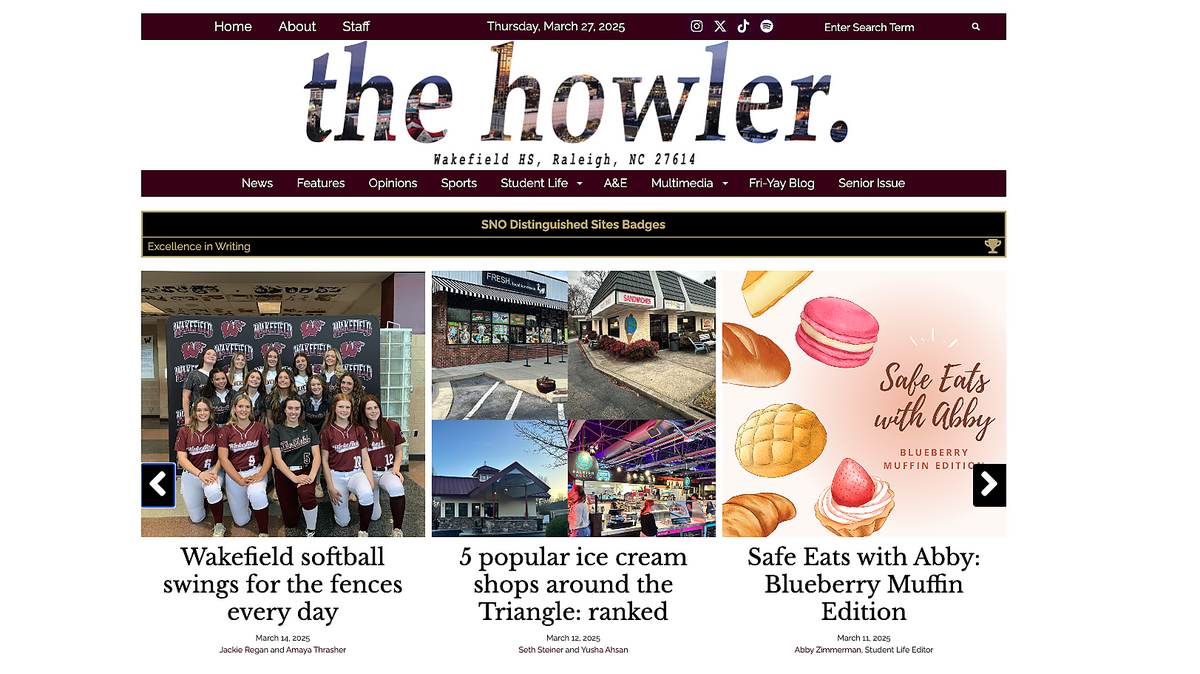
The Wake County school system is shutting off access to a popular website used by high schools to publish student newspapers.
Citing online security issues, Wake County will not let high schools use SNO Sites to host their student newspapers after June 30. Many student newspapers no longer publish print editions, so they may not be able to continue operating if they can’t find an online alternative to SNO.
Student journalists have created a “Protect Student Journalism in Wake County” online petition and plan to show up at the April 8 school board meeting They hope to persuade Wake to change its mind on SNO access.
“I speak for all of us when we say that we’re not in a position currently to take no for an answer,” Kendall Wilson, a senior at Wakefield High School in Raleigh, said in an interview. “I think we also have a lot of fight left in us, and SNO means a lot to us.
“Whatever we have to do, if we have to go to the school board meeting, if we have to get a petition, we’re going to make sure that this is an issue that they can’t ignore anymore.”
Wilson is a co-editor-in-chief of The Howler, the student newspaper at Wakefield.
’Industry standard’ for high school newspapers
SNO, which stands for School Newspapers Online, is used by college students as well as 2,700 K-12 schools around the country, according to Tom Hutchinson, co-founder of SNO. The company lists 38 North Carolina schools as customers, including nine high schools in the Wake County school system.
SNO is the “industry standard” in the high school journalism world, according to Monica Hill, director of the N.C. Scholastic Media Association.
“SNO helps us do what we love in the best way possible as high school journalists,” Nora Richards, a senior at Athens Drive High School in Raleigh and co-editor-in-chief of The Athens Oracle, said in an interview. “The amount of features on the website is helpful.”
In addition to hosting the newspapers and providing tech support, SNO provides curriculum, mentoring, coaching support and an awards program.
“Without SNO, we are literally at such a loss,” Katie Spampinato, a Wakefield High senior and co-editor-in-chief of The Howler, said in an interview. “We use SNO every single day.”
Wake finds security vulnerabilities in SNO
But Wake students learned this semester that the district will discontinue SNO access at the end of the school year.
In a statement to The N&O, the Wake school system said its Technology Services team identified serious security vulnerabilities within SNO Sites and its use of WordPress, particularly when it comes to signing on. Wake said those issues pose a threat to the safety of student and staff data.
“Recent cybersecurity incidents, such as the PowerSchool data breach, underscore the importance of prioritizing secure technology solutions,” Wake said in the statement. “Student and staff security remain our top priority, and as a result we have made the difficult but necessary decision to discontinue the use of SNO Sites at the end of this academic year.”
In the PowerSchool data breach, a hacker gained access into a global database to obtain personal information on students and teachers. But Hutchinson said they don’t have that kind of data on SNO.
“They’re understandably concerned about student data privacy but we don’t have any of that,” Hutchinson said in an interview. “All of the content that the students publish is intended to be public.”
Hutchinson said he was able to resolve similar security concerns raised by two larger school systems: Los Angeles and Broward County in Florida. But Hutchinson said Wake has not returned any of his emails offering to resolve the security concerns.
“We have heard from student journalists across the country — from Los Angeles to Chicago — whose schools have attempted to cut off their access to SNO Sites and similar platforms,” Jonathan Gaston-Falk, staff attorney for the Student Press Law Center, said in a statement. “In many situations, those students and administrators have found ways to continue publishing, and we encourage Wake County Schools to do that here.”
Student work could be lost
One of the concerns for the students is that years of published articles will be lost if they lose SNO access. These includes links to articles and SNO awards that can be searched for online.
Wilson, the Wakefield student, has four years worth of articles that could disappear.
“I want that to continue to live on and be on the internet for anyone to be able to see or for me to be able to share with people,” Wilson said. “And to see something that I’m so proud of at risk of being lost forever is really disheartening.”
The loss of SNO could also impact college plans for students like Caroline Rhoad, a Wakefield junior and sports editor on The Howler. She’s planning to list her SNO awards and articles on her college applications.
“Losing that is really frustrating and kind of scary because I don’t know what’s going to happen to all my past work that kind of shows my credentials and shows that I would be good in a journalism program,” Rhoad said in an interview.
Are student voices being valued?
In its statement, Wake said it “values student voice.” It has recommended that schools use Canva, Adore Express or Google Sites as alternatives to SNO.
But the student journalists say in their petition that Wake hasn’t provided a viable alternative. They say the options suggested by Wake aren’t complex enough for an online student newspaper.
Richards, the Athens Drive student, said student readership could drop if they have to use less appealing websites. Plus, she said the quality of the product could drop without access to SNO’s features.
“I’m very worried that the students who are in newspaper next year won’t have the same amount of freedom for what they write about and just not having as great an experience as I’ve had in newspaper,” Richards said.
‘Dangerous precedent for restricting student voices’
What’s at stake, the students say, is respect for student journalism.
“Student newspapers are not a free-for-all — we follow journalistic ethics, work under the guidance of experienced advisers, and hold ourselves to the same standards as professional newsrooms,” the online petition says. “Removing our platform not only limits our ability to report but also sets a dangerous precedent for restricting student voices.”
Spampinato, the Wakefield student, said Wake’s actions make it feel like the district doesn’t understand how seriously they take their roles as student journalists.
“We work so hard on our work, and for it to seem like it’s not being taken seriously really hurt, because we do maintain a strong level of professionalism in this classroom,” Spampinato said. “And we take what we publish very seriously, too.”
This story was originally published March 28, 2025 at 1:28 PM.