Wake to drop special ed cut that would have eliminated 130 teaching positions
AI-generated summary reviewed by our newsroom.
- Superintendent will drop the 130-position special ed cut from his recommendation.
- Board seeks alternatives after admins warn carryover special ed funds nearly exhausted.
- Superintendent warns saving the 130 jobs will force cuts elsewhere in budget.
Wake County Superintendent Robert Taylor plans to drop the elimination of 130 special education teaching positions after school board members strongly opposed them Tuesday.
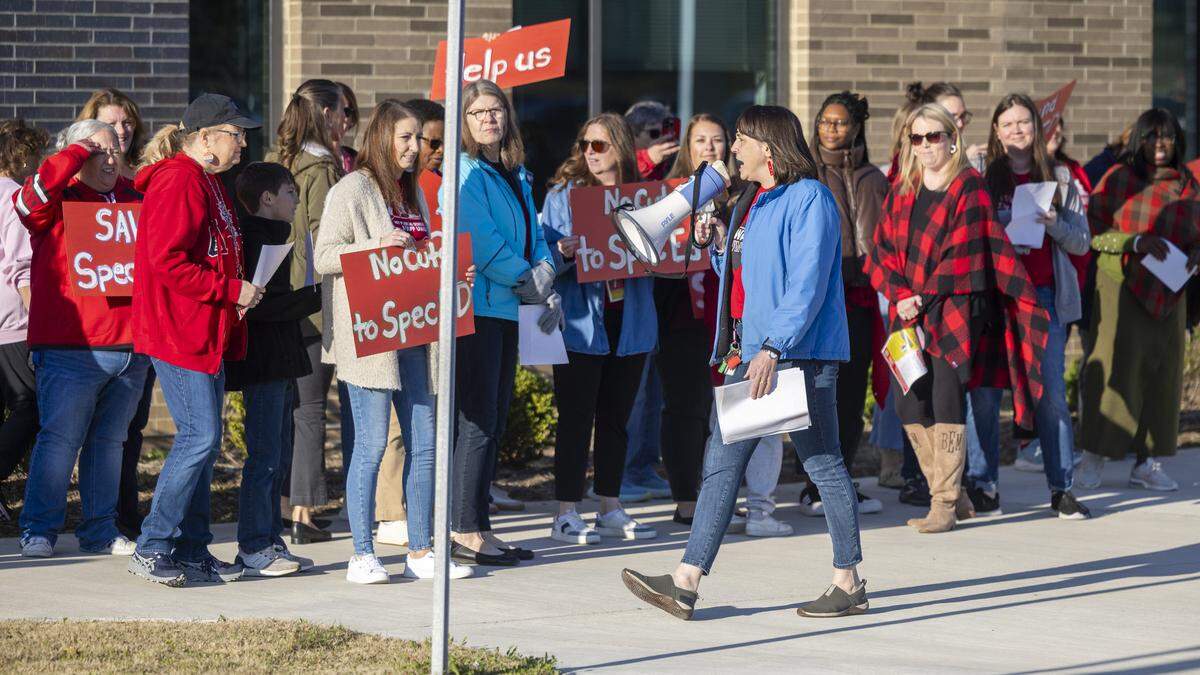
The announcement of an $18 million special education budget reduction last week triggered an uproar, including protests outside schools and a special board meeting on Tuesday to “ensure transparency and accountability.”
After a five-hour meeting on Tuesday, Taylor said he will come up with recommendations to replace the budget reductions that would have eliminated the 130 special education positions.
Taylor said he won’t have enough time to change the budget he’ll present to the school board on April 7. But Taylor said he knows the board won’t back the proposed special ed reductions.
“The work now is about what are the other options that we can provide the board now that you’ve clearly said you don’t want it,” Taylor told the board after it came out of closed session on Tuesday.
The board will get Taylor’s alternative budget suggestions and incorporate them into what they approve in May to send to the Wake County Board of Commissioners.
“I’m not in favor of balancing budgets on the backs of our most vulnerable students,” said board chair Tyler Swanson, a former special education teacher. “Our students receiving special education services depend on us to protect and prioritize their needs.”
Board questions superintendent’s leadership
The meeting saw pointed questioning of Taylor and staff by board members before they went behind closed doors to meet with their attorney. Multiple board members accused staff of giving them conflicting information.
“Why are we paying a person the money that we pay a person in this budget to lead this department and you can’t give me factual information about your department and how you run it?” said board member Toshiba Rice. “That makes me reflect on the only person that I can hire and fire. Do I need to make a motion that we consider what we do about our superintendent?”
Taylor acknowledged that he and his staff could have communicated the information about the budget reductions in a better way. But he said they wanted to let affected teachers know as soon as possible.
“We’re not firing 130 teachers,” Taylor said. “Again, timing was not perfect and never will be. But it was required that we be upfront with all stakeholders about the proposed changes.”
The special education cuts were announced in conjunction with a preview of the budget that Taylor gave last week. Taylor said the district will need to make budget reductions this year.
Administrators laid out a proposal to eliminate 130 cross categorical resource (CCR) teaching positions. as part of an $18 million reduction to the special education budget. These teachers help monitor the academic progress and behavior of special education students.
District cites need to cut $18M from special ed
Terri Kimzey, the district’s senior director of budget, said Wake received a $14.2 million boost in federal IDEA (Individuals with Disabilities Education Act) grant funds in 2021. She said they’ve used unspent carryover grant funds to pay for recurring special education positions.
But administrators said they’ve used up much of the carryover funds, to the point where spending will need to be reduced next school year.
“While we’ll finish in the black this year, if we don’t make adjustments as we go into the ‘26-27 school year, we will exhaust all budget funds before the end of the year,” Taylor said.
To reduce the $18 million, administrators proposed shifting $7 million in federally funded special eduction positions to local dollars. The rest would have come from eliminating the 130 federally funded CCR positions.
Taylor is expected to continue recommending the transfer of the $7 million in special education positions. Taylor warned the board though that dropping the elimination of the 130 positions means they’ll have to find somewhere else in the budget to cut.
Why didn’t the public know sooner?
According to board member Lynn Edmonds, the situation was preventable. She said staff should have recognized the impact of using so much of the carryover funds.
“This sounds like a mismanagement,” Edmonds said. “Something went wrong.”
In hindsight, Taylor said, they should have recognized that they would need to replace any recurring services that were being paid for by the carryover money.
Multiple board members questioned why they and the public weren’t notified sooner to try to address the funding in a different way.
“People are hurt and they’re angry and they’re pissed because they’ve had a week to process massive changes,” said board vice chair Sam Hershey. “Where was the urgency? Why are we putting it on the backs of special education?”
Change in staffing ratios questioned
Staff had proposed changing staffing ratios:
- Elementary school CCR would have gone from 1 teacher for every 17 to 20 students to 1 for every 25. The state allows 1 to 35.
- Middle school CCR would have gone from 1 teacher for every 20 to 24 students to 1 for every 30. The state allows 1 to 50.
- High school CCR would have gone from 1 teacher for every 37 students to 1 for every 40. The state allows 1 to 50.
- Autism support teachers would have gone from 1 position for every 12 students to 1 for every 14. There is no state guidance.
- Behavior support teachers would have gone from 1 position for every 12 students to 1 for every 14. There is no state guidance.
- Occupational course of study would have gone from 1 teacher for every 12 students to the state guidance of 1 for every 14.
The district says special education students would have continued to receive all the services outlined in their Individualized Education Programs (IEPs) even after the staffing ratio changes.
“There will be no change in a student’s IEP,” Taylor said. “We cannot choose to not provide services due to a lack of funding.”
But board members said being within state ratios won’t matter if it puts more stress on overworked teachers. Board member Jennifer Job, a former teacher, said a higher caseload will lead to worse services for special education students and affect IEP implementation.
“We’re talking about teachers who are working in superhuman ways,” Job said. “They have a finite amount of time in the day.”“
Other special ed cuts questioned
Wake also plans to eliminate the cross-categorical kindergarten program that helps determine whether some students with disabilities can transition into regular classrooms. The district is also phasing out the Middle School Essentials program that provides small group instruction for special education students who need help with math and language arts.
Administrators pointed out that the majority of teachers aren’t properly certified to teach in those two programs.
“There’s a breakdown here that we need to look into,” said AJ Muttillo, assistant superintendent for human resources.
That came as a surprise to board members, who asked how the lack of proper certification could have been allowed to happen.
“If there’s any program in our school system that requires oversight it’s our special education program,” said board member Chris Heagarty.
This story was originally published March 24, 2026 at 10:51 PM.