Will new NC math standards make it more relevant to students? DPI thinks so.
AI-generated summary reviewed by our newsroom.
- DPI proposes Math 3 be optional; final two courses offer flexible choices.
- Revised Math 1 and 2 will teach essential skills needed for graduation.
- Public comment, approval, and teacher training planned ahead of 2028-29 implementation.
North Carolina education leaders are proposing new math standards that they say will give high school students more flexibility in choosing courses that will meet their needs and career interests.
The state Department of Public Instruction has proposed overhauling high school math requirements so that students would no longer have to take Math 3. It’s part of a change that DPI says will give students more control over picking the math courses they think they’ll need whether they plan to go to a four-year college, community college or directly into a job.
“We need to think of mathematics less as a study in isolation but more as content that’s really focused on workforce needs and development,” Charles Aiken, DPI section chief of math, science and STEM, told the State Board of Education on Wednesday.
DPI presented the first draft of new K-12 math standards in November. Aiken told the state board during an update Wednesday that the second draft will be presented for public comment April 15.
Aiken said the plan is to present the third and final draft in August with the state board approving it in September. Teachers would be trained on the new standards before they go into effect in the 2028-29 school year.
The standards say what students should know about a subject by the end of a grade level or course. Schools select curriculum to teach those standards.
Changes in high school math requirements
North Carolina high school students are required to complete four math credits/courses to graduate,
Currently, high school students must take NC Math 1, NC Math 2 and NC Math 3. Students can pick from different choices, including NC Math 4, for their fourth required math course.
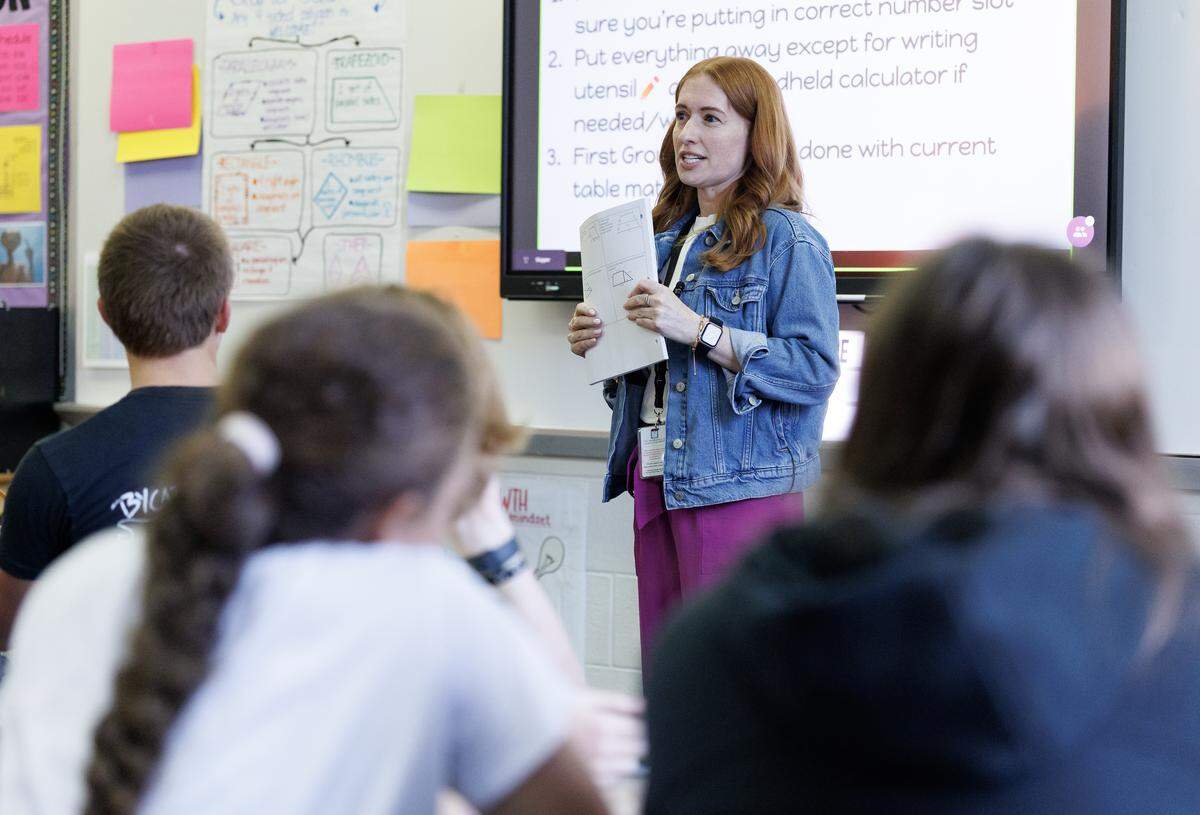
But Aiken said many high school students aren’t seeing how the math courses they’re taking are relevant to them.
Under the new proposed sequence, students would be required to take revised Math 1 and Math 2 courses that Aiken said would teach students the essential skills they need to graduate . But then students would choose from different options for the final two courses, including newly created data science and statistical modelling classes.
For instance, Aiken said students interested in business careers might want to take data science. He said aspiring teachers might choose applied logic and reasoning and engineers might take calculus.
“We don’t want to ask a rising junior to know for a fact what they want to do eight years from now,” Aiken said. “But we want to give them a sense of the mathematics that are available to them,”
Support from principals and students
The response to the proposed changes was positive on Wednesday from state board members and advisers.
“The principals I’ve talked to, they’re excited about the changes,” said Jason Johnson, principal of Orange High School and an adviser to the state board.
Johnson asked if the state end-of-course exam given to students in Math 3 would now move to Math 2. Aiken said no decision had been made yet about how the new standards would change testing requirements.
Ian House, a senior at Green Hope High School in Cary, said the students he’s spoken with are also excited about the new math sequencing.
“There’s general enthusiasm to really have your own pathway, to select your own journey and not be funneled through a system,” said House, an adviser to the state board.
House said one reservation he’s heard is whether students have the maturity to skip Math 3 and go from Math 2 to precalculus. Math 3 goes into topics such as complex numbers, inverse functions, trigonometric functions and geometric concepts such as conics and circles..
But House said he thinks it can work after the Math 1 and Math 2 standards are revised.
“As we start making these courses more relevant to the real world, regardless of their age, I feel they’ll be more engaged in the instruction and take advantage of it and take advantage of the opportunities to excel in it.” House said.