Will St. Augustine’s sell off land to survive? Who still works there? What to know
AI-generated summary reviewed by our newsroom.
- St. Augustine’s University will lose accreditation on May 15, 2026.
- The university owes up to $100 million to hundreds of creditors.
- University leaders said they may sell peripheral campus land and property to repay debts.
When St. Augustine’s University announced last month it was bankrupt and losing its accreditation, those who care about the 160-year-old historically Black university in Raleigh were left with more questions than answers.
At a bankruptcy hearing on Tuesday morning, the university’s lawyer, Ciara Rogers, and Paul Fanning, the attorney for its creditor, Self-Help Ventures Fund, provided some clarity.
The university owes between $50 and $100 million to hundreds of creditors.
Rogers emphasized in the hearing that preserving the mission of the school is paramount. St. Augustine’s began as a school for formerly enslaved people, and is one of the oldest HBCUs in the South.
“It is clear to me that the impact that St. Augustine’s University has had on this Raleigh community is one that is deep and is one that is worth trying to save and to rebuild,” Rogers said. “It is through this process that we hope that it will continue to be an institution that stands for another 160 years after all of us are long gone.”
What will happen to campus?
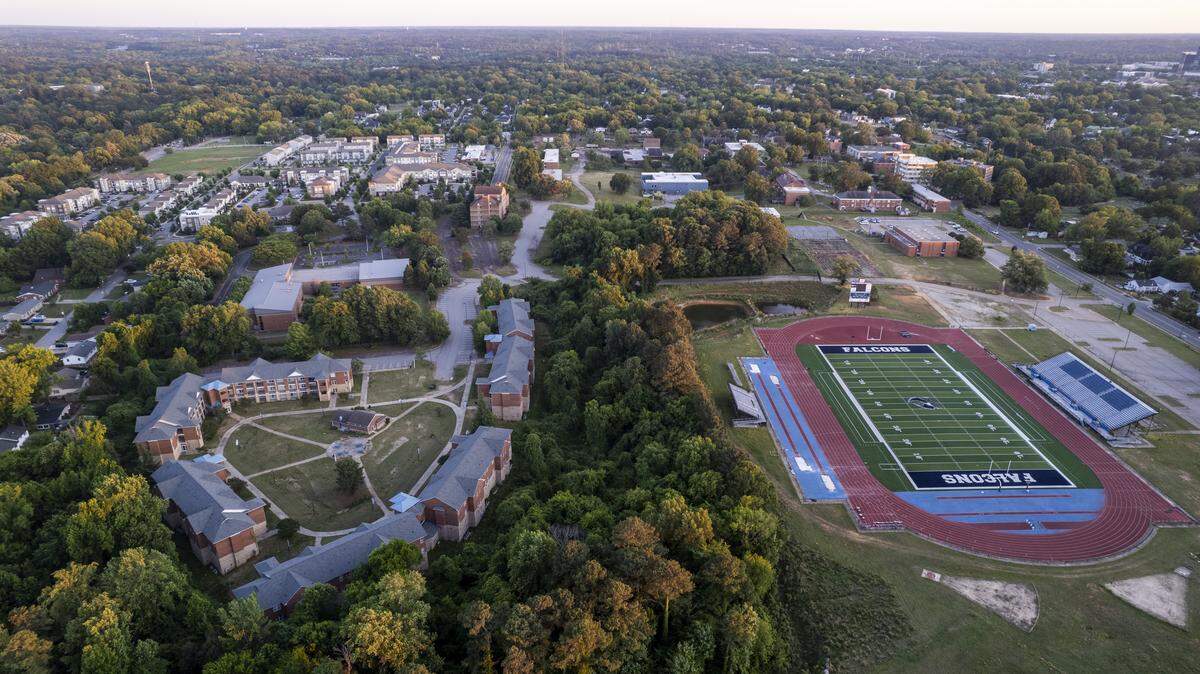
The university has to find a way to repay its debts and reorganize its finances. To that end, the school is considering selling off parts of campus.
“There are some initial thoughts that there will be some sale of real and personal property that the university does not need at this point,” Rogers said. “The hope is, of course, to be able to keep the core campus of the university and maybe sell some of the periphery.”
Rogers emphasized that the plan to sell land is in early stages, and that options are still under consideration. Parts of campus are in the National Historic Registry, making their sale more complicated and potentially valuable.
For now, the school is struggling to keep campus secure and maintained.
What are the school’s sources of revenue?
The school brings in $10,000 per month through its rental properties.
St. Augustine’s owns 26 apartments between Oakwood Avenue and Hill Street, Rogers said, and 10 of those apartments are currently occupied. It also intermittently rents one of its buildings for testing events like the SAT. The school owns a house — which was donated to the school — in Rome, Georgia, on which it collects $950 per month in rent.
This is far too little to sustain operations, so the university has been almost entirely dependent on disbursements from Self-Help.
“Every dollar matters,” said Rogers, but “the nominal amount” generated by the rentals is going into a separate account and not being used.
Who works at St. Aug’s? What’s the leadership structure?
The school employs fewer than five administrative staff, and approximately five faculty members, Rogers said. It has a roster of six security personnel, but deploys only one during the day and one at night.
The new interim president, Verjanis Peoples, the former interim provost, took over just before the bankruptcy filing. She has a salary of $125,000.
“It’s not a number that shocks the conscience, but I guess it depends on the conscience,” bankruptcy administrator Brian Behr said in court.
The Board of Trustees is made up of 15 members, with an executive committee of seven that meets weekly on Thursdays. The board has changed significantly in recent years, with most members joining during the period of extreme financial difficulty, which Rogers said “shows their commitment to the university.”
Self-Help’s decision to take over the university’s debt and help them through the bankruptcy included “removal of less-than-productive board members,” Self-Help’s attorney said at the hearing.
The secretary of the board, Joseph Lynn, testified Tuesday morning before Chief Judge David Warren of U.S. Bankruptcy Court for the Eastern District of North Carolina. Warren asked him questions about the failings of past leadership, calling it a “revolving door.” He referenced issues with financial mismanagement in the past, asking Lynn to comment on those.
“It’s hard to monitor if you have folks who are not reporting to you,” Lynn said. “Thusly, we had a president that was terminated in 2023 because of failure to disclose to the board. That moved forward to internal situations with accounting. I will not dare to say to you, your honor, that there was not a problem with the financial accounting and whatnot, because there was.”
Former St. Augustine’s president Christina McPhail was fired in 2023, and she died earlier this year.
But Lynn says he has confidence in the board today.
“If it were not for the changes that have been made recently, I would not be sitting here speaking with you today,” he said. “I’m here today ... because I feel comfortable with the team of board members that had been assembled over the past three or six months.”
He emphasized the need to enlist even more board members from different backgrounds: financial, higher education, legal, and commercial development and growth.
What are some of the biggest challenges the school faces now?
Because of the school’s exceedingly small staff, it’s been hard to assemble all the documents needed for the bankruptcy. That’s partially why Rogers requested to extend the time they have to file schedules.
“This is not the type of debtor that keeps an inventory,” Rogers said. “So that’s something that we’re kind of building from scratch there.”
The school also has yet to file its tax returns from 2024 and 2025. It is working on hiring an accounting firm to get these done.
It needs to borrow more money from Self-Help to continue any operations, and has asked the court to allow a $2 million loan. Warren allowed a preliminary amount of $200,000.
The school needs $95,000 in payroll by May 15, $82,000 more in payroll by May 31, $29,000 in utilities, $22,000 in tech services, and $18,000 in repairs and maintenance.
What will the school continue to offer?
The school says it chose to abandon its legal fight for accreditation because it was too expensive. Now, the school will lose accreditation on May 15, and all current students will have to transfer. Rogers said many are opting to transfer to nearby schools like Shaw University, another HBCU in Raleigh.
St. Augustine’s is working to prepare some certification and apprenticeship programs for next fall. Those would be aimed at working professionals and wouldn’t necessarily follow a traditional academic calendar. The school would charge per certification or per apprenticeship, not on a credit-hour model.
The school says it wants to pursue public-private, as well as religious, partnerships that could help it get on a better path.
The university will be back in bankruptcy court May 27.
How is Self-Help helping?
Self-Help Ventures Fund is the creation of Self-Help Credit Union. Fanning said at the hearing the fund has a mission to “create and protect ownership and economic opportunity for all, especially people of color, women, rural residents, and low wealth families and communities,” even if that requires “financing capabilities beyond conventional lending standards [and] managing higher-risk business loans.”
Self-Help purchased two loans St. Augustine’s had taken out, including one $30 million loan from Gothic Falcon LLC, which had come with a 24% interest rate.
Self-Help reduced the interest rate to 9%, eliminated some fees, granted St. Aug’s a year without payments, and inserted protective covenants. It helped the school hire a lawyer and a crisis management PR firm, and has provided monthly disbursements to sustain operations. It also has provided “significant guidance” to the board in recent months, Fanning said.
It is now offering to loan the school $2 million more, and is appearing in court alongside St. Augustine’s representatives to “demonstrat[e] confidence in the university’s future.”
This story was originally published May 13, 2026 at 11:18 AM.