Duke switches health insurance for students, steering them to preferred providers
AI-generated summary reviewed by our newsroom.
- Duke will switch its Student Medical Insurance Plan from Blue Cross Blue Shield to Aetna.
- Aetna’s plan favors Duke Hospitals and WakeMed with lower copays and no deductible.
- Students are concerned about higher costs, reduced coverage, and mental health.
Hello Higher Stakes subscribers! I’m higher education reporter Jane Winik Sartwell, back in your inbox with this week’s news.
Are you ready for Game 1 of the Stanley Cup Finals tonight? I know I am. I’ll be there covering it! Make sure to keep up with our comprehensive coverage all night.
Duke switches health insurance for students, steering them to preferred providers
This summer, Duke University is switching providers for its Student Medical Insurance Plan from Blue Cross Blue Shield of North Carolina to Aetna.
The new Aetna plan incentivizes the use of WakeMed, Cone Health, and the university’s own Duke Health system over other in-network medical providers. The Duke, Cone Health, and WakeMed systems are in a special tier dubbed Select Care, which comes with better deals compared to other in-network providers.
Some students are concerned this tiered system will increase costs for in-network providers and complicate access to care. North Carolina’s State Health Plan made a similar switch from Blue Cross to Aetna last year, and recent projections show the state will spend much more than it intended on the contract. Now, the plan has opened a new bidding process that could lead to another switch.
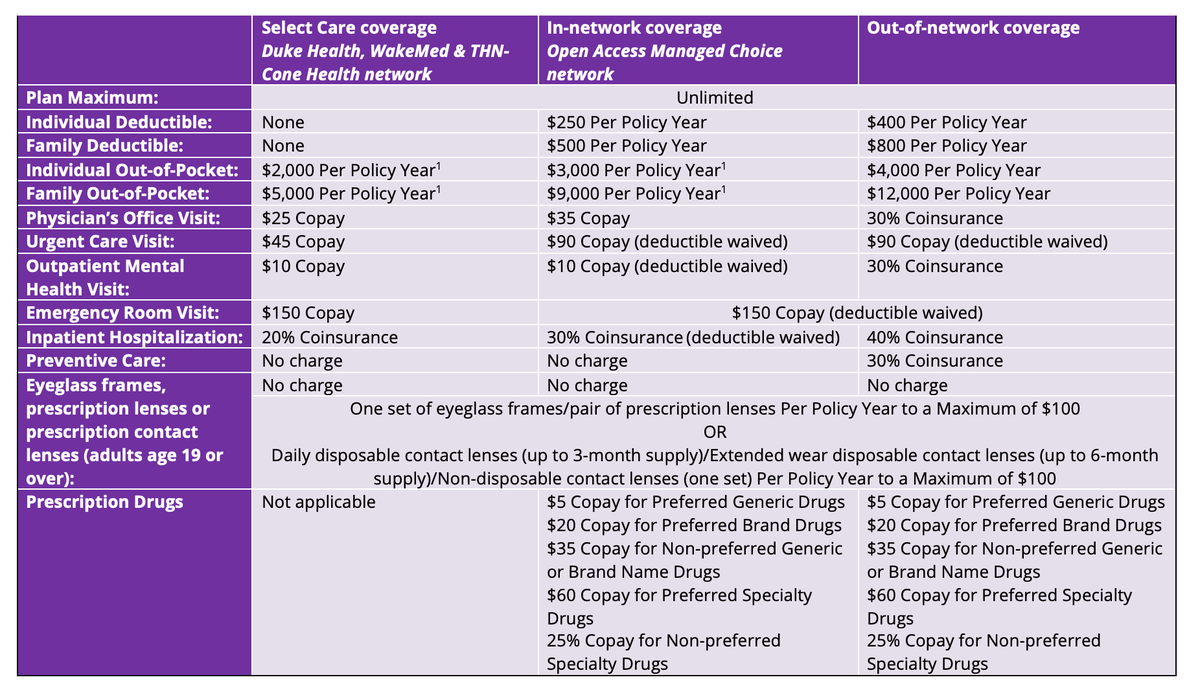
For its Duke contract, Aetna has no deductible at Duke Health, Wake Med, and Cone Health facilities, but charges a $250 deductible at other in-network providers. With Blue Cross Blue Shield of North Carolina, all in-network providers had a $0 deductible.
Copay and coinsurance costs also increase at in-network providers that aren’t in the Select Care tier.
The copay for a visit to urgent care at one of the Select Care systems will cost $45 — what it cost with BCBS — but at other in-network providers, it jumps to $90.
The pattern is similar with other common services. For a regular visit to the doctor, the copay at Select Care systems is $25, while at other in-network providers, it’ll come to $35. For an inpatient surgery, Aetna will pay 80% of the negotiated charge at a Select Care hospital, compared to 70% at other in-network providers.
This setup disadvantages students who see specialists outside of those three providers or work at Duke’s marine biology lab more than two hours away from the Triangle, some graduate students say.
But Rachel Kaufman, president of the graduate student union at Duke, says all graduate students who see in-network providers that aren’t in the Select Care tier have reason to feel cheated. Kaufman sees the tiers as a way to gain more market share over competing providers like UNC Health.
She worries in particular about continuity of care for mental health.
“A lot of us who see specialists in the UNC system would be expected to pay a lot more. Everyone with therapists and psychiatrists have all been set up with Blue Cross Blue Shield, and [it’s possible people will] lose the relationships they’ve developed with their doctors,” she said. “It’s going to flood the system when it’s already completely overwhelmed.”
Duke announced the switch on their Student Affairs website. It will occur Aug. 1.
“We are very excited to share that we will be partnering with Aetna to serve as our new Student Medical Insurance Plan carrier,” Duke’s website reads. “... Aetna brings a wealth of student insurance experience to this partnership and has more than 40 years of experience serving colleges and universities. They have a robust team of more than 200 professionals dedicated to their student insurance work, which results in resources, tools, and service that is more specific to university students and their distinct needs in an insurance plan.”
Initially, Duke shared a draft plan with students that caused outrage among some graduate student workers. The plan indicated that elective abortions will no longer be covered by insurance, in a more restrictive stance than what state law requires.
Now, Duke promises that coverage will continue.
“An incomplete draft plan shared with students as part of Duke’s notification requirements did not include all of the updated benefits, which caused some confusion,” a statement from a university spokesperson reads.
“Student medical insurance plans are renewed and benefits are updated each year to manage costs while providing outstanding coverage,” the statement continues. “As part of our renewal process this year, Duke is transitioning from Blue Cross Blue Shield to Aetna Student Health for our student medical insurance coverage. Our coverage for most core services — including reproductive health care — will continue as it has in our previous plan, in several cases with improved benefits.”
Duke did not provide further information on how that inconsistency occurred.
Duke says that students with questions about the new plan should address them to the Student Insurance Support Team at shs-insurance@duke.edu.
Campus redevelopment at NC State
A bill making steady progress through the legislature could provide $295 million for NC State to begin redevelopment on Cates West, a 27-acre area in central campus. The university plans to demolish what’s there, including three residence halls, and build more modern facilities with expanded capacity. It will help NC State deal with enrollment growth and the requirement that freshmen must live on campus.
Cates West, when the redevelopment is finished, will be pedestrian-oriented and replete with green space, according to plans. Eventually, there will be 3,000 beds and a 1,100-seat dining space.
When all is said and done in about 10 years, the redevelopment will cost more like $750 million. But if the Senate passes this initial funding for Phase I, it would mean the ball is rolling.
Higher ed headlines from this week
- NC State to demolish contaminated Poe Hall. Work will start this week by me
- How will new limits on grad-school loans affect prospective students in NC? by me
- Some NC State students are on the verge of going hungry. One makes sure they won’t by me
- This university in Raleigh doesn’t have a single student. Can it really survive? by me
- Virginia Foxx says she’s immune from student’s lawsuit over antisemitism probe by me
- Former UNC Chancellor Kevin Guskiewicz returning to the Carolinas for a new job by Chapel Fowler
- UNC men’s basketball adds commitment from Greek star. Meet Alexandros Samodurov by Shelby Swanson
- No. 5 overall seed UNC baseball moves to NCAA Super Regional with win over ECU by Shelby Swanson
- Report: Former Western Carolina QB Taron Dickens decommits from UNC by Shelby Swanson
What I’m reading
- Duke engineers develop robot with 20 legs and eyes by Allen Breed and Holly Ramer at The Associated Press
- How the Trump Admin Could Speed Up a Controversial New Accreditor by Dylan Halper at The Assembly
- Beyond the chancellor: How UNC is governed by AnnaJames Lynch
- Duke starts construction on data center near Central Campus by Dylan Halper at The Duke Chronicle
- Duke Health settles class-action suit for $3.7 million after patients alleged personal data shared with Meta by Ella Moore at The Duke Chronicle
Thanks for reading! See you back here next week.
— Jane Winik Sartwell
Not a subscriber? Sign up on our website to receive Higher Stakes in your inbox each week: newsobserver.com/newsletters.