
150 years later, Sherman’s March to the Sea still vivid
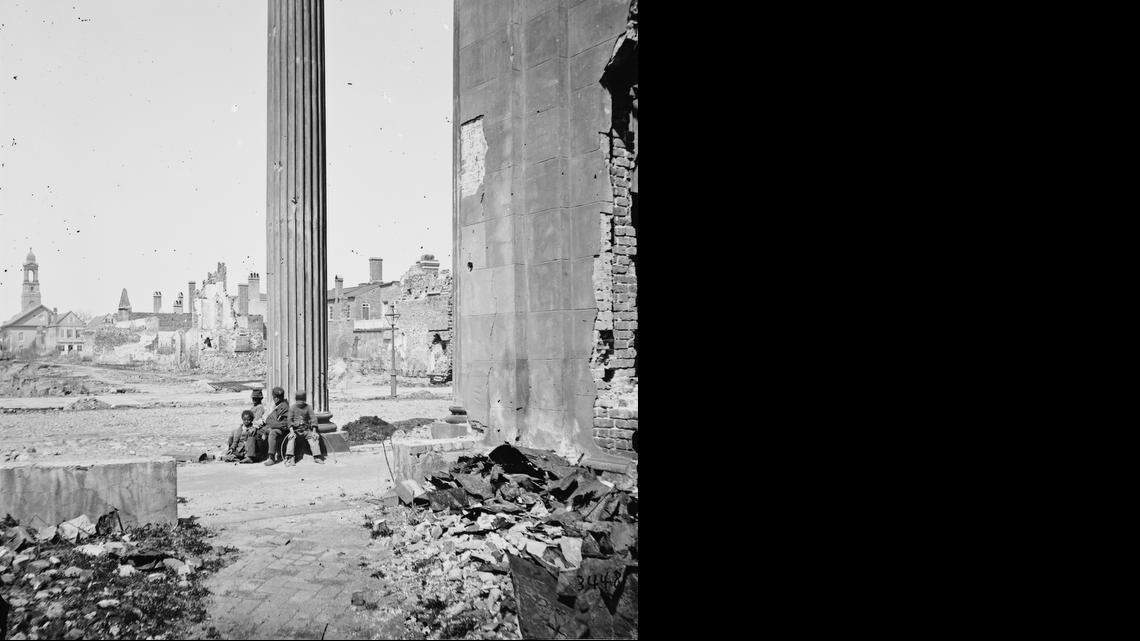
At the heart of this well-preserved antebellum city, sunbeams stream through the arched windows of a grand public meeting room that mirrors the whole Civil War – including its death throes, unfolding 150 years ago this week when Union Gen. William Tecumseh Sherman launched his scorching March to the Sea.
The first major objective along Sherman’s route, Milledgeville was Georgia’s capital at the time, and this room was the legislative chamber. Crossing its gleaming floor, Amy Wright couldn’t help recalling family stories of the hated “foragers” who swept through then. “They were just called ‘Sherman’s men,’ ” she said in a hushed voice.
Gesturing across the room, she pointed to the spot where Georgia’s leaders had voted to secede in 1861. This, too, was where, after three years of brutal fighting, battle-hardened soldiers in Sherman’s juggernaut burst in, drunkenly convened a mock assembly and “repealed” secession.
Their raucous laughter soon gave way to rampaging – and then to tears and fury among local people, including Wright’s forebears, and countless others along the path of destruction Sherman slashed from smoking Atlanta to trembling Savannah and beyond. For many, even a century and a half later, Sherman’s name still evokes epithets – villain, war criminal, devil – for the horrors he countenanced, and even commanded.
Still, if his reputation for mayhem remains firmly intact, the passage of time has allowed for his march and indeed his own complex character to receive a more nuanced reassessment.
Here are some questions and answers about the commander whose name, to this today, evokes both admiration and hatred for him and the march that hastened the war’s end:
Q. Why march to the sea?
A. The Civil War was in its third year in 1864, and casualties continued to mount. Sherman’s capture of Atlanta in September helped President Abraham Lincoln win a second term on Nov. 8, ensuring that his fight to preserve the Union would continue. At the same time, the Confederacy showed no sign of giving up.
With the top Union general, Ulysses S. Grant, confronting Robert E. Lee in Virginia, Sherman proposed an arcing campaign, first southward across Georgia to Savannah, then through the Carolinas toward Virginia to aid Grant. His army would leave a trail of destruction. This plan, Sherman reasoned, would conquer land but also send the enemy a message.
“If we can march a well-appointed army right through his territory, it is a demonstration to the world, foreign and domestic, that we have a power that (Confederate President Jefferson) Davis cannot resist,” Sherman wrote to Grant.
“I can make this march and make Georgia howl.”
Lincoln worried a misstep “might be fatal to his army.” Davis promised as much, saying that Sherman, alone in the heart of enemy territory, would be crushed.
But Grant trusted Sherman.
“Shock and awe. That’s really what Sherman was talking about,” historian John Marszalek, author of “Sherman: A Soldier’s Passion for Order,” said in an interview.
Q. Who was Gen. William Tecumseh Sherman?
A. Going back to “Cump” Sherman’s boyhood, when his father died virtually penniless and his mother sent him to be raised by another family, Marszalek said the warrior known for chaos was really guided by a lifelong quest for order. Central to this notion was restoration of Union and the rule of law.
Sherman, a West Point graduate, was superintendent of a military school in Louisiana when South Carolina seceded in 1861, setting the war in motion. He wept out loud when he heard the news, then took a commission in the U.S. Army, knowing he’d fight cadets he’d trained. Ironically, Sherman always considered himself friendly to the South.
At the same time, he came to believe the Southern population’s continuing support for war had to be broken, along with the Confederate army.
Sherman’s veteran troops had come to love his quirky, unkempt style, his intelligence that some felt verged on craziness, and his fighting spirit.
“I’d follow Uncle Billy to hell,” one soldier said.
Q. Did Sherman destroy everything in his path?
A. No. But as part of a “war on the Confederate mind,” his march left many feeling that way – to this day.
Without supply lines, his 62,000-member army needed to live off the land.
“Forage liberally,” he famously ordered – and many troops took that as license to pillage.
One letter home describes the spoils that foragers returned to camp with one night: “Pumpkins, chickens, cabbages” for the evening meal, but also “a looking-glass, an Italian harp , a peacock, a rocking chair.”
Much destruction was formally ordered. Whatever could benefit the enemy – cotton gins, barns, factories, Confederate leaders’ homes – could be set ablaze. Teams assigned to wreck rail lines made bonfires of torn-up ties, heated rails red hot, then twisted them around trees: “Sherman’s neckties.” Sherman torched some towns that harbored snipers or guerrillas.
Rumors of this onrushing whirlwind spread fearfully among those in Sherman’s path. And who knew what that path was? Even Lincoln would say: “We know what hole he went in, but we don’t know what hole he’ll come out of.”
And the deception echoes today. Historian Marszalek said he’s often approached after talks.
“He burned my great-grandfather’s barn,” a listener will say.
“Where was that?” Marszalek will ask – and it will be nowhere near Sherman’s path.
“He got into people’s psyche. That’s exactly what he wanted to do. And it’s still very much there,” Marszalek said.
Q. How is Sherman’s march remembered today?
A. Many Southerners quote family stories about “the devil incarnate.” Confederate-interest websites brand him “a war criminal” and worse.
But the passage of time has allowed a more nuanced view.
At a reenactment in Atlanta, David French, portraying one of Sherman’s troops, said, “He took the chivalry out of war, and frankly it’s why he won. He was really one of the first modern generals.”
Historian Robert O’Connell, author of “Fierce Patriot,” a 2014 biography of Sherman, said in an interview he senses the march is now “perceived as a cruel but necessary thing.”
Q. Why Tecumseh?
A. Naming his son after the American Indian leader made perfect sense to Sherman’s father. Unwittingly prophetic, he explained, “Tecumseh was a great warrior.”
This story was originally published November 15, 2014 at 5:40 PM.