Who can serve on the Supreme Court? What the Constitution — and history — say
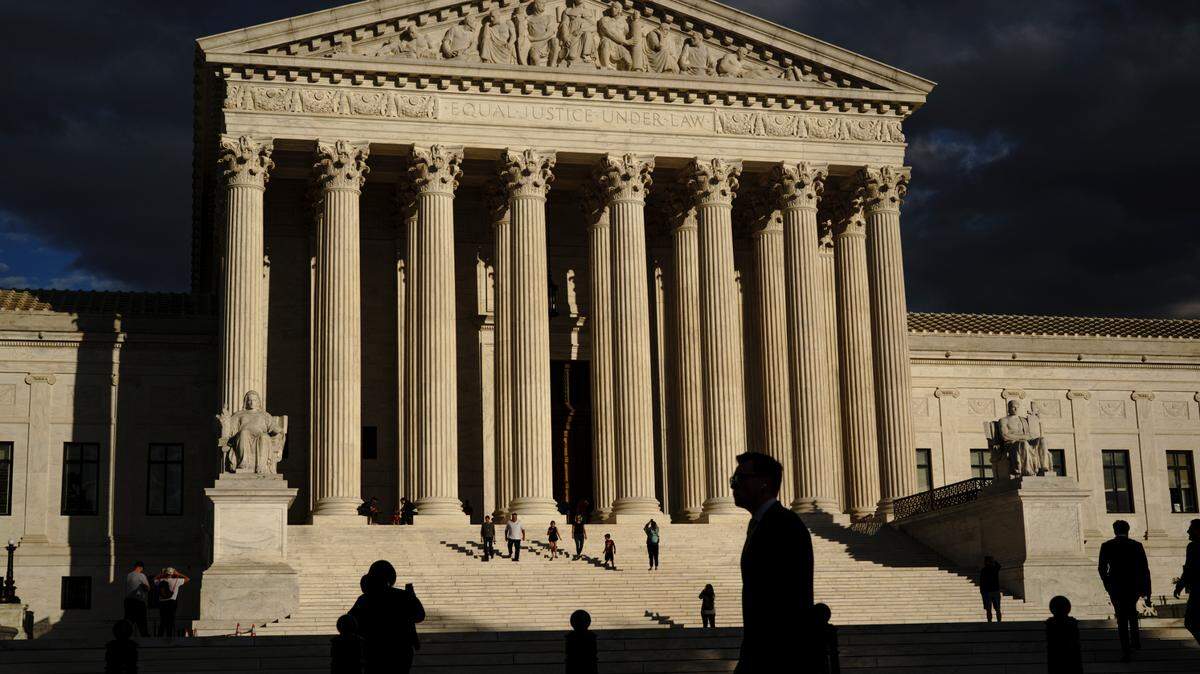
The oldest sitting justice on the U.S. Supreme Court will retire after more than 27 years, leaving a vacant seat for President Joe Biden to appoint his first nominee since taking office.
Justice Stephen G. Breyer, who is 83, announced his retirement on Thursday, Jan. 27.
The Supreme Court is the nation’s highest tribunal tasked with being both “guardian and interpreter of the Constitution.” Nine justices, including one chief justice, sit on the bench.
Breyer’s exit has prompted a push from advocacy groups and civil rights leaders for Biden to make good on a campaign promise to appoint the first Black woman to the Supreme Court — an assurance he reiterated after Breyer’s retirement was announced.
”While I’ve been studying candidates’ backgrounds and writings, I’ve made no decision except one,” he said. “The person I will nominate will be someone of extraordinary qualifications, character, experience and integrity, and that person will be the first Black woman ever nominated to the United States Supreme Court. It’s long overdue in my view.”
Several names are reportedly on his short list — including California Supreme Court Justice Leondra Kruger, U.S. Circuit Judge Ketanji Brown Jackson for the D.C. Circuit Court of Appeals, U.S. District Court Judge Michelle Childs in South Carolina, and North Carolina Supreme Court Justice Anita Earls.
Is Stephen Breyer liberal — and who appointed him?
Breyer was appointed by former President Bill Clinton and took office in 1994. Although liberal, he was confirmed by a vote of 87 to 9 — a kind of bipartisanship that “has not been seen in recent years,” CNN reported.
A California native and former Chief Judge of the U.S. Circuit Court of Appeals for the First Circuit, Breyer is currently among the liberal minority on the bench alongside Justices Sonia Sotomayor and Elena Kagan — both of whom were appointed by former President Barack Obama.
Former President Donald Trump had three conservative appointees during his singular term in office — Neil Gorsuch, Brett Kavanaugh and Amy Coney Barrett, the last of whom replaced liberal Justice Ruth Bader Ginsburg after her death in 2020.
Following Breyer’s retirement, the oldest sitting justice will be 73-year-old Clarence Thomas, who was nominated by former President George H.W. Bush in 1991.
Do you have to be a judge to be on the Supreme Court?
If a Supreme Court justice dies, retires or resigns, the current sitting president will nominate someone for the vacancy and the Senate will vote to confirm the nominee by a simple majority.
Once confirmed, a justice can serve for life.
While the Constitution outlines strict qualifications for the office of the president or members of Congress, nominees for the Supreme Court do not share the same level of scrutiny. In fact, the Constitution does not specify any qualifications to become a Supreme Court justice — either by age, education, profession or citizenship.
“A Justice does not have to be a lawyer or a law school graduate, but all Justices have been trained in the law,” according to the Supreme Court website.
The only qualification specifically mentioned in the Constitution is that justices “shall hold their Offices during good Behaviour.”
Early in the history of the Supreme Court, namely during the 18th and 19th centuries, many justices studied under a mentor rather than at law school because there were so few in the United States. There were, however, some later appointments who also did not attend law school.
The last justice to serve on the Supreme Court who did not go to any law school was James F. Byrnes, who served from 1941 to 1942 and taught himself law before passing the bar at 23 years old. The South Carolina native was “restless” on the bench and resigned after just a year to return to the legislative branch, according to the Office of the State Historian.
Robert H. Jackson, who served as a justice from 1941 to 1954, didn’t get an undergraduate degree before studying law at Albany Law School in New York, according to the Supreme Court’s website.
Because he was only 20 at the time of his graduation — and the requirement for a law degree was at least 21 — Jackson reportedly accepted a “diploma of graduation.” He did not receive a formal law degree until 29 years later, when Albany Law School retroactively awarded him one.
What are the qualifications to be a Supreme Court Justice?
While there are no formal requirements outlined by the Constitution for a Supreme Court justice, the president does weigh political considerations and professional qualifications when considering a nominee.
As former Supreme Court Justice Oliver Wendell Holmes once said, justices should be a “combination of Justinian, Jesus Christ, and John Marshall.”
Generally speaking, the president will choose a candidate that serves his or her political interests and has the “highest professional qualifications,” according to a 2021 report by the Congressional Research Service. That not only means the candidate shares the president’s political ideology, but they also are “pleasing to the constituencies upon whom (the president) especially relies for political support,” the report states.
Biden’s support among Black voters has fallen to 60% since taking office, McClatchy News reported, and some Democrats hope his Supreme Court pick will win back that voter base ahead of the midterms.
The typical candidate will also have “distinguished themselves in the law (as lower court judges, legal scholars, or private practitioners) or have served as Members of Congress, as federal administrators, or as governors,” the Research Service said.
The majority of Supreme Court appointments since 1945 were a U.S. Circuit judge at the time of their nomination, according to its report.
Potential justices must also have “integrity and impartiality,” the report states, citing a bipartisan study commission on judicial selection in 1996 that espoused the merits of “judicial temperament,” meaning a “personality that is evenhanded, unbiased, impartial, courteous yet firm, and dedicated to a process, not a result.”
The public record and private background of a potential candidate are often under scrutiny as part of the nomination process, according to the Research Service. The FBI typically investigates their private background, which includes personal financial affairs, while high-level Justice Department officials and White House aides look into their public record.
The president’s eventual pick will then be subjected to an evaluation focused on their professional qualifications by the American Bar Association’s Standing Committee, the Research Service said, before they are put before the Senate Judiciary Committee and eventually the Senate.
A Supreme Court nominee must receive at least 51 votes in the Senate to be confirmed.
This story was originally published January 27, 2022 at 2:04 PM with the headline "Who can serve on the Supreme Court? What the Constitution — and history — say."