
‘A post-apocalyptic scene.’ 3 US doctors describe what they saw working in Gaza
This article contains graphic images.
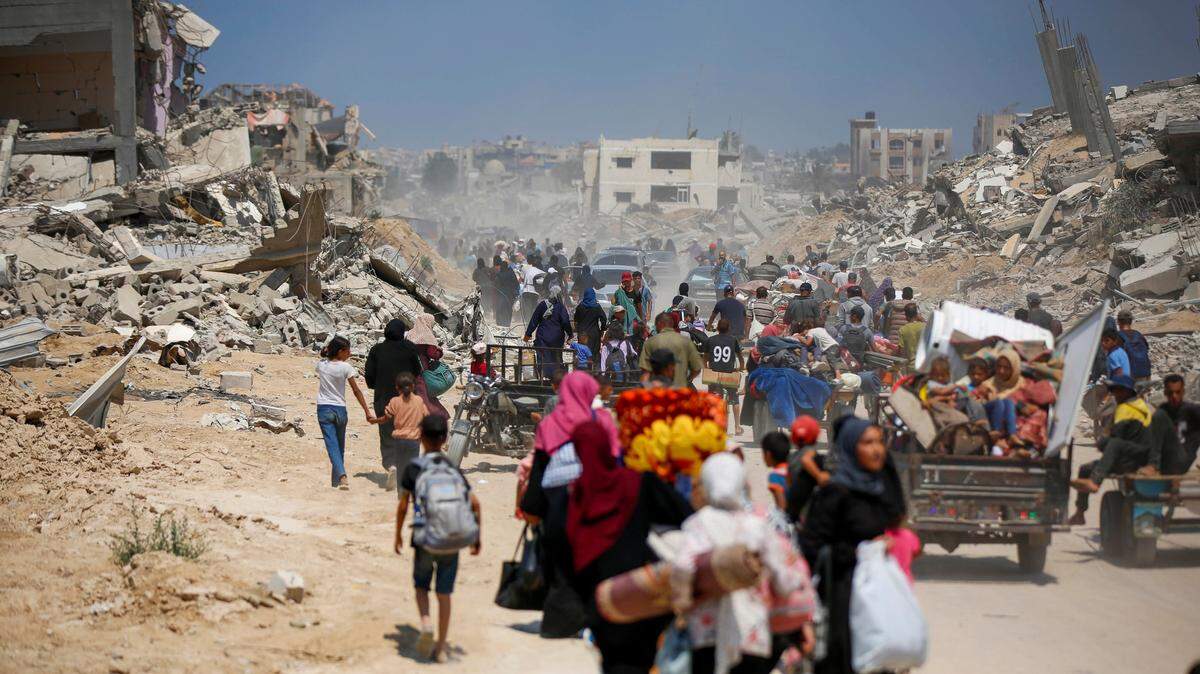
A desolate landscape strewn with rubble and tents. Hospitals overflowing with patients ripped by shrapnel and pierced by bullets. Hunger grips everyone.
That’s how three American physicians described the Gaza Strip after spending several weeks treating the sick and wounded there last month.
In interviews, Drs. Mohammed Adeel Khaleel, Umar Burney and Waqas Ali — Dallas-area doctors recently back from a World Health Organization-sponsored mission trip — spoke about the injuries and devastation they witnessed.
“Every time we go, you don’t expect it to get worse — but it is worse,” Khaleel, who went on two similar trips in 2024, told McClatchy News.
Injuries from bombardments and aid site ‘death traps’
The doctors — who volunteered at multiple hospitals in the seaside enclave Aug. 5-21 — said they treated hundreds of patients with severe injuries amid Israel’s ongoing war against Hamas.
“I saw more trauma cases than I have in my entire career,” Ali told McClatchy News. “You would see multiple mass casualty incidents throughout the day.”
They came in predictable waves. During the daytime, streams of people would be brought to hospitals with blast wounds, with explosive fragments having ricocheted through their bodies, Ali said.
Many of these injuries were caused by aerial bombardments, as Israel Defense Forces jets, helicopters and drones regularly roamed the skies, Burney said.
In the evenings — as aid sites, like those run by the Gaza Humanitarian Foundation (GHF), opened up — groups of people would appear with gunshot wounds, Ali said.
According to the U.N., hundreds of Gazans have died in recent weeks near food distribution centers, with most deaths being linked the U.S. and Israel-backed GHF. CBS News reported that both Israeli forces and international contractors have fired on those trying to access humanitarian aid.
“I think everyone there has kind of recognized that the aid distribution sites are basically death traps,” Khaleel told McClatchy News. “So people will show up knowing that they’re likely to get shot at, but there’s such desperation.”
Khaleel added that there were indications the wounded were used “for target practice.”
“Just in a matter of two days, we saw three kids come in that had to have testicles removed because they were shot in the genitalia,” he said.
Those wounded at aid sites were largely young people, many of them teenagers, Burney said, adding, “It was hard to imagine that those kids are militants.”
One boy, believed to be about 10 or 11, arrived at Al-Shifa Hospital in Gaza City on Aug. 15 with a gunshot wound to his leg. In a photo, he can be seen lying on the bare floor wearing a Los Angeles T-shirt, his limbs coated in blood and dirt.
“He said both of his parents were disabled from a blast injury, so he was the only one that could prepare food for his family,” Ali said. “So he went out to the food distribution site.”
The suffering extends to older generations as well.
While working at Al-Ahli Hospital in Gaza City, Khaleel said a hospital anesthesia technician’s husband was shot in the head at an aid site while trying to obtain food for their four children.
“We just found out about three days ago that he ended up dying,” Kahleel said. “It’s really pretty heartbreaking.”
A spokesperson for the IDF strongly objected to these accounts.
“The IDF categorically rejects the claims of intentional harm to civilians, particularly in the manner described in your query,” the spokesperson told McClatchy News. “The army’s binding orders prohibit forces operating in the area from intentionally firing at civilians.”
The spokesperson said reported incidents at aid sites are under review and added that the military is working to minimize “friction between the population and the IDF forces as much as possible.”
A representative for the GHF could not be reached for comment. The organization, in statements to other outlets, has denied shootings have taken place at their aid sites and has blamed Hamas for attempting to cause unrest at the sites.
To date, the war has resulted in the deaths of some 64,000 Palestinians, according to the Gaza Health Ministry. About 17% of them have been identified as Hamas fighters, indicating roughly 83% were civilians, according to an August investigation by The Guardian, which used classified Israeli intelligence in its analysis. Nine hundred Israeli soldiers have died in the war, according to the Times of Israel.
Widespread starvation
Many of the patients the doctors saw showed signs of acute malnutrition, most of whom were children, Ali said.
“It was very obvious when you look at them,” he said. “We could see their ribs. You could see the muscles in their jaws pretty much gone. They would have very sunken temples and sunken eyes.”
One 13-year-old girl that Ali saw at Al-Shifa Hospital on Aug. 13 died after suffering from malnutrition starvation, he said.
And patients without visible signs of starvation showed severe electrolyte imbalances and significant anemia in their lab results — clear indicators of malnutrition, Ali said.
Even the three doctors — who were in Gaza for less than a month — all lost 10 to 15 pounds, Khaleel said, noting they were eating only one meal per day, typically consisting of just rice or bread.
“There’s nobody there who’s had a full meal,” Burney said. “Very, very rarely do you see somebody who looks healthy.”
These accounts are supported by U.N. reports stating everyone in the Gaza Strip — which has a population of some 2 million people — lacks sufficient food due, in part, to Israeli restrictions on outside aid.
Israeli officials, however, have denied a hunger crisis is taking place.
The IDF spokesperson said since the war began following Hamas’ Oct. 7, 2023, attack on Israel — which resulted in 1,200 civilian deaths and about 250 hostages taken — Israel has delivered over 2 million tons of aid into Gaza.
“In recent weeks, approximately 300 aid trucks have entered daily, primarily carrying food, medical supplies, hygiene products, and other essential items,” the spokesperson said.
“There is no starvation in Gaza, no policy of starvation in Gaza,” Prime Minister Benjamin Netanyahu said in July. The following month, he said “the war can end tomorrow if … Hamas lays down its arms and releases all the remaining hostages.”
‘A post-apocalyptic scene’
Gaza itself — which is inaccessible to foreign journalists — has been reduced to a wasteland, the doctors said.
“It looks like a post-apocalyptic scene from a sci-fi film,” Khaleel said. “There’s no structure that seems to be standing that is not damaged. People are living in tents. … Sanitation has gone out the window. People are walking barefoot through the streets.”
Hospitals, relying on scarce resources, are unable to accommodate the scores of patients in dire conditions. Following mass casualty incidents, they would run at two to three times capacity, and children would be treated without pain medication, Ali said.
“When you walk into the ER, you literally have to walk over patients,” Khaleel said.
Burial sites, too, are filling up fast.
At Al-Ahli Hospital, 20 to 30 bodies would be prepared for burial each day, Khaleel said, adding that, outside the hospital, “the main thing that you see are just graves as far as the horizon.”
“There’s no question that there’s an absolute humanitarian crisis going on,” Burney concluded.
Still, despite their suffering, the patients the doctors saw displayed remarkable generosity.
“Whenever we try to bring in food,” Khaleel said, “the first thought that they have is to share it with us.”
This story was originally published September 5, 2025 at 2:59 PM with the headline "‘A post-apocalyptic scene.’ 3 US doctors describe what they saw working in Gaza."