
Signs of Confederacy, white supremacy more than just statues on NC Capitol grounds
On the night of Saturday, May 30, as looters were ransacking downtown Raleigh businesses, several dozen police officers in riot gear stood silently in a line on the grounds of the state Capitol, just a block away from the destruction taking place.
To their backs: Numerous monuments to the Confederacy and white supremacist politicians of North Carolina’s past, which in recent years have become targets of anti-racist activists and protesters.
Around midnight fewer than 10 protesters remained at the heavily guarded Capitol, as many of those who had engaged in the day’s earlier peaceful protests had left once the tear gas and looting began. One of them was Daniel Harris, who stopped to take a photo of the most prominent Confederate monument at the Capitol, which had been defaced with graffiti earlier in the night.
“I’ve got to walk past this every day,” said Harris, a UX designer who lives downtown. “As a black person, I hate it.”
Harris said he wished that people wouldn’t loot local businesses, but also that he understood where their anger stemmed from. He wondered what legislation had been proposed for police reforms or criminal justice reforms, and if it had any chance of passing.
“If not, it’s going to happen again,” he said.
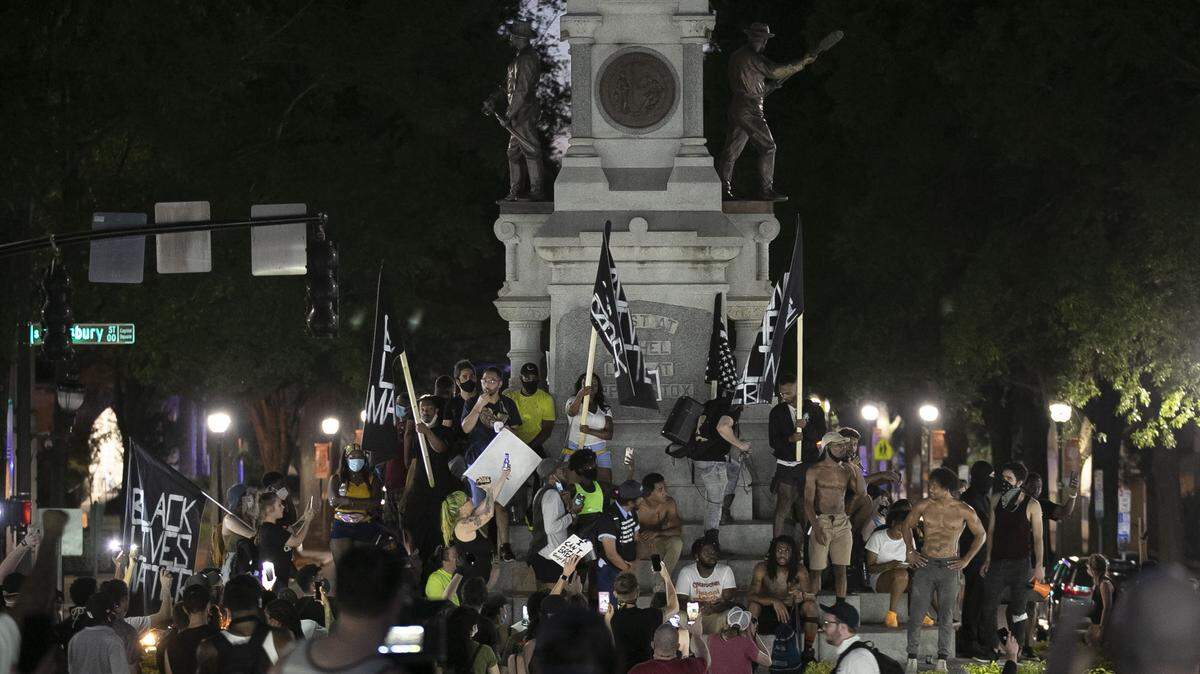
The following Thursday, 17-year-old Ny Williams was at the same Confederate statue. She said she had been out marching every day since Saturday and questioned why there were no such memorials for lynching victims.
“We’re standing in front of a Confederate monument that says ‘To our Confederate dead,’” she said. “We have nothing to memorialize ... the black victims of North Carolina.”
Monuments, white supremacy and slave owners
A law passed under former Gov. Pat McCrory restricts moving Confederate statues on government-owned property. All the Confederate monuments on the North Carolina Capitol grounds were placed there at least 30 years after the Civil War ended.
In addition to the vandalism done to the column honoring Confederate casualties at the Capitol during recent protests — some of which has criticized police, and some of which has honored recent victims of police and racial violence — some anti-police graffiti has also appeared on other statues at the Capitol associated with white supremacy, including two former governors, Zebulon Vance and Charles Aycock.
None of the statues have been torn down, however, as protesters did to Confederate statues in Durham and at UNC Chapel Hill in years past. The Durham statue crumbled when it was toppled and remains in storage. The question of what to do with the toppled UNC statue, known as Silent Sam, set off a legal battle.
The Board of Governors for the UNC System, whose members are appointed by the state legislature, originally decided to give Silent Sam to the Sons of Confederate Veterans, along with $2.5 million through a trust for the monument.
But the judge who signed off on that deal — which had been made to settle a lawsuit the SCV brought against the university system — later reversed his ruling and struck down the deal. Silent Sam remains in the state’s custody, and has not been put back up in Chapel Hill.
The state Historical Commission voted to let three Confederate memorials remain on the Capitol grounds, but there are more than just three references to the Confederacy.
Here are the statues and monuments on the grounds now that are connected to the Confederacy, slave owners and white supremacy:
▪ Confederate Soldiers Monument: At 75 feet, this is the tallest monument on the grounds. A Confederate soldier statue tops a column. On two sides of the base stand two more Confederate soldiers statues. Below them are two cannons. It was dedicated May 20, 1895.
▪ Charles Aycock: Former state senator and governor. The statue was unveiled March 13, 1924. Aycock’s family were also slave owners, and Aycock campaigned in the late 1890s on a white supremacy platform.
▪ Zebulon Vance: Confederate officer and slave owner who was elected governor during the Civil War, and later became a U.S. senator. His statue faces the Aycock statue after being relocated in 1949 from a pedestal elsewhere on the Capitol grounds to make room for the N.C. presidents monument.
▪ Confederate Women’s Monument: Dedicated June 10, 1914. The monument is a scene of a seated woman and a child — a boy holding a sword. It faces the street, and has two stone benches facing each other, flanking the monument. It was donated by Ashley Horne, a Confederate veteran and one-term state senator.
▪ Henry Lawson Wyatt: First North Carolina Confederate volunteer soldier to be killed in battle during the Civil War. The Edgecombe County native was killed at the battle at Bethel Church in Virginia on June 10, 1861. The statue of Wyatt depicts him standing, leaning forward and holding his gun across the front of his body. The statue was dedicated on June 10, 1912, according to the N.C. Department of Cultural Resources, which keeps a list of state Civil War monuments.
▪ Samuel Ashe Monument: Ashe is memorialized not by a statue, but rather a large horizontal rectangle with a bronze plaque showing his face, U.S. and Confederate flags and a paragraph describing him. Ashe was a Confederate soldier in the Civil War and went on to become a historian, legislator and newspaper editor. He died in 1938. It was unveiled on Sept. 13, 1940, which would have been his 100th birthday.
▪ Presidents: Three roads dead-end at Union Square, which is what the Capitol grounds block is called. Hillsborough Street ends at the Confederate soldiers statue, while the two other roads end at statues of U.S. presidents. At the end of Fayetteville Street is the country’s first, President George Washington. The three presidents claimed by North Carolina — James K. Polk, Andrew Jackson and Andrew Johnson — face New Bern Place. Washington, Polk, Jackson and Johnson were all slave owners.
African-Americans monument stalled
The 2019 state budget had included $2.5 million for a monument to African-Americans in North Carolina on the Capitol grounds, plus $1.5 million for a sculpture garden between the legislature and governor’s mansion dedicated to “the enduring roles of African-Americans in the struggle for freedom in this State.”
Both Democratic Gov. Roy Cooper and Republican lawmakers had supported that proposal.
According to the state’s most recent report, the target audience for the Capitol monument was to be school children, as they are a major segment of Capitol visitors.
But due to Cooper’s veto of the budget over other policy disagreements with state legislators, that funding never materialized.
And while bill filing has ended for the remainder of 2020 in the N.C. General Assembly, lawmakers can still amend existing bills to add new provisions. That does not appear to have happened yet for any renewed attempts to fund the monument or garden, however, meaning it’s likely stalled for at least another year.
There are some efforts underway, outside of state government, to push forward with similar plans. One is being led by students at the downtown Raleigh Charter High School — including Williams, the 17-year-old protester who spoke about the Confederate monument Thursday.
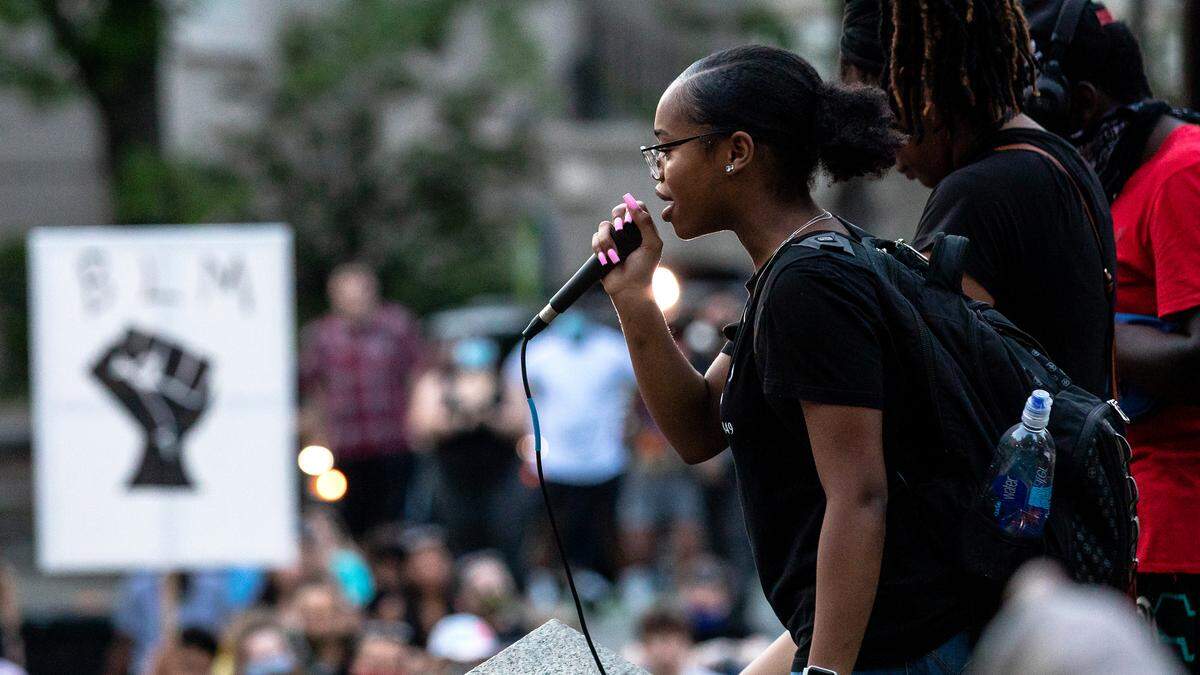
Williams said she and some classmates are raising money for a monument to lynching victims, through a group their school formed in 2016 called the Freedom Struggle Committee.
The News & Observer reported last year that while no one knows for sure, historians believe North Carolina lynch mobs killed anywhere from 100 to 300 black people between 1882 and 1968. That doesn’t count other violence — like the Wilmington Massacre of 1898, when a white supremacist militia overthrew the city’s mixed-race government and murdered an unknown number of black residents, for which no one was ever punished.
“I’m black in America, and I’m black in North Carolina, and North Carolina is not doing a great job at confronting its history in any way,” Williams said.
News & Observer reporter Kate Murphy contributed to this story.
For more North Carolina government and politics news, listen to the Domecast politics podcast from The News & Observer and the NC Insider. You can find it on Megaphone, Apple Podcasts, iHeartRadio, Stitcher or wherever you get your podcasts.
This story was originally published June 9, 2020 at 6:00 AM.
.jpg)