
Trump makes 5th trip to NC in a month, talks health care in Charlotte
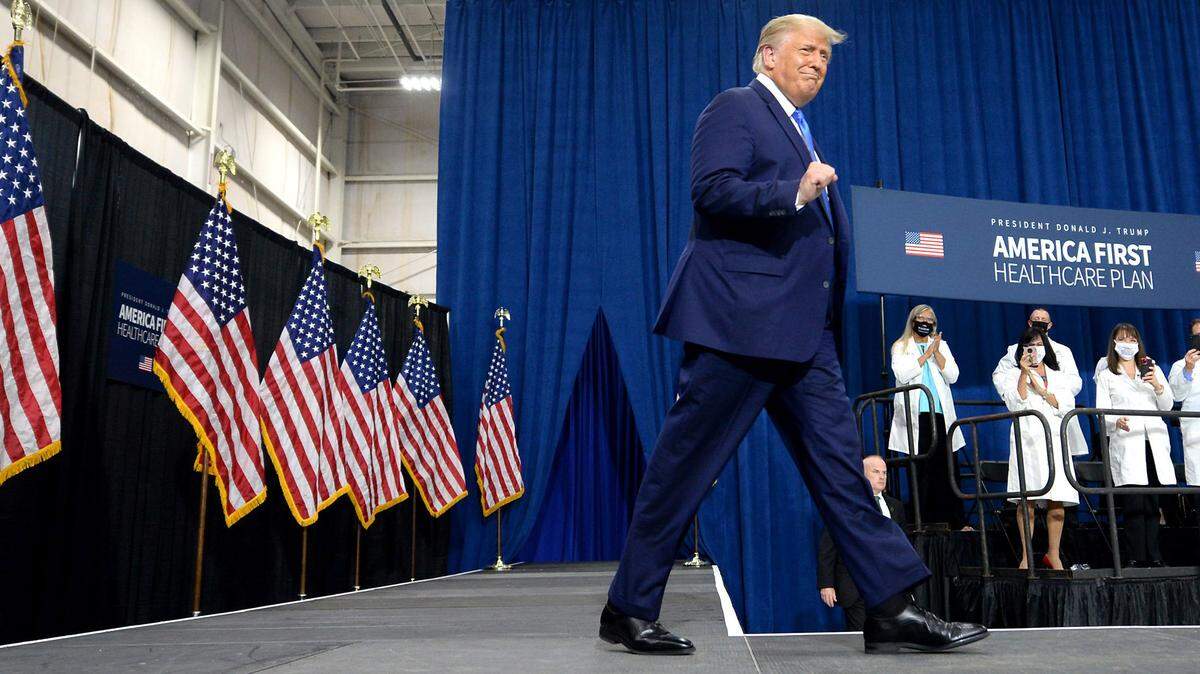
President Donald Trump returned to North Carolina for the fifth time in a month on Thursday, this time coming to Charlotte to promote a plan he calls “America First Healthcare” while describing the GOP as “the health care party.”
“Today I will lay out my vision for a health care system that puts patients first, families first and most importantly America first,” Trump told about 200 people, including many health care providers, at a warehouse near Charlotte-Douglas International Airport.
Trump laid out a plan he said would save Americans money while giving them more choices. He also announced that Medicare beneficiaries will get $200 to pay for prescription drugs. And he said a new rule will allow the importation of cheaper drugs from Canada.
“This will be a game changer for American seniors,” he said.
Polls suggest that Trump, who carried seniors in the 2016 election, is losing support from many of them this year because of the way he’s handled the pandemic.
But Trump painted a rosy picture of how he’s handled what he calls the “China virus” and predicted a vaccine by year’s end. Democrats and, according to polls, most voters think Trump has mishandled the public health crisis, which has claimed more than 200,000 American lives.
“We have reduced the fatality rate by 85% since April,” he said. “Incredible.”
Politifact ruled the claim “half-true,” saying while the death rate fell from better treatments and testing, deaths continue to be high.
Trump pledged to protect Medicare, the popular health care program for seniors, though he’s pushing for an end to the federal payroll tax, which funds Social Security and Medicare.
“As long as I’m president, no one will lay a hand on your Medicare,” Trump said.
Trump’s visit came a day after his Democratic opponent, Joe Biden, spoke at a “Black Economic Summit” in Charlotte. The former vice president, wearing a mask and addressing a small, socially distanced group outdoors, had not campaigned in North Carolina since the pandemic closed down much of the country in March.
Executive order
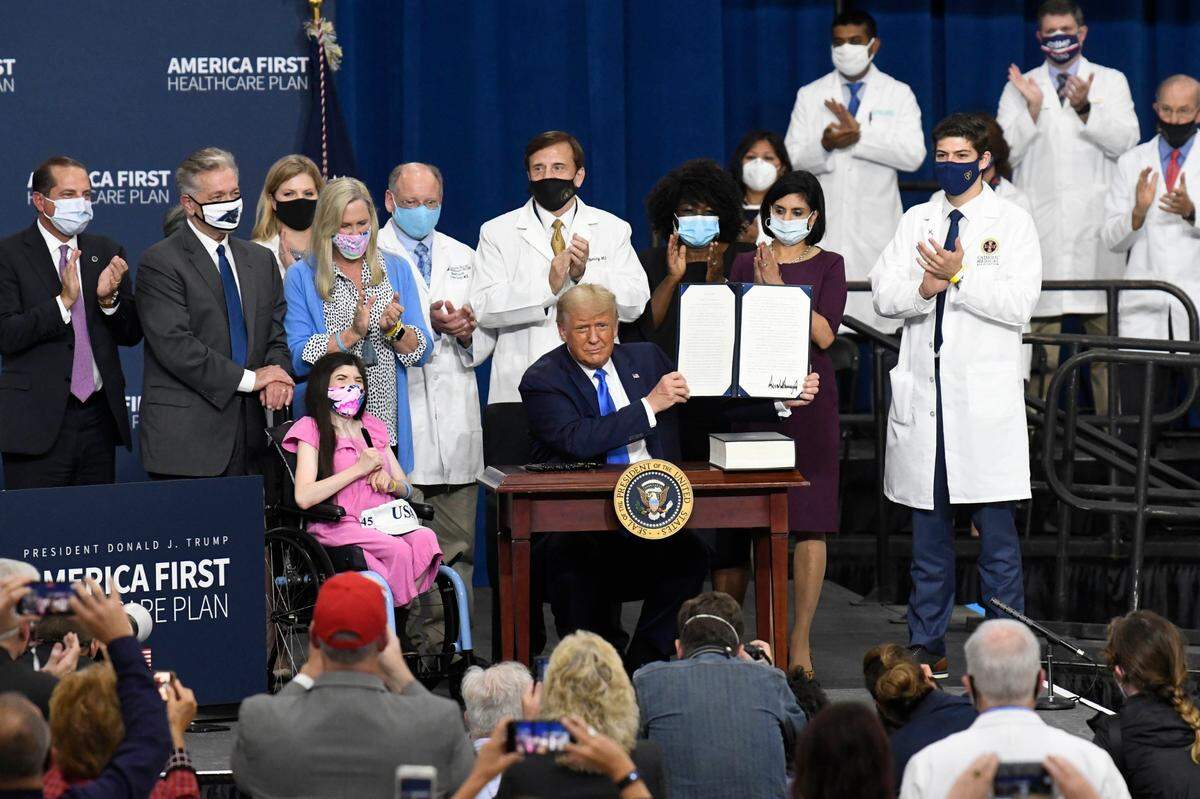
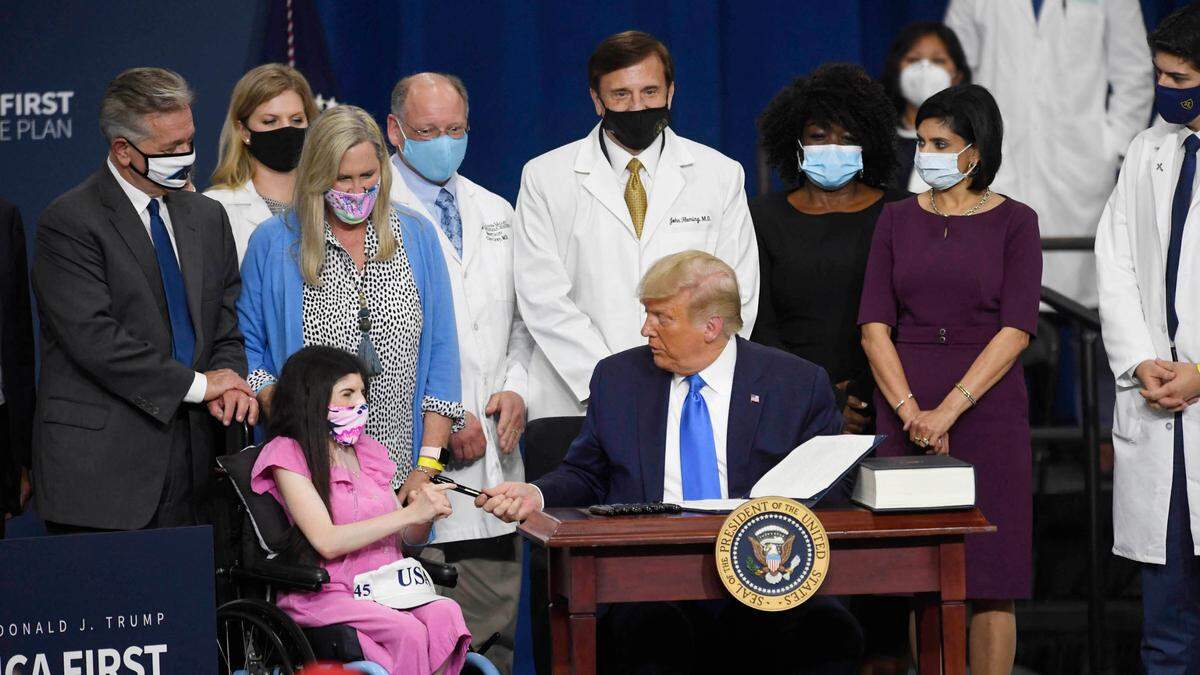
Trump signed an executive order during the event.
Health and Human Services Secretary Alex Azar told reporters before the event that the order makes it the official policy of the United States that Americans with pre-existing conditions will be protected, regardless of whether the Affordable Care Act is ruled unconstitutional by the U.S. Supreme Court. But Trump, Politico reported last month, acknowledged the order amounts to political messaging.
The order also directs HHS to work with Congress to pass legislation that protects patients against “surprise medical bills” by Jan. 1, Azar said. Once that’s done, Trump will instruct HHS to “investigate executive actions and regulatory actions” the administration can take to protect against such bills, Azar said.
Democrats said the acts don’t mean much. And they say existing protections under the Affordable Care Act would disappear if the Supreme Court upholds a Trump-backed case that could rule the law unconstitutional.
“Trump’s own HHS Secretary admitted today that this executive order has no force of law to actually ensure the 5 million North Carolinians with pre-existing conditions remain covered,” state Democratic Parrty spokesman Austin Cook said in a statement. “The only law guaranteeing that coverage right now is the same one Donald Trump is committed to tearing apart: the Affordable Care Act. If he’s successful, millions of people across our state from all backgrounds will be thrown into financial and medical jeopardy.”
Though it was an official White House event, Trump attacked Democrats almost immediately. He charged that they were promoting health care plans that would amount to a “socialist nightmare,” with wait lists, delays in life-saving cures and many doctors exiting the medical field.
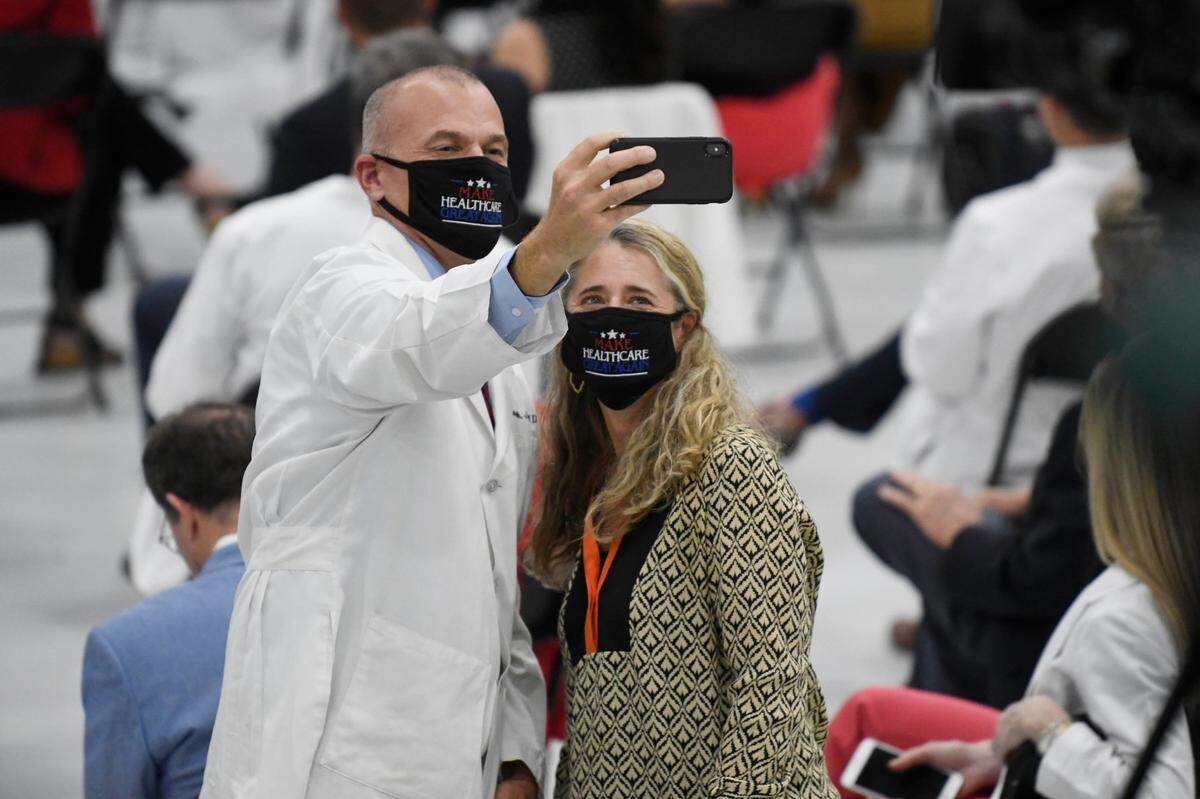
Trump’s event drew medical professionals, some wearing white coats and scrubs. Others in the crowd wore “Make health care great again” masks.
Dr. Clare Gray, a physician with Hickory’s Catawba Valley Medical Center, said he supports the president’s work on health care. While he was initially in the “repeal and replace” camp with regard to the Affordable Care Act, he said that time has passed and is now focused on incremental reforms that take government out of medicine.
Gray, who is the founder of Physicians for Reform, said he opposes a public option or “Medicare for All” platform, because it increases bureaucracy.
”We’re fighting to get the patient and the physician back at the center of the American health care system,” Gray said.
He praised President Trump’s handling of the COVID-19 pandemic, including his decision to halt some international travel. He said people who are not more susceptible to serious complications — such as those who are not elderly or who have no pre-existing health conditions — should be able to resume work and other life.
”The American people sacrificed tremendous amounts to (flatten the curve),” he said. “Now we’re trying to flatten the fear.”
However, public health experts, including Mecklenburg Public Health Director Gibbie Harris, have expressed concerns about the number of new cases among young adults, as well as their risk to spread it to less healthy peers or family members.
Pre-existing conditions
It was Trump’s repeated — and so far unrealized — promise to replace the Affordable Care Act with a new health plan that would protect those with pre-existing conditions that drew fire from Biden before Trump’s arrival on Thursday. Critics said the new orders amount to little more than public relations.
“Despite repeatedly promising to release a health care proposal, President Trump has never offered a plan of his own,” Biden said in a statement. “Instead, he’s cheered on attempts by Congressional Republicans to rip health care away from more than 20 million Americans. ... (And he’s) currently trying to get the U.S. Supreme Court to take us back to the days where as many as 4.1 million North Carolinians with pre-existing conditions could be charged more or denied health care coverage entirely.”
The Affordable Care Act, also known as Obamacare, was passed by Congress and signed into law in 2010. Among its most popular provisions, it stopped insurance companies from denying coverage to people with pre-existing conditions, did away with lifetime caps, permitted children to remain on their parents’ health insurance until age 26 and allowed states to expand Medicaid to cover more people. North Carolina is among 12 states that have not expanded Medicaid under the law.
The law has survived numerous Republican congressional attempts to repeal it and a few legal challenges, including at the Supreme Court.
But a case brought by Republican state attorneys general to toss the ACA will be argued before the U.S. Supreme Court in early November, a week after the election. The plaintiffs argue that since Congress stripped out the individual mandate for people to purchase health insurance, the entire law should fall. Republicans got rid of the individual mandate in 2017.
The death of Supreme Court Justice Ruth Bader Ginsburg, a liberal justice, makes it more likely that the court will strike down the law given its current composition. Trump will nominate someone to fill the vacancy Saturday, and Senate Republicans — including North Carolina’s Thom Tillis, who is up for re-election — are pushing for a confirmation vote before Election Day.
Trump last visited Charlotte on August 24, when he was nominated for a second term by a sampling of GOP delegates gathered at the uptown convention center for a scaled-back kick-off to the Republican National Convention.
NC ‘must-win’ state for Trump
North Carolina is one of the six most competitive battleground states in this presidential race. Trump won it in 2016, and political analysts say he likely can’t afford to lose it this year.
“It’s a real target for Biden, but President Trump needs it a whole lot more than Biden does,” Charlie Cook of the Cook Political Report told the Observer. “So you’ll see the president there more than Biden because it’s a must-win state for him.”
And whoever wins in North Carolina, it’s likely to be close, said Michael Bitzer, a professor of political science at Catawba College and author of the “Old North State Politics” blog.
“This state hinges on a 3 percent, or maybe a 4 percent margin of victory,” he said. “Both camps realize a strategy that includes North Carolina. For Trump, he has to win North Carolina. There’s no path to 270 (electoral) votes without North Carolina in that mix.”
For Biden, a win in the state would be “icing on the cake,” Bitzer said. “And if (he) can force the Republicans to spend time and money here, those dollars spent on North Carolina media outlets are dollars not spent in Wisconsin, Pennsylvania, Florida, Arizona, Georgia . . .”
Cook said North Carolina is among a group of Sunbelt states —also including Virginia, Georgia, Texas and Arizona — that are “rapidly changing” demographically in ways that can affect elections.
“A lot of suburban voters are moving away from the Republican Party,” he said. “And blue-collar white voters are moving in the opposite direction,” toward the GOP.
With many North Carolinians already voting, the latest polls of N.C. voters show Biden and Trump essentially tied.
Charlotte City Council member Tariq Bokhari, one of two Republicans on the council, said Trump’s multiple visits show “he’s obviously taking Charlotte and North Carolina very seriously . . . I see the data and it shows a very competitive race shaping up here.”
Bokhari added that, based on what he is hearing from voters, “it seems issues like support for the police and the Supreme Court vacancy are helping the president gain support.”
No Republican has lost North Carolina and won the White House since Dwight Eisenhower in 1956.
Trump in middle of controversy
Trump’s latest stop in North Carolina came amid a jarringly eventful week, with the president in or near the center of it all.
On Wednesday, he refused to commit to a peaceful transition of power if he loses the election. He noted again his unsubstantiated claim that mail-in ballots will lead to fraud, then added cryptically: “Get rid of the ballots. ... There won’t be a transfer, frankly. There’ll be a continuation.”
Also Wednesday, protests broke out across the country after a Kentucky grand jury decided not to charge any of the Louisville police officers in the March killing of Breonna Taylor, a 26-year-old Black woman, during a raid. One officer was indicted for firing into a neighboring apartment. Later Wednesday, two other Louisville police officers were shot during angry protests in that city.
Trump tweeted that he was praying for the wounded officers and told reporters that Kentucky Attorney General Daniel Cameron, a Republican who had taken over the Taylor case, was “handling it very well.”
And before traveling to Charlotte on Thursday, Trump paid his respects to the late Justice Ginsburg, whose flag-draped casket was placed in the Great Hall of the U.S. Supreme Court. Her death set off a partisan firestorm, as Senate Republicans vowed to quickly approve Trump’s likely nomination, this weekend, of a conservative jurist to replace the liberal Ginsburg.
North Carolina’s Tillis has said he will vote for whoever the president nominates. The finalists are believed to be U.S. Circuit Court judges Amy Coney Barrett and Barbara Lagoa.
Ad features NC-born disabled vet
Last Saturday, Trump spoke to a campaign rally in Fayetteville, near Fort Bragg. The president hopes to again win the support of the many veterans and active-duty soldiers who call North Carolina home.
But on Thursday, the Biden campaign released an ad that criticized Trump’s alleged use of the words “suckers” and “losers” to describe U.S. soldiers killed or injured in battle.
In the ad, Sgt. Cedric King, who grew up in Warren County and served in the 82nd Airborne division, speaks about losing his legs while serving in Afghanistan, and about his fallen comrades.
“And you mean to tell me you called them ‘suckers’ and ‘losers,’” King says in the ad. “With all due respect, I think you missed it on this one.”
Trump has vehemently denied using those words, which were attributed to him by anonymous sources in a recent article in The Atlantic magazine.
McClatchy Washington Bureau reporters Francesca Chambers and Brian Murphy contributed.
This story was originally published September 24, 2020 at 5:02 PM with the headline "Trump makes 5th trip to NC in a month, talks health care in Charlotte."