Three years after a state takeover, Cardinal Innovations faces new challenges
Three years after a scathing audit prompted sweeping changes and a rare state takeover, Charlotte-based Cardinal Innovations Healthcare is facing new challenges after a surge of threatened defections from at least six of the counties it serves.
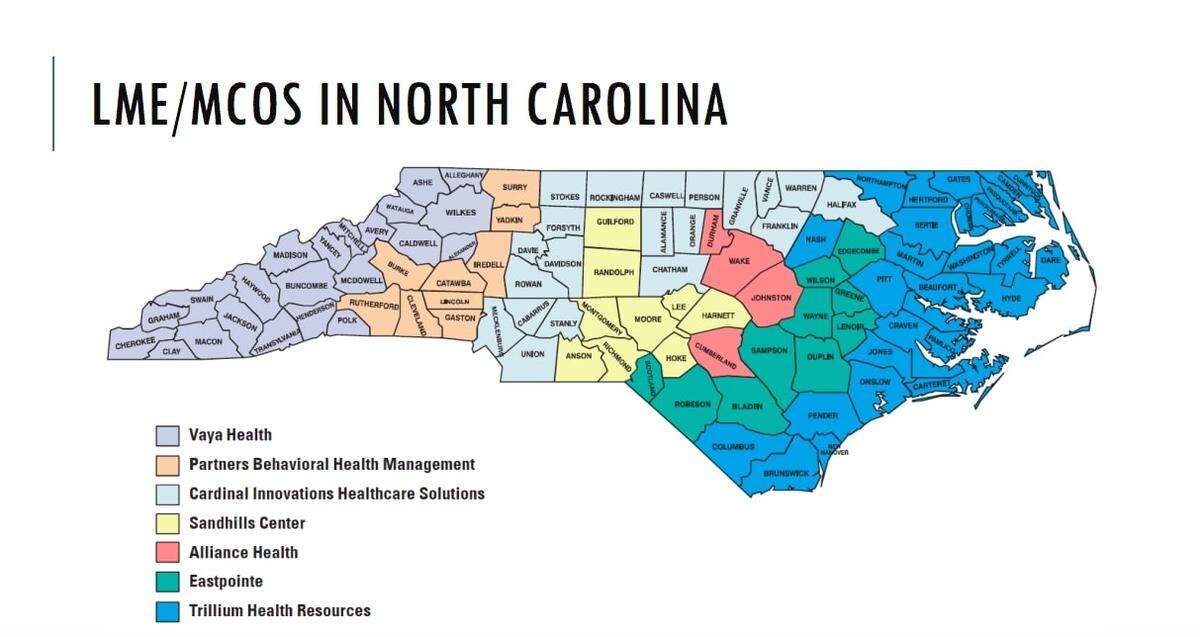
This month Mecklenburg, Union, Cabarrus, Forsyth, Stanly and Orange counties all began the process of severing ties with North Carolina’s largest managed care organization. That’s almost a third of the 20 counties in Cardinal’s service area. Mecklenburg County Manager Dena Diorio recently suggested that number could grow.
Of the state’s seven managed care organizations, only Cardinal is seeing a rush to the door.
“I just think Cardinal has gotten too big for their britches and they’ve forgotten their mission,” said former state Sen. Tommy Tucker, a Union County Republican and longtime Cardinal critic.
Cardinal serves more than 800,000 of North Carolina’s poorest and most vulnerable residents, including 145,000 in Mecklenburg County. It contracts with providers to offer care to people with developmental disabilities, mental health issues, substance abuse problems and other complex medical needs.
In 2019 it spent more than $800 million to provide those services and an additional $80 million on administration and other expenses. Most of the money came from federal and state Medicaid tax dollars.
Officials in other counties have echoed charges made earlier this year by those in Mecklenburg, who detailed a pattern of inadequate service and long wait times for the county’s neediest residents. Mecklenburg officials blasted what they said was Cardinal’s faulty handling of emergency placements for children who are abandoned or neglected. And Mecklenburg has been forced to enter into contracts directly with providers to ensure patients are not overlooked.
“We believe beginning this process is still warranted because of a lack of confidence in Cardinal’s ability to make the necessary changes,” Assistant County Manager Anthony Trotman told commissioners this month. “Mecklenburg County residents continue to go without appropriate services and timely treatment.”
Last week, Cardinal CEO Trey Sutten told his board that some counties were making decisions too rapidly and emotionally “without a lot of due diligence.” He rebuked county administrators for not inviting Cardinal to speak at public meetings or giving sufficient notice.
”We want to make sure that folks know how serious we are taking this,” Sutten told his board.
Dave Richard, a deputy secretary of the North Carolina Department of Health and Human Services, said the issue for most of the six counties revolved around the needs of foster children.
“The common thread in most of these is kids that need behavioral health services,” he told the Observer.
Cardinal is still embroiled in lawsuits involving its former CEO, Richard Topping. And next year it plans to move out of uptown’s NASCAR Plaza, where it leases four floors, for cheaper space in northeast Charlotte.
Sutten acknowledged problems this month when he submitted to the counties “a plan of action.” Developed with DHHS, it’s designed to address critics’ concerns by, among other things, investing $30 million to help foster children, speeding services to those Cardinal serves and boosting the number of providers in its 20 counties.
“We understand that the stakes are high not only for us, but for the broader safety net system and the instability that these moves could have on the support and care for our state’s most vulnerable,” Sutten told the Observer. “We’ve got a strong plan and we’re going to execute on that plan.”
Dr. Mandy Cohen, secretary of the N.C. DHHS, has said it’s critical for Cardinal to not only submit a plan but to follow through on it.
Charlotte’s Carmen Hooker Odom, a former DHHS secretary in line to chair Cardinal’s board, said Cardinal’s leaders are “committed to building a strong and trusting relationship with all the members of our community.”
And the board, she said, is intent on “holding the leadership team’s feet to the fire.”
A long process
For the six counties, leaving Cardinal won’t happen overnight.
By law, the process would take up to nine months. A formal request to N.C. DHHS would trigger public hearings and a review by Cohen. Richard said the department would consider nearly a dozen factors. Among them: Could one of the six other managed care organizations, known as LME/MCOs, absorb another county and its clients? And how would any realignment of LMEs impact the stability of the whole system?
Cardinal is a successor to Piedmont Behavioral Health, a public authority that oversaw behavioral services in Cabarrus, Union and Stanly counties. In 2005, with Medicaid costs rising, federal and state officials made Piedmont the state’s pilot for an experiment in managed care. They hoped that by allocating a fixed amount of money per client – rather than reimbursing the costs of services – they could control costs.
In 2011, the state required all local authorities to adopt a managed-care model. That led to creation of LME/MCOs, or local management entities/managed care organizations two years later. By then Piedmont had changed its name to Cardinal Innovations.
The prospect of more changes is apparently a factor in the counties’ rush to leave Cardinal.
The state will begin Medicaid managed care “transformation” next year. The transformation will put all services, medical and behavioral, in one plan. It will start with the launch of so-called standard plans on July 1 and “tailored” plans a year later. Richard said most Medicaid recipients, including people with mild or moderate mental health needs who are now in LMEs, will transition to plans run by Blue Cross Blue Shield or one of several other insurers.
In 2022 the tailored plans would serve those with more severe behavioral health needs and people with intellectual and developmental disabilities. Once those plans take effect, counties will have to sign 4-year contracts, making it more complicated for counties to switch behavioral health plans.
Last week county managers from Cardinal’s 20 counties met in a Zoom session organized by the N.C. Association of County Commissioners to talk about the issues surrounding Cardinal. Richard said tension between managed care services and the counties and communities they serve is not unusual.
But, he said, “Cardinal has been more of a lightning rod than the others.”
State takeover
Cardinal has had a troubled history.
In 2017, state auditors blasted what they called Cardinal’s “irresponsible” spending on board retreats as well as executive perks and salaries far outside the range allowed by law. The state DHHS took the unusual step of taking over the organization after Cardinal’s board fired CEO Topping and paid him and three other executives $3.8 million in severance. The state later replaced Cardinal’s old board.
Cardinal is still in court trying to to get back Topping’s payout.
“We are still suffering from Mr. Topping,” Cardinal board member Judy Klusman told the board last week.
State Rep. Donny Lambeth, a Forsyth County Republican and former CEO of Wake Forest Baptist Medical Center, said while Cardinal has made a “good faith effort” to carry out its mission, people in the counties trying to pull out often don’t see it.
“The families of these patients that need services are very concerned that they are not getting the services Cardinal has been getting paid for,” said Lambeth, who chairs the House Health Committee. “These problems . . . have been around a while. And they’ve escalated.”
In a letter to Secretary Cohen, Virginia Knowlton Marcus, CEO of Disability Rights North Carolina, urged her “to make a fundamental shift in how behavioral health services are delivered in North Carolina.
“And it will not be through tweaks and adjustments; it can happen – and will only happen – with real accountability and clear messaging about how you expect LME/MCOs to serve the public interest, and how you expect your department to enforce that vision.”
This story was originally published November 19, 2020 at 6:00 AM with the headline "Three years after a state takeover, Cardinal Innovations faces new challenges."