Why Asian American voters are becoming a ‘force to be reckoned with’ in NC politics
North Carolina is one of the fastest-growing states in the country and in a few months, new Census data from 2020 will likely show that its growth will earn the state an extra seat in the U.S. House of Representatives beginning in 2022.
And the fastest-growing demographic in this fast-growing swing state is a group The New Yorker recently called “the last undecided voters” in America: Asian Americans.
Asian American voters in North Carolina tend to live in the suburbs, which in many cases have recently shifted from leaning Republican to leaning Democratic, so both parties may find themselves fighting to win over this demographic for years to come.
There are currently fewer than 200,000 Asian American voters in North Carolina — a small percentage of the state’s total voters. But at the same, Republican Donald Trump’s 2020 victory in North Carolina over Democrat Joe Biden was by an even narrower margin of 74,000 votes.
“They can determine the future of the state, which is the swingiest of swing states,” said N.C. Sen. Jay Chaudhuri, a lawyer and Democrat from Raleigh who is Indian American.
And not only are Asian Americans the fastest growing demographic in the state, they’re also more likely to vote than most other demographic groups. In 2020 Asian American voters had a 72% turnout rate — slightly lower than white voters but higher than Black or Hispanic voters.
“It’s a force to be reckoned with, and I think people just don’t realize that,” said Alan Swain, a retired U.S. Army colonel and Japanese American.
Swain, a Republican, ran an unsuccessful 2020 campaign for Congress against Democrat Deborah Ross in a newly drawn and heavily Democratic district representing most of Wake County. He’s not the first Asian American Republican to run for Congress in the Triangle; GOP voters nominated Chinese-American Sue Googe to take on Democratic Rep. David Price in 2016.
Swain said even though he and Googe lost, there’s a good chance North Carolinians will elect their first Asian American member of Congress in the near future, and likely from the Triangle. It’s not so much a question of if it happens, he said, but for which party.
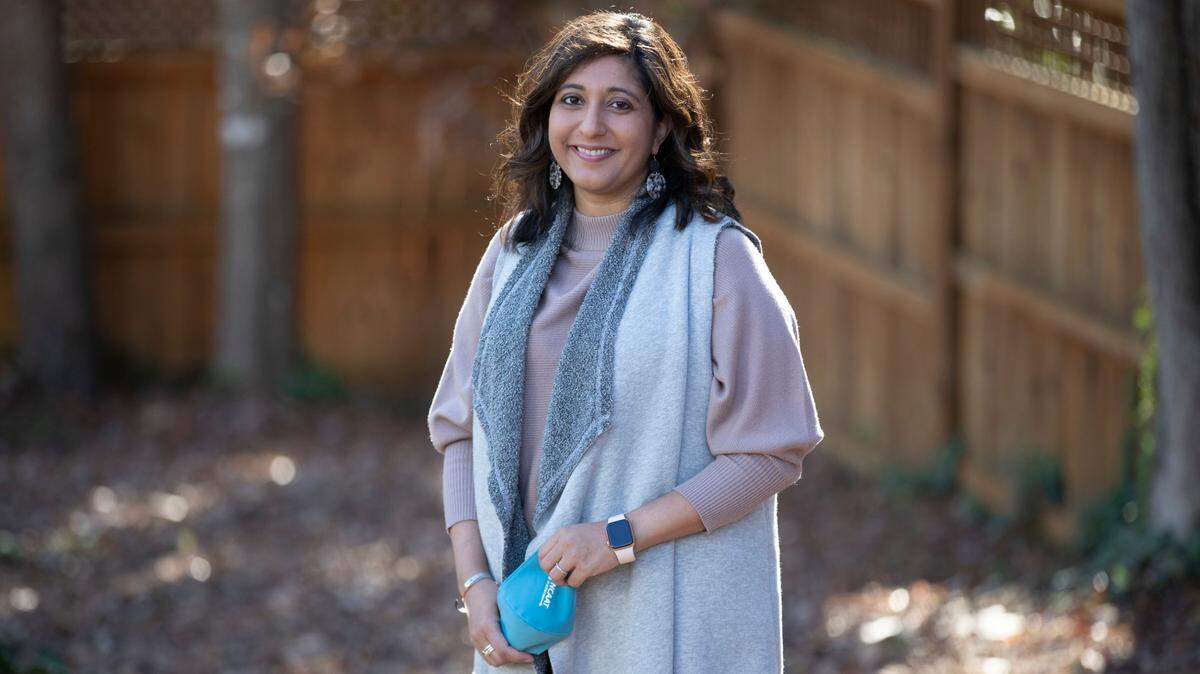
One of the people trying to lay the groundwork for that is Chavi Koneru, executive director of North Carolina Asian Americans Together, a political nonprofit.
Within the Asian American diaspora, she said, some ethnicities tend to be more conservative and others tend to be more liberal. There are also many of the same political dividing lines along age and gender lines that are seen in the wider pool of all American voters.
“Obviously, the population is not a monolith,” she said.
Do Democrats or GOP have the edge?
Post-election data from the state shows that the places where Asian American voters live were largely in favor of Biden in the 2020 elections. It’s impossible to make direct correlations, because there are no large voting precincts where Asian Americans make up the majority of voters. But there are some where they make up one in every four or five voters.
Biden won 38 of the 40 voting precincts with the biggest Asian American populations — and frequently did so with more than twice as many votes as Trump. In the most heavily Asian American precinct in North Carolina, which covers the Morrisville neighborhoods near Cisco’s RTP campus, Trump won less than 29% of the vote.
Before the election, Koneru’s group conducted a poll of likely Asian American and Pacific Islander (AAPI) voters in North Carolina. It included an open-ended question on what people wanted the president to focus on.
Fighting racial discrimination was the most common response, followed by various foreign policy issues, and then the COVID-19 pandemic.
“I think that there’s this perception that Asian American voters vote with their wallets and care most about taxes, but that doesn’t even show up,” Koneru said.
The poll also found voters were less likely to support politicians who used racist terms or stereotypes to describe COVID-19, like the ones Trump often used to describe the coronavirus that originated in China.
In a possible silver lining for Republicans though, the poll also found Asian American voters ranked other issues higher than big Democratic Party planks, such as gun control and abortion access.
Swain, who describes himself as a moderate Republican, said the GOP can win over undecided Asian American voters — and Hispanic voters, too, for similar reasons. Many came to the United States fleeing left-wing governments, he said, and share the Republican Party’s pro-family and pro-business stances.
“The reason why people want to come to America, particularly in the Asian community, is for the chance to have freedom and opportunity,” he said.
But when asked about the rising xenophobia in the Trump-era GOP, he said that can make it harder to reach racial minorities. If he had gone to Congress, Swain added, he would have disagreed with people on both sides of the aisle.
“Sometimes I wonder if they’re real Republicans when that stuff starts coming out of their mouths,” he said. “It seems like they need a new party because the traditional Republican just wants to be left alone.”
Chaudhuri, however, said that Asian American voters have historically been more conservative than other racial minorities, but they recently have been moving left, in a shift that Trump accelerated.
“In this election, I think an AAPI voter sized up Donald Trump and said that the American dream is in jeopardy,” he said. “And it’s in jeopardy because Trump was undercutting public education and wasn’t extending health care to people who need it.”
Chaudhuri said Asian American voter participation in North Carolina nearly doubled, growing by 88% from 2016 to 2020 — higher than any other state except Georgia, which had a 91% increase. He credited that increase to explain, at least in part, why Biden beat Trump in Georgia and nearly won in North Carolina.
Fast growth in largest counties
From 1980 to 2010, the number of Chinese speakers in North Carolina grew 13-fold. In that same period, Hindi went from nearly nonexistent to the third most common language in the state, behind English and Spanish. And many of those new arrivals settled in the suburbs, which Democrats and Republicans are both increasingly focusing on as the state’s new political battleground.
More than half of the Asian Americans in North Carolina live either in the Triangle or the Charlotte area. In Wake County alone, 53,000 people speak Chinese, Vietnamese or various languages from India, according to a 2019 state government report.
That’s more than the entire population of about half the counties in North Carolina.
There are Asian American communities in other parts of the state — like the Hmong refugees who settled in western Burke County after the Vietnam War, or the Karen refugees who came to New Bern, fleeing genocide in their native Burma. But mostly North Carolina’s Asian American residents can be found in and around Raleigh or Charlotte.
In terms of registered voters, the list of the state’s most heavily Asian American areas is dominated by neighborhoods in Wake, Durham, Orange and Mecklenburg counties. There are also some in the Charlotte suburbs of Union and Cabarrus counties, as well as in the Triad in Guilford County, and on the coast in Onslow County.
But with the booming Asian American populations in those areas — and the fact that Asia consists of around 60 counties where people speak hundreds of different languages — politicians and organizers like Koneru will have their work cut out for them in future elections.
North Carolina Asian Americans Together made 150,000 phone calls to Asian American voters here in the leadup to the 2020 election, in addition to hundreds of thousands of text messages plus mailers in 20 languages. During the election, they staffed a hotline for voters experiencing problems, with translators standing by for 11 languages.
“I still get a migraine every time I think about that hotline,” Koneru said. She plans to pressure the state to add more multilingual election information in the future, because the need is growing and she thinks it shouldn’t just be up to private groups like hers.
Indian Americans outnumber other Asian American groups
The largest group of Asian Americans in North Carolina are Indian Americans.
Many of the small but growing number of Asian-American elected officials in North Carolina are Indian American — like Chaudhuri, Charlotte City Councilwoman Dimple Ajmera and Morrisville Town Council members Steve Rao and Satish Garimella.
Those four are all Democrats, and in this year’s three-person Democratic primary for state treasurer, Ajmera came in second to fellow Indian-American Ronnie Chatterji, a Duke University professor who ended up losing to Republican incumbent Dale Folwell.
Meanwhile, Cary recently elected its first Chinese American town council member, Ya Liu, and Wake County voters also elected Maria Cervania to the county commission. Koneru said Cervania is the first Filipino American elected to any office in North Carolina.
For more North Carolina government and politics news, listen to the Domecast politics podcast from The News & Observer and the NC Insider. You can find it on Megaphone, Apple Podcasts, iHeartRadio, Stitcher or wherever you get your podcasts.