
Underfunded for years, many NC public health departments lack resources to fight COVID
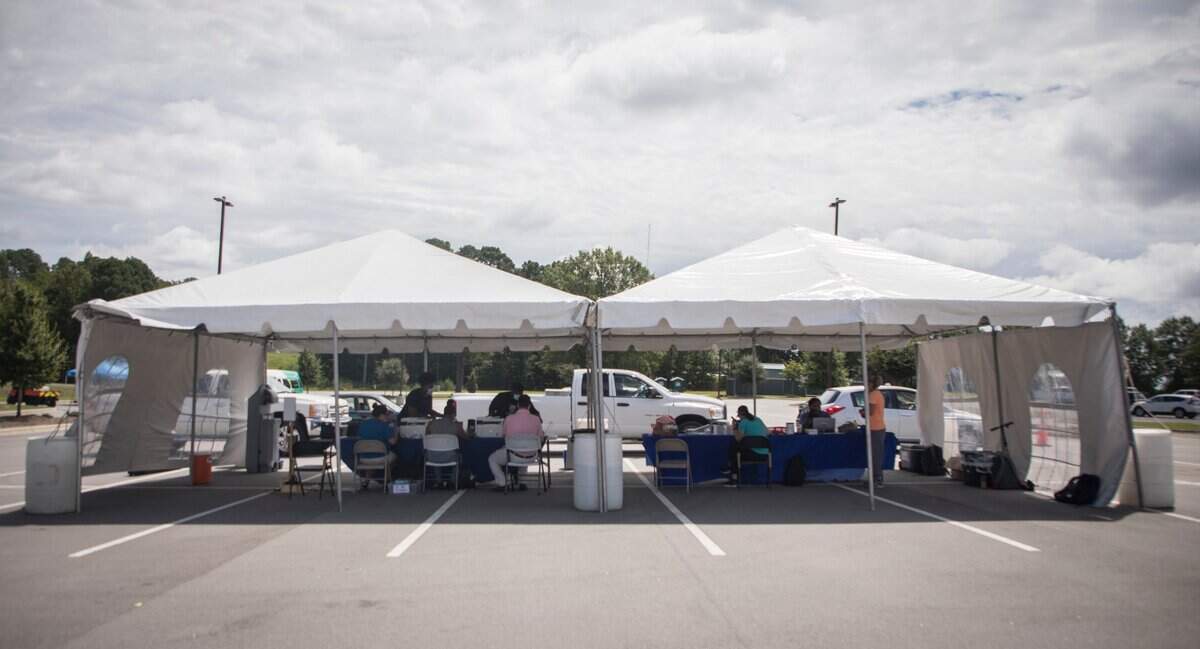
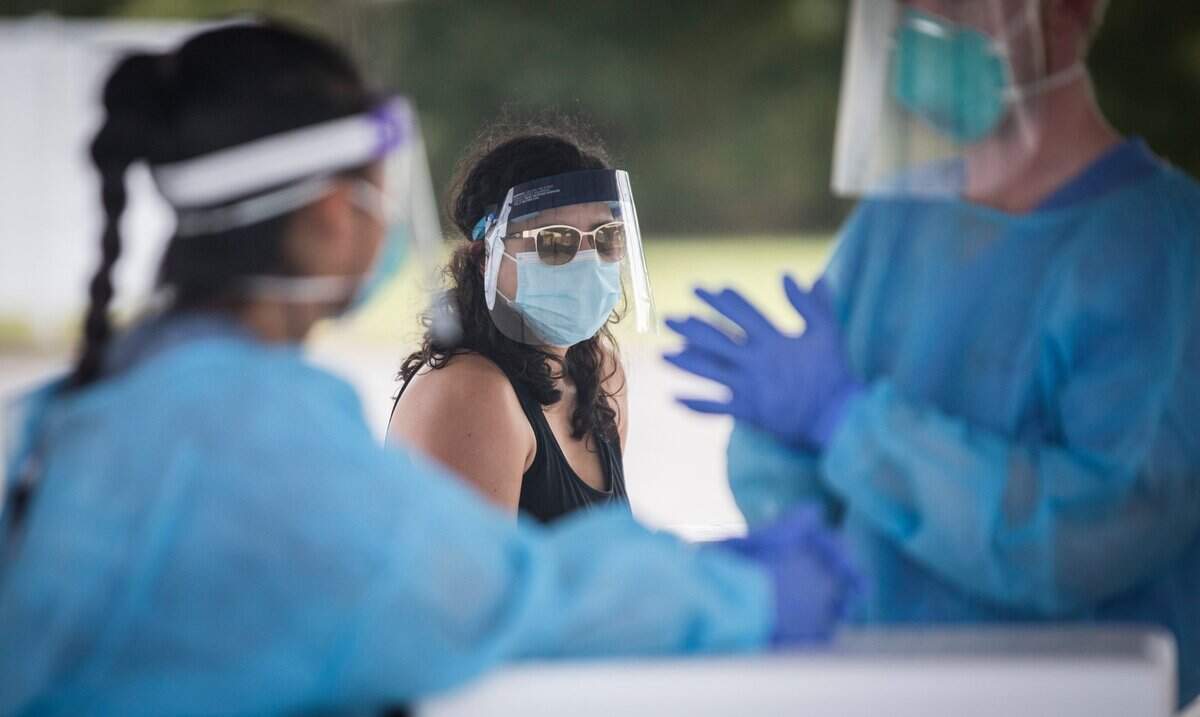
Across the state, local public health workers are on the front lines of North Carolina’s response to the COVID-19 pandemic. They play important roles like testing, contact tracing, educating their communities about safety precautions and more, on top of their regular duties like inspecting water wells and restaurants.
“Public health employees are exhausted, mentally and physically,” said John Morrow, a former Pitt County health director who is assisting the state’s Department of Health and Human Services with its COVID-19 efforts. “Many of them have been going hard, working weekends and evenings, since March without a break. They’re extremely stressed. They’re worried about their families, their home life, their coworkers. They’re doing outstanding work. But it’s a challenge, month after month, to continue to go at that pace.”
In part, that’s because over the past decade the number of people working in local public health and the money being spent on it at both the state and local level has declined. And while some counties say they have welcomed a boost in resources to fight the virus, they say that a long pattern of eroding resources has left them without the infrastructure they need.
Spending on public health at the state level from 2010 to 2018 dropped by more than 27% when adjusted for inflation and population increase, according to an analysis by Kaiser Health News and the Associated Press of data from the Association of State and Territorial Health Officials. This spending decline is even steeper than the national slide of 16% across all states.
North Carolina’s state government spent about $72 per person on public health in 2018, which is less than all but 13 other states, according to the analysis by KHN and the Associated Press. In 2010, North Carolina spent 90% of the national average on state-level public health. By 2018, North Carolina spent only 78% of the national average per person.
“I think the state really depends on each county to support us a lot,” said Diane Creek, health director of the Toe River Health District, which serves the rural mountain counties of Yancey, Avery and Mitchell that have recently had some of the highest positive coronavirus test rates in the state. “The counties can’t afford it, they’re on a tight budget — a lot of them — so we’re kind of stuck trying to make do with what we have and try to kind of limp along.”
And while North Carolina’s state government has reduced spending on public health faster than most states, it’s been compounded by drops in county-level spending — a decline that has, until now, remained hidden from public view.
Based on our financial analysis of 46 health departments in North Carolina, county-level spending on public health dropped 22% from 2010 to 2018 when adjusted for inflation and population increase. At least 40 health departments serving 45 counties saw a decline in inflation-adjusted public health spending per person from 2010-2018.
Because the state does not keep individual health departments’ annual expenditures in one centralized location, the data in this story is the most current and complete picture about spending on local public health in the nation’s ninth most populated state.
Starting in September, we requested annual expenditures since 1999 from all 85 local health departments in the state, which serve each of the state’s 100 counties, in an effort to understand local public health spending in North Carolina. We received data from 51 local health departments, and there was some variance in the years each health department was able to provide. Forty-six health departments representing 51 counties provided full data spanning from 2010-2018.
Our analysis of local health department spending records represents over half of the total departments in the state. These health departments serve about 70% of North Carolina’s population.
‘Vastly underresourced’
North Carolina has a decentralized public health system, meaning the local level bears most of the responsibility in figuring out how to fund local public health.
Doug Urland, director of the North Carolina Institute for Public Health at UNC Gillings School of Global Public Health, which serves as a bridge between academia and public health practice partners across the state, said health departments rely on property taxes to obtain a good portion of their operating budget. He also said rural health departments with smaller tax bases generally have less money coming in, requiring greater reliance on grants from the federal government and non-profit foundations, which are a more volatile source of funding for local health departments.
“There’s not been the will, in many local and state levels across the country, to really put the requisite amount of money in that we need as a nation, to adequately fund our public health infrastructure,” said Urland, also a former president of the NC Association of Local Health Directors. “That is exactly what we see playing out now because of COVID.”
Lisa Macon Harrison, health director of Granville Vance Public Health and vice president of the National Association of County and City Health Officials, estimates that at least 50% of North Carolina’s health departments are “vastly underresourced” and that the other 50% could likely use more targeted funding in specific areas.
Beth Lovette, deputy director of Local and Community Support at the North Carolina Division of Public Health, said in an email that local health departments do not submit total expenditures to the state. Rather, they report expenditures by program for the programs that are funded by state and federal dollars and full-time equivalent employee data every two years.
North Carolina is not the only state that does not have a complete budget look into its local health departments. In fact, it is common across the nation.
Betty Bekemeier, a public health systems researcher at the University of Washington who focuses on the structures and practices of health departments in relation to health outcomes, said not having centralized and comparable data is a deficiency of our public health system. Based on the current setup, it is difficult to compare counties within the same state and also states to each other. She said the implication of not having this data is huge, as it makes it challenging to disperse resources, gauge need and assess improvements.
Bekemeier said that at the beginning of the pandemic, many public officials, policymakers and reporters approached her and a handful of other national public health finance researchers with questions regarding how much money was needed to fight the pandemic and where it needed to be distributed. She said when she told those people outside her field that their questions were unanswerable due to a lack of data, they were shocked.
“They can make a wild guess or educated guess, but they really don’t know what they need and what they need relative to others and what it’s going to take now and into the future unless we have a more data-driven, comparable means of providing that kind of information,” Bekemeier said.
An erratic spending landscape
Bekemeier, along with a team at the University of Washington, started working to solve this problem before the pandemic further highlighted the need for centralized and comparable data. They developed a standardized financial data system that can be used across public health agencies. The system has been implemented in just under 4% of the nation’s approximately 2,800 health departments since 2018. In North Carolina, it hasn’t been implemented at all.
But what the data gathered for this story shows is that county-level public health expenditures haven’t experienced a slow and gentle decline, but instead an erratic landscape of peaks and valleys that often coincide with changes in county organizational structure or reflect emergency funding for public health crises.
Local public health officials say this crisis funding pattern prevents adequate infrastructure from being built, leaving health departments ill-prepared to address emergencies as they arise. Instead of consistently funding public health, funding surges as emergencies occur and dwindles soon after the threat subsides.
“They throw money at us, probably more than we can handle at any given time, in a short period of time, and it dwindles,” Gibbie Harris, health director of the Mecklenburg County Health Department, said. “That keeps us from building the infrastructure so we can be ready to respond right away when something like COVID hits. That’s the argument we’ve been making. There’s got to be a baseline for public health infrastructure to be able to address issues like this as they come, rather than starting from scratch every time.”
.jpg "002_IMG_CLT_coronamainfri_30_5_1_3CHR3G0M_L554789718 (1).jpg")
Harrison, of Granville Vance Public Health, agreed that the way governments infuse big, short-term funding does not help pay for the infrastructure that her health department and others need so desperately. She said her main shortage is people, and she can’t really pay for staff by getting $300,000 that she has to spend in three months.
Lillian Koontz, director of the Davidson County Health Department and vice president of the NC Association of Local Health Directors, expressed a similar sentiment and said that the biggest shortfall every department is experiencing is a lack of staff. As a result, health departments need to get creative and move people around to perform different tasks. For example, she said they assigned a substance abuse coordinator to their COVID-19 response team to meet the department’s priorities.
Harrison also said the short-term CARES Act funding comes with a lot of very specific parameters on how it can be spent and a lot of responsibility for reporting. In fact, Harrison said she has needed to use money to hire a temporary employee just to keep up with the financial paperwork, rather than using that money to hire someone that can help directly with the pandemic response. Properly documenting where the money is going is important, but Harrison said she thinks important regulatory reform is needed to streamline the process so it is not as burdensome on the local level.
Creek said the financial reporting requirements can be so extensive that she has needed to turn down COVID-19 relief money and funds from non-profit foundations.
“I’ve turned the money away, because we can’t fulfill the paperwork,” Creek said.
Once emergency funding dries up, many health departments will be back at square one with weak infrastructures unless long-term and consistent funding is committed to public health.
Communicable diseases underfunded
But among the peaks and valleys of emergency funding, one area that local public health officials say has been consistently underfunded despite increased need is communicable disease.
In February 2018, Morrow, director of the Pitt County Health Department at the time, told the Joint Legislative Oversight Committee on Health and Human Services that local health departments have been responding to double the number of communicable disease cases such as chlamydia, pertussis and hepatitis C over the past 10 years. Yet state funding has remained stagnant, not keeping pace with the increase in disease.
The NC Association of Local Health Directors listed increased state funding for communicable disease programs as one of its top legislative priorities at the start of 2020, even before the onset of the pandemic. According to the association, in fiscal year 2017, responding to communicable diseases cost more than $20 million and the state provided just 4.3% of that cost, placing increased pressure on local governments to meet demands.
Republican Rep. Larry Potts from Davidson County introduced a bill in the state House in April 2019 that he said would have helped ease some of that pressure. But the $16 million that it would have allocated to local health departments over the course of two years to expand infrastructure for activities associated with the surveillance, detection, control and prevention of communicable disease was incorporated into the state budget that Gov. Roy Cooper vetoed as part of a larger political battle.
“I don’t think the governor found fault with the way that money was applied or allocated. He just vetoed the budget period,” Potts said.
Koontz said her department has not received additional money for communicable disease control since the onset of the pandemic.
“It is a recurring theme that we do not have enough communicable disease funding,” Koontz said. “Despite a global pandemic, there is still a lot of communicable disease work to be done.”
Even some of the state’s most populous and well-funded counties have issues with communicable disease staffing. Mecklenburg County, the biggest total spender on public health in 2020 and home to 1.1 million people, has 10 permanent communicable disease staffers.
Small communicable disease staff numbers are indicative of broader staffing declines across the state’s local health departments. From 2009 to 2017 — the most recent year for which the DHHS has staffing data — 62 of the 85 local health departments reported to DHHS that their staff decreased, according to our analysis of N.C. Department of Health and Human Services data collected and published by KHN and the Associated Press. Thirteen health departments saw their staffing drop by more than a third over the time period.
These decreases are sometimes due to reorganization of department duties. In North Carolina, many health departments provide services for a fee as a means to generate revenue. Harrison said often when a service is profitable, private industry will seek to take over and leave public health departments to do the things that do not make money. For example, most health departments have needed to sell their home health programs because private companies came in and made it more difficult to generate revenue to cover the expenses.
Toe River Health District sold its home health program in 2015, leading to nearly a 62% drop in full-time equivalent employees between 2013 and 2017. Hyde County did the same thing in 2016, causing it to lose a third of its full-time equivalent employees.
While Hyde’s health department has increased its number of full-time equivalent employees by two since 2017, three of its 16 employees recently left the department, including the nurse in charge of the county’s COVID-19 response. The county is only able to offer potential replacements $38,000-39,000 per year, a price health director Luana Gibbs said no public health nurse will work for. In North Carolina, the average annual salary for a nurse is $66,000, according to May 2019 data from the federal Bureau of Labor Statistics.
“I don’t know how we’re going to replace them,” Gibbs said.
In addition to staffing decreases, many staffers have had to take on additional responsibilities during the pandemic. Jones County, which spent less money on public health than any other county in 2019, lost its health director Wesley Smith to medical leave, passing on his responsibilities to Public Health Nursing Supervisor Ann Pike.
At Toe River Health District, Creek has had to take on the additional vacant role of nursing supervisor in Yancey County that she has been unable to fill for months because the $40,000 salary is so low.
Their experiences contrast with Mecklenburg County, which has been able to hire around 100 temporary workers to combat COVID-19, bringing its staff to nearly 1,000.
Pamela Brown, health director of the Lenoir County Health Department, said public health departments’ everyday resourcefulness prepares them for situations like COVID-19.
“I know health departments are pretty good at doing what needs to be done with what we do have,” Brown said.
But Harrison said the public health workforce can only get so far on perseverance. They need infrastructure to get the job done.
Public Health Infrastructure Saves Lives Act
One solution Bekemeier and others have been advocating for is the Public Health Infrastructure Saves Lives Act, a federal bill that would provide $4.5 billion annually in basic infrastructure funding for state and local public health departments. The amount is derived from the estimated $13 per person gap between current spending and needed spending to fully implement foundational public health capabilities. Sen. Patty Murray, D-Wash, and 18 other Democratic senators have sponsored the bill.
“During this pandemic, they’re shoveling trillions out the door. And suddenly $4.5 billion to create a stronger, more sustainable prevention system is a drop in the bucket, right?” Bekemeier said.
Catie Armstrong, a spokesperson for the NC Department of Health and Human Services, predicted that state funding to local health departments would likely be higher in 2020 given the influx of federal and state-appropriated funds as well as the increase in Medicaid reimbursement rates specific to COVID-19.
She also noted that funding from the state Division of Public Health to local health departments increased 22% from 2015 to 2019, and that Medicaid revenue earned by the departments increased by 16%.
“The global COVID-19 pandemic has highlighted both the importance of strong, local communicable disease prevention/mitigation efforts and the need to make further financial investments in our statewide public health infrastructure,” Armstrong said in an email.
Potts said this will be an unusual budget year with revenues at an all time low. He said it will be a balancing act of addressing the funding needs of education, health, law enforcement and others.
“Some people get a cure and some people get a band-aid,” Potts said.
For now, however, public health officials will continue to push for consistent funding across the board, instead of crisis funding.
“We have to sustain that momentum, over time, and not just say, ‘Oh wow, we have got to fix this, the house is on fire, we have to put the fire out,’” said Leah Devlin, former Wake County health director and state health director. “You have to continue to protect the house from being on fire, over time.”
Christian Avy, Dominick Ferrara and Jamie Krantz contributed reporting to this story.
See the data
▪ The raw data and analysis code used to report this story is publicly available at https://github.com/carolinadatadesk/NC-Public-Health-Data.
▪ And for more on how the data was collected and analyzed, including additional data visualizations, go to https://carolinadatadesk.github.io/NC-Public-Health-Data/
This story was originally published January 19, 2021 at 6:19 PM.