Is voter ID unconstitutional? NC’s newest trial on that question is happening now
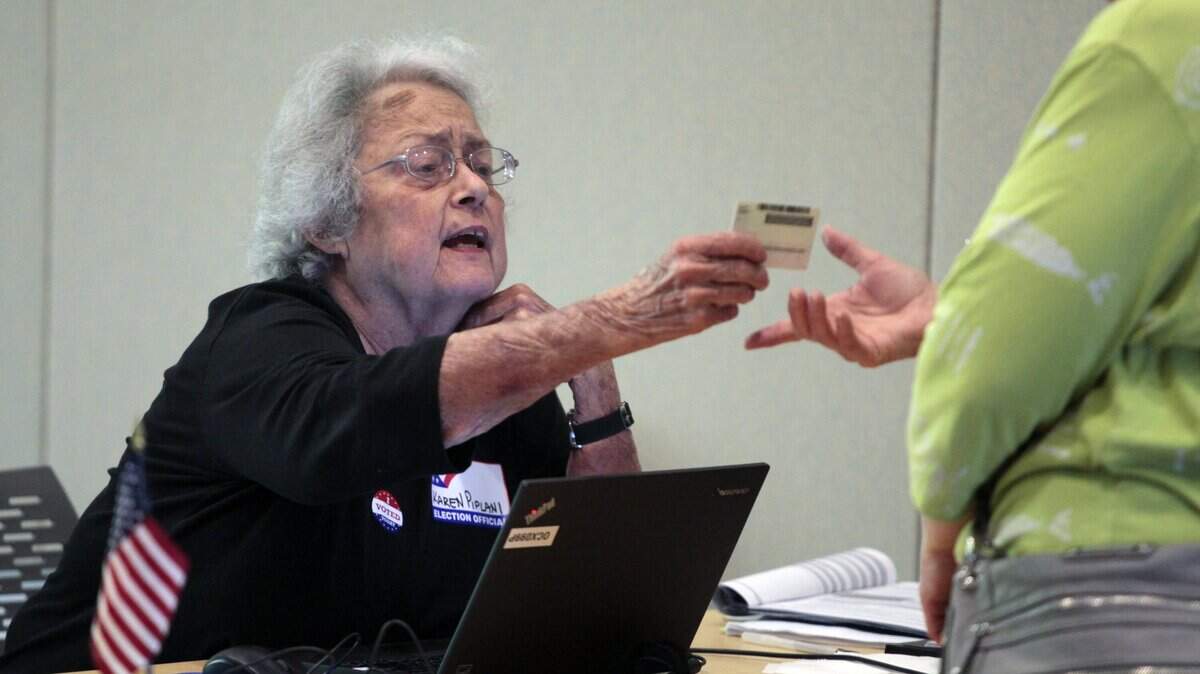
A trial that started Monday in Raleigh will help decide whether North Carolina voters will need photo identification next time they vote.
This is the state-level trial over the constitutionality of a 2018 voter ID law. There is also a separate lawsuit, over the same law, moving forward in federal courts.
No elections have been held using voter ID since the law was passed in 2018; it was put on hold until this trial.
The trial is expected to last multiple days. Monday’s schedule included opening arguments from both the plaintiffs challenging the constitutionality of voter ID and the legislators who are defending it, and at least one witness for the plaintiffs.
“Your honors, voters will be harmed by this law,” Allison Riggs of the Southern Coalition for Social Justice, the lead attorney for the challengers in the case, said in her opening arguments. “And they are disproportionately Black ... They are voters that face barriers to voting already. And they are voters who were targeted by previous laws, and this law, in an attempt to keep Black North Carolinians from voting.”
David Thompson of the Washington firm Cooper & Kirk, who is representing the GOP legislative leaders, shot back at that claim in his own opening arguments.
“We acknowledge the deeply lamentable and indeed shameful history of racial discrimination in this state,” he said. “But SB 824 is not part of that shameful history. It is a state-of-the-art voter ID law that both seeks to secure elections and guarantee access to all registered voters.”
The trial is being livestreamed online, on the Wake County Superior Court page on YouTube, allowing anyone to watch. Unlike a normal trial, which has a single judge and usually a jury, this trial will have no jury and three judges. That’s how all constitutional cases are handled in North Carolina.
People who are interested in reading the evidence after it’s been filed can find the documents on the Wake County Courthouse’s “cases of public interest” web page. Most court documents in the state are not available online — but for large, high-profile cases like this one, the courts make an exception.
No matter which side wins here — either the Republican lawmakers who are defending the law, or the liberal voting-rights groups trying to overturn it — the result likely won’t be the final word. In addition to the separate federal lawsuit, there could also be appeals after the ruling in this trial.
Arguments for, against voter ID
Most states have some form of voter ID law, although only some require a photo ID like North Carolina will if this law is upheld in court. Others allow non-photo documents like a utility bill, bank statement or something else that shows the person’s name and address match the voter registration files.
Supporters of voter ID say it’s necessary to stop fraud and create confidence in elections. Opponents say the number of legitimate voters who would be prevented from voting would be much higher than the number of fraudulent ballots stopped.
There’s also a racial aspect to voter ID laws, since white people are more likely to have photo IDs than other voters. A previous attempt by the Republican-led legislature to create a voter ID law and make other restrictions to voting access, in 2013, was overturned as unconstitutional in 2016. Federal judges found evidence that lawmakers wrote it with racially discriminatory intent, and that the way the law was written would “target African-Americans with almost surgical precision.”
After that 2016 ruling, the legislature put the voter ID question on the ballot in 2018, as a state constitutional amendment. It passed with 55% support of voters, even as Democrats had a historic year in the “Blue Wave” midterms, showing that voter ID has support among members of both parties, not just among Republicans.
The legislature then passed the law now on trial to fill in the details of the IDs that would be acceptable. Riggs said lawmakers “wrote themselves a blank check” by not writing the law until after voters approved the amendment for it, which she said should raise flags.
So, too, she said, should the fact that lawmakers passed it quickly in a post-election, lame-duck session in December 2018, right before Republican lawmakers lost their veto-proof supermajority. She said their rush to pass the law before the Democrats who won legislative elections in 2018 could be sworn in was not only an affront to the will of the voters, but also meant there wasn’t time to really analyze the law and ask questions about how it would affect voters.
“If you had just been found guilty of racial discrimination in imposing a voter ID law, why wouldn’t you take more care to carefully craft a law, rather than to rush it?” Riggs said.
Thompson, arguing for the legislature, said that Riggs and the challengers don’t have a good argument against the 2018 law so they will try to distract the judges by pointing to the 2013 law. But with the new law, he said, around 95% of white voters would have an acceptable ID as would around 93% of Black voters.
Like Riggs, he also mentioned that Republican lawmakers wrote the law when they still had a veto-proof supermajority. But he said that makes it notable that Republicans allowed Democrats to make several changes to the bill, even though they didn’t have to.
“One of its primary sponsors was an African American Democrat,” he said. “And it obtained votes from other African American members of the legislature and other Democratic members of the legislature.”
The Black Democrat who sponsored the bill was former Sen. Joel Ford of Charlotte. Lawyers for the legislature may call Ford to testify for them, but they tried to stop him from potentially testifying as a witness for the plaintiffs, too. The judges overruled that objection and said he can speak if called on by either side.
Thompson repeatedly pressed one of the challengers’ expert witnesses, Emory University historian Carol Anderson, on her past statements about “white rage” leading to things like voter ID, and her belief that even Black people can sometimes exhibit that white rage and vote for things against their interest.
Anderson said her research “shows that there is a pattern of lawmakers looking at Black political power, Black political advocacy, and electoral power, and then responding with a series of laws to undercut that Black political power.”
Election security and fraud
Judges at both the state and federal levels have temporarily blocked the voter ID law until trials could be held, ruling that it seemed the plaintiffs will be able to prove there were racist motivations behind the 2018 voter ID law just like with the 2013 one. The federal ruling on that was later reversed on appeal, but not the state-level ruling that found the same thing.
On the topic of fraud, state officials did a massive audit after the 2016 elections and found 508 instances of alleged voter fraud, out of 4.8 million North Carolinians who voted that year.
Even if every single allegation were true, the state’s report found, no results of any election would have been changed. And of those 508 allegations of fraud, only one was of in-person voter impersonation — the type of fraud that voter ID would stop.
In that case, a woman admitted to investigators that she pretended to be her dead mom to cast a fraudulent vote in the 2016 presidential race for Republican Donald Trump. The local district attorney, a Republican, chose not to charge her with a crime.
For more North Carolina government and politics news, listen to the Under the Dome politics podcast from The News & Observer and the NC Insider. You can find it on Pandora, Spotify, Apple Podcasts, Stitcher, iHeartRadio, Amazon Music, Megaphone or wherever you get your podcasts.
This story was originally published April 12, 2021 at 9:56 AM.
CORRECTION: An earlier version of this story misstated the nature of an objection in the state’s voter ID trial. Lawyers for the legislative defendants had objected to former state Sen. Joel Ford serving as a witness specifically for the plaintiffs.