Voting changes proposed in NC are straight out of ‘national playbook,’ critics say
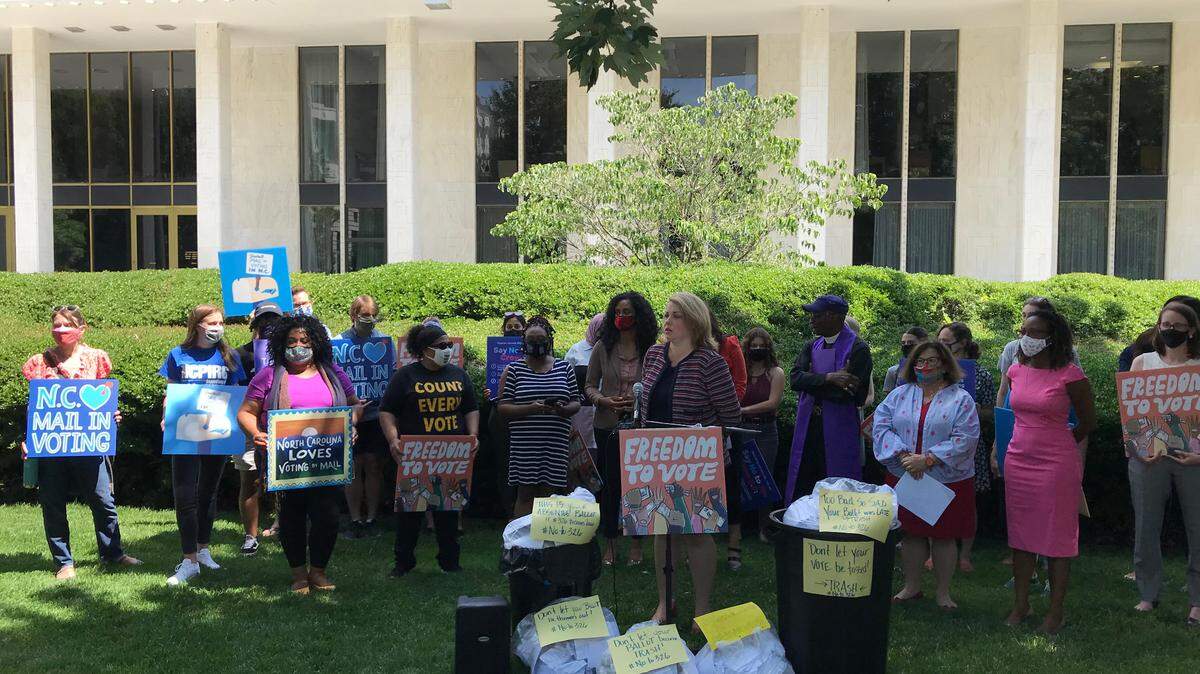
Civil rights groups and liberal organizations denounced on Monday a group of bills advancing through the state Senate that would make changes to absentee voting and limit sources of funding for election administration in North Carolina.
Speaking in front of the North Carolina General Assembly, leaders from the ACLU of North Carolina, Democracy NC, and other groups called on lawmakers to reject the three measures, Senate Bills 326, 724 and 725, ahead of votes on the Senate floor which could come as soon as this week.
Invoking former President Donald Trump, the advocates tied the bills, introduced by Republican legislators last week, to restrictive measures being pursued nationwide in light of Trump’s unfounded claims that the 2020 election was rigged or tainted by widespread voter fraud.
“As we’re seeing across the country this year, hundreds of bills that chip away at voting access are being advanced at an alarming rate,” said Chantal Stevens, executive director of the ACLU of North Carolina. “The bills being considered at our General Assembly come from this national playbook.”
Originally parts of a single bill, the Election Integrity Act, that was introduced by Republican lawmakers in March, the three bills were re-packaged as standalone pieces of legislation last week.
SB 326 would change the deadline that absentee ballots must be received by to be counted to 5 p.m. on Election Day. North Carolina law currently provides for an extra three days following the election during which mail-in ballots postmarked by Election Day can be accepted, to account for postal delays and to provide absentee voters with just as much time to make decisions as in-person voters who go to the polls.
As many as 14,539 mail-in ballots that were accepted on or after Nov. 4 during last year’s election would not have been counted if the deadline for those ballots in 2020 was Election Day, according to data reviewed by The News & Observer.
SB 724 prescribes procedures to allow visually impaired voters to request and cast absentee ballots online. It also directs the State Board of Elections to establish an online voter registration platform for anyone who is eligible to register to vote, and calls on the General Assembly to allocate funding to set up a program to provide individuals with photo identification who need it. Currently, North Carolina does not require photo ID for registered voters to cast their ballots, but that could change depending on the outcome of court challenges to the state’s voter ID law.
The third measure, SB 725, would prohibit election officials at the state and county levels from accepting nonprofit grants or other private funds to conduct elections. Several counties and the State Board of Elections relied on grant funding during last year’s election to procure personal protective equipment, face masks, and other COVID-19 related equipment.
If passed, these bills would mark the return to “policies that restrict voting access, something that should be forever left behind,” Stevens said.
Citing record turnout in last year’s election, advocates accused the Republican sponsors of the bills of pursuing changes that would make voting in North Carolina more difficult, and lead to lower turnout in future elections.
“These bills are not about election integrity and they are not about transparency,” said Manny Mejia Diaz, an organizer at Democracy NC. “They are about controlling who has the right to vote by repeating tactics that have historically disenfranchised voters.”
Sen. Paul Newton, a Republican from Mount Pleasant and one of the lead sponsors of the three bills, rejected the notion that the proposed changes would make voting harder. In an email, he said the reforms he has endorsed “have been narrow in scope, addressing specific concerns we saw in North Carolina.”
“All elections must have deadlines,” Newton said in reference to SB 326. Making Election Day the deadline for absentee ballots would align North Carolina with 29 other states, he said, including Delaware, the home state of President Joe Biden.
Newton also defended SB 724, which calls on the legislature to fund a mobile facility that proponents of the bill say would make it easier for people to obtain photo ID, as an answer to complaints from advocates that requiring identification is too burdensome. “They want to deny North Carolinians their right to amend their Constitution to require voter ID, and they are inventing arguments to accomplish that unconstitutional goal,” he said of opponents of the bill. State voters passed a constitutional amendment to require voter ID in 2018.
He denied that the bills were inspired by Trump’s claims of widespread voter fraud. “These reforms were inspired by actual electoral weaknesses we observed in the conduct of North Carolina’s 2020 election,” Newton said.
It remains unclear if the bills will receive any support from Democrats. During consideration of the bill to block private funding of elections last Thursday in a Senate committee, the bill passed without any audible “no” votes.
Sen. Warren Daniel, a Republican from Burke County and one of the lead sponsors of the three bills, said in an interview last week he believed Democrats may be more receptive to that measure on private funding than the bill to eliminate the three-day grace period for absentee voting, which was met with strong opposition from Democrats and activists during an elections committee hearing last Wednesday.
Daniel said last week he believes it is necessary to stop accepting absentee ballots after Election Day because doing so “causes distrust” in the election process, The News & Observer reported. “Every day without a clear winner breeds suspicious theories in people’s minds, and that’s not healthy for the elections process,” he said.
That argument was challenged by advocates Monday, who said that election results are never final on Election Day, due to the potential for recounts and the certification process.
“Throwing away thousands upon thousands of legitimate votes won’t provide election finality any sooner,” said Allison Riggs, a co-executive director of the Southern Coalition for Social Justice. “It will just needlessly disenfranchise voters who can’t vote in person and who rely on USPS to deliver their ballot.”
For more North Carolina government and politics news, listen to the Under the Dome politics podcast from The News & Observer and the NC Insider. You can find it at link.chtbl.com/underthedomenc or wherever you get your podcasts.
This story was originally published June 14, 2021 at 2:57 PM.