Medical marijuana gets broad approval in first vote by North Carolina lawmakers
Medical marijuana won near-unanimous approval in a committee hearing in the Republican-controlled N.C. General Assembly on Wednesday, the first of potentially many votes standing in the way of the plan becoming law here.
It’s a sign the bill could have broad support. While the votes were not officially recorded, it appeared that every Democrat voted for it, as did all but two or three Republicans.
The bill’s sponsor is Sen. Bill Rabon, an influential committee chairman. And one of the votes in favor of it Wednesday came from Senate Majority Leader Kathy Harrington, a Gastonia Republican. She said her husband was recently diagnosed with multiple myeloma, a type of blood cancer, and she has since come to realize that medical marijuana could help other patients in similar, painful situations.
“If you had asked me six months ago if I would support this bill, I would have said no,” Harrington said. “But life comes at you fast.”
If the bill is passed into law, North Carolina doctors would be able to prescribe marijuana for PTSD, cancer, sickle cell anemia, ALS and several other specific health problems. Lawmakers had initially included glaucoma on the list too, but deleted it Wednesday.
Rabon is also a cancer survivor and said his experience with chemotherapy is what inspired him to push for medical marijuana, even though his party has often been against it in the past. But that appears to be changing: Public polling shows around 75% of North Carolina voters support medical marijuana, The News & Observer reported in February, including two-thirds of GOP voters.
“I’ve been quite moved by this because of my personal experiences,” Rabon said. “At times it has been difficult for me to talk to some people about that. But I will say that the time has come. This needs to be discussed. We need to compassionately care for our fellow man.”
Sen. Natasha Marcus, a Charlotte Democrat, said the bill was longer overdue.
While she personally thinks it’s too restrictive, Marcus said, she understands that Democrats can’t get everything they want in the Republican-controlled legislature. And Rabon has said he intentionally wrote it to be the strictest rules of any state with medical marijuana. Marcus said that even if she doesn’t think the bill is perfect, it’s important to find a middle ground that can result in something actually passing.
“We don’t want to continue to make criminals out of caregivers and patients and war veterans,” she said.
‘I am a criminal’
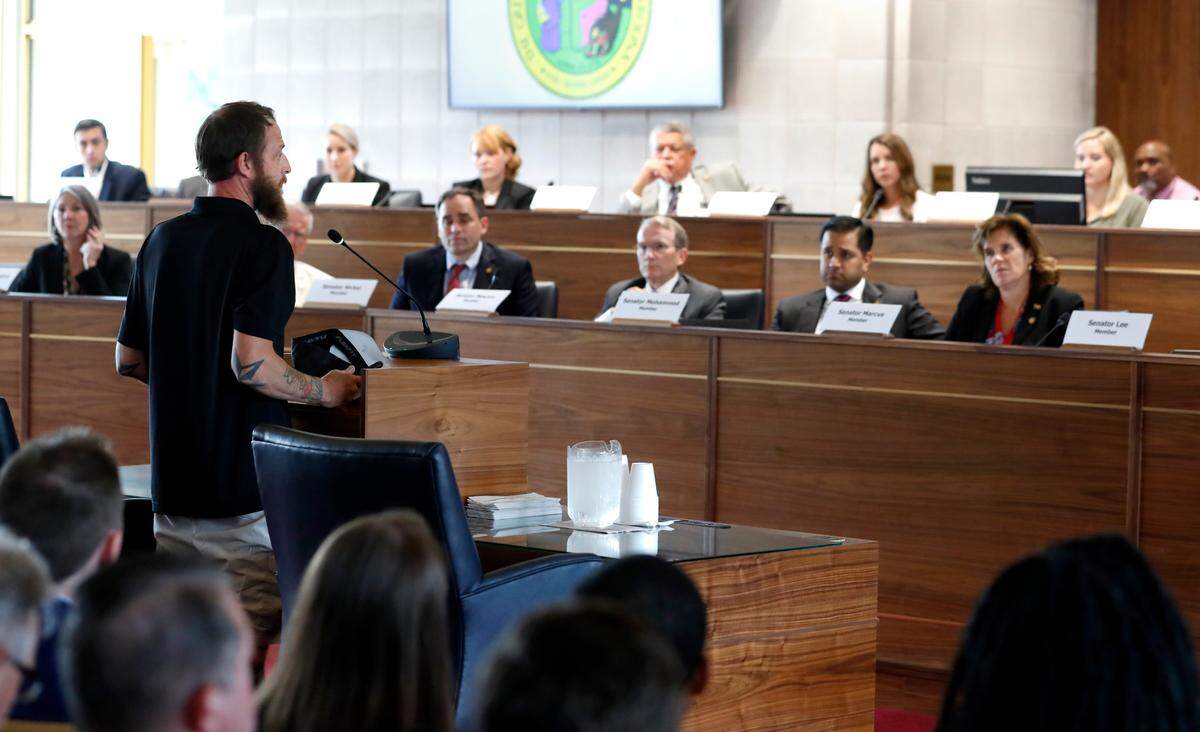
Some legalization activists, however, don’t necessarily share Marcus’ views on compromise. Chris Suttle, who was there with other activists from the North Carolina chapter of the pro-marijuana National Organization for the Reform of Marijuana Laws (NORML), called the bill “an insult.”
He criticized its restrictions on the number of dispensaries that would be allowed to open statewide — a maximum of 40 — as well as other pieces of the bill, including what medical conditions would be approved for treatment with marijuana. But Suttle also told lawmakers how important he thinks medical marijuana is in general. He was given just a year to live due to a brain tumor, he said, and spent his 40th birthday planning his own funeral. Then he started using marijuana. That was four years ago, and he’s still alive.
“I stand before you today to say I am a criminal for choosing medicinal cannabis to reduce the swelling in my brain,” he said.
But the Rev. Mark Creech, the head of the Christian Action League, said if lawmakers legalize medical marijuana it’s a slippery slope to full legalization.
“What this bill will mostly do is dress up an illicit, mind-altering product as something good ... and ultimately lead to the legalization of recreational marijuana,” Creech said. “By passing the measure today, we begin to open Pandora’s box.”
In the end, though, that wasn’t enough to convince lawmakers to oppose the bill. This committee was just the first of many votes the bill will have to pass, but the fact it got a hearing in the first place shows that GOP leadership is at least tentatively on board. Many if not most bills that get filed at the legislature never make it this far, since legislative leaders typically only allow bills that they support to get hearings.
It’s possible the bill could still face opposition or undergo changes as it moves forward in the legislative process, like adding or removing medical ailments that would qualify for marijuana prescriptions.
For instance, Rabon said Wednesday he was interested in a proposal from Charlotte Democratic Sen. Mujtaba Mohammed to set aside a certain amount of funds that the new fees and taxes on marijuana would bring in every year, to be spent specifically on mental health issues.
Pot vs opioids
Janis Ramquist, another NORML activist, said one thing she hopes changes is that lawmakers add another medical treatment to the approved list — for “opioid reduction plans.”
She has been using opioids for the last 20 years due to pain from severe arthritis and multiple surgeries, she said. But she dislikes the side effects of pain pills and would prefer to replace them with a more natural substance like marijuana.
Ramquist said after the meeting that she did smoke marijuana in her 20s but hasn’t in decades, due to her health problems and the fact that she’s not sure what dose she should take. But having a trained doctor be able to prescribe it, she said, would be a great alternative for her and other long-term pain sufferers — if the legislature agrees to such a change.
The bill is sponsored by Winston-Salem Democratic Sen. Paul Lowe as well as Rabon and his fellow Republican Sen. Michael Lee of Wilmington.
The southeastern corner of the state that Rabon and Lee represent has been one of the hardest-hit areas by the opioid epidemic — not just in North Carolina but in the entire country. Ramquist said that while opioids kill thousands every year, marijuana has not killed anyone.
”Cannabis does not have any overdoses,” she said. “Zero.”
For more North Carolina government and politics news, listen to the Under the Dome politics podcast from The News & Observer and the NC Insider. You can find it at link.chtbl.com/underthedomenc or wherever you get your podcasts.
This story was originally published June 30, 2021 at 3:59 PM.